


Host tree selection
Establish colonies near suitable conifer hosts such as pine, spruce, or Douglas fir, since this fungus is mycorrhizal and depends on tree roots for nutrition and long-term survival.

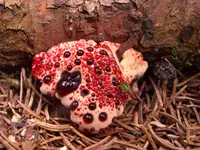
Red-juice tooth (Hydnellum peckii) is a terrestrial fungus, not a leafy houseplant, best known for its pale cap dotted with bright red, blood-like droplets when young. It forms irregular, often flattened caps with a tough, corky texture and tooth-like spines on the underside instead of gills.
This species usually grows on the ground in conifer forests, often near pines, in parts of North America and Europe. It forms mycorrhizal partnerships with trees, which makes it difficult to cultivate and means most people do not care for Red-juice Tooth as a traditional garden or indoor specimen.
It prefers cool, moist, acidic soils with undisturbed leaf litter and partial shade. In practice it is mainly appreciated in situ or by specialist fungal enthusiasts.

Care Difficulty
Hard Care

Light Preference
Partial Shade

Water Requirements
Keep Soil Moist

Temperature Preference
Cool Climate

Hardiness Zone
5–8

Soil Texture
Loamy, Peaty, Organic-rich

Soil pH
Strongly acidic (4.5–5.5), Acidic (5.5–6.5)

Soil Drainage
Moist but well-drained

Fertilization
Minimal (feed rarely)
Scan your plant to receive care tips personalized for your specific plant
Available on iOS and Android
This fungus thrives in cool, forested conditions with limited direct sun exposure.
Hydnellum peckii depends on evenly moist, not waterlogged, forest soil supported by its tree partners.
This species prefers cool to mild woodland temperatures and does not handle extreme heat well.
This fungus depends on consistently moist, cool air and substrate rather than typical indoor humidity management.
This ectomycorrhizal fungus relies on natural forest soil conditions rather than standard potting media.
This species is not suitable for container growing because it needs a living association with tree roots and complex forest soil conditions.
Hydnellum peckii is a mycorrhizal fungus that usually does not benefit from added fertilizer in garden or container culture.
Hydnellum peckii requires no true pruning, but limited cleanup keeps surrounding planting areas tidy.
This fungus is seldom grown in containers; management focuses on careful transplanting of colonized soil and host plants.
Propagation of Hydnellum peckii at home is challenging and typically not attempted directly.
This species is naturally cold hardy in much of its range and usually needs no special winter care in the ground.

Plant Health Check
Not sure what's wrong with your plant? Check your plant's health inside the app.
The fruiting body produces bright red droplets on its upper surface, a guttation fluid rich in pigments that gives the fungus its distinctive bloodlike appearance when young.
Instead of gills or pores, this fungus has downward-pointing spines (teeth) under its cap, where basidiospores are formed and released, placing it in the tooth fungi group within the family Bankeraceae.
It forms ectomycorrhizal associations with conifer roots in nutrient-poor, acidic soils, exchanging mineral nutrients for plant-derived carbohydrates and contributing to forest soil health.

The characteristic red pigments of this species have attracted chemical interest because some of its secondary metabolites show anticoagulant activity in laboratory assays, although it is still considered inedible and is not used as a food or medicinal species.
This fungus is technically non-toxic but considered inedible due to its extremely bitter, resinous taste and tough texture. It is not used as food and is best treated strictly as an ornamental curiosity in the landscape.
Keep your plants happy and healthy with plant identification, disease detection, and easy care guidance.

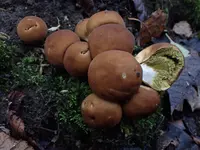
Pear-shaped Puffball
Apioperdon pyriforme
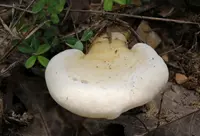
golden reishi
Ganoderma curtisii
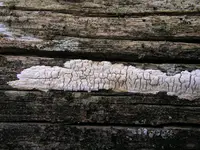
crescent crust
Chaetodermella luna
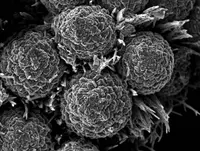
Chaetosphaerella phaeostroma
Chaetosphaerella phaeostroma
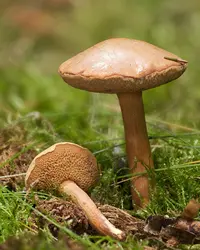
Peppery Bolete
Chalciporus piperatus
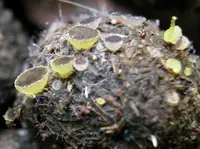
Ascobolus furfuraceus
Ascobolus furfuraceus
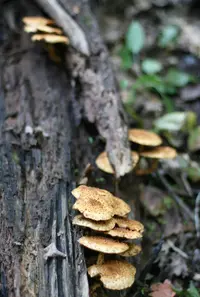
Pholiota adiposa
Pholiota adiposa
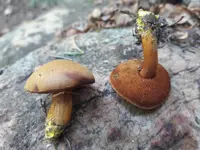
Chalciporus
Chalciporus piperatoides