


Log selection
Use fresh, disease-free hardwood logs (oak, sweetgum, or beech) cut in late winter and allowed to rest 2–4 weeks so sugars stabilize but bark is still tight, which supports better colonization and fruiting.

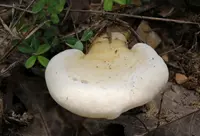
Golden reishi, Ganoderma curtisii, is a wood-decaying mushroom rather than a leafy houseplant. It forms firm, shelf-like brackets with yellow to golden-brown caps and a smooth, varnished surface. The underside carries fine pores instead of gills.
This fungus naturally grows on hardwood logs and stumps in eastern North America, especially on oaks. It plays an important ecological role in breaking down dead wood.
For those who care for golden reishi at home, it is usually grown on prepared hardwood substrates rather than soil. It prefers stable moisture, indirect light, and good air circulation, and is moderately challenging for beginners because it needs consistent, clean conditions.

Care Difficulty
Hard Care

Light Preference
Partial Shade

Water Requirements
Keep Soil Moist

Temperature Preference
Warm Climate

Hardiness Zone
Unknown

Soil Texture
Organic-rich, Loamy

Soil pH
Acidic (5.5–6.5)

Soil Drainage
Moist but well-drained

Fertilization
Minimal (feed rarely)
Scan your plant to receive care tips personalized for your specific plant
Available on iOS and Android
This wood-decay fungus prefers shaded forest conditions rather than open, direct sun.
Moist, airy substrate is essential for healthy fruiting of Ganoderma curtisii.
Stable, mild temperatures support reliable growth and fruiting for this species.
This wood-decaying fungus prefers evenly moist, high-humidity environments when actively growing.
Ganoderma curtisii does not grow in conventional potting soil but on woody, organic substrates.
This species can be grown in containers when provided with a stable, well-ventilated woody substrate block rather than conventional potting mix.
Ganoderma curtisii grown on logs or hardwood blocks generally needs very little additional fertilizer.
Pruning for Ganoderma curtisii is minimal and focuses on hygiene rather than shaping growth.
This species is usually grown on outdoor logs or buried wood rather than in standard pots.
Propagation of Ganoderma curtisii for home culture is specialized and usually done by spores or tissue culture under controlled conditions.
Outdoor Ganoderma curtisii on hardy host trees generally needs little specific winter care in temperate climates.

Plant Health Check
Not sure what's wrong with your plant? Check your plant's health inside the app.
This species is a close North American relative of the better-known red reishi complex but is distinguished by its consistent golden-yellow pore surface and often bright yellow to orange cap margin rather than deep red tones.
It is primarily found in the eastern United States, where it grows on hardwood logs and stumps, especially oak, suggesting a long coevolutionary relationship with these tree hosts.
Its basidiospores form a brown spore print with characteristic microscopic features, including double-walled, ornamented spores, which mycologists use to separate it from similar reishi-like bracket fungi.
Growth is relatively slow. From inoculation on a suitable hardwood log or sterile sawdust block, it often takes 2–4 months to see visible fruiting bodies, and several additional weeks for caps to reach harvestable size.
Keep your plants happy and healthy with plant identification, disease detection, and easy care guidance.

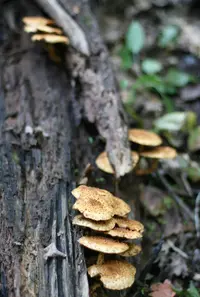
Pholiota adiposa
Pholiota adiposa
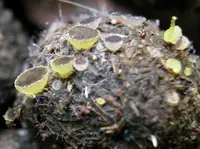
Ascobolus furfuraceus
Ascobolus furfuraceus
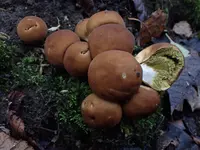
Pear-shaped Puffball
Apioperdon pyriforme
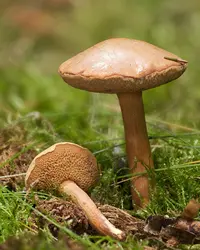
Peppery Bolete
Chalciporus piperatus
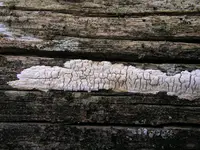
crescent crust
Chaetodermella luna
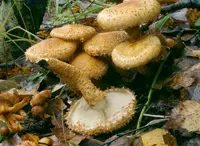
shaggy scalycap
Pholiota squarrosa
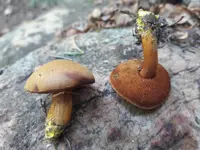
Chalciporus
Chalciporus piperatoides
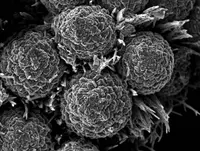
Chaetosphaerella phaeostroma
Chaetosphaerella phaeostroma