


Host tree selection
Establish the fungus near compatible conifer hosts such as pine or spruce, as Chalciporus piperatus relies on forming mycorrhizae with living tree roots rather than growing in isolated beds.

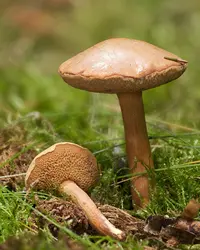
Peppery bolete, Chalciporus piperatus, is a small wild mushroom rather than a traditional houseplant. It forms mycorrhizal partnerships with tree roots, especially pines, and appears in forests across Europe, North America, and parts of Asia. Caps are usually brown to reddish-brown with yellowish pores and a distinct sharp, peppery taste. It often grows singly or in small groups on soil and forest litter. This species is not typically cultivated at home because it depends on living trees and complex soil biology. Anyone exploring how to care for Peppery Bolete should understand that its success relies more on maintaining healthy woodland conditions than on standard garden or indoor care routines.

Care Difficulty
Hard Care

Light Preference
Partial Shade

Water Requirements
Keep Soil Moist

Temperature Preference
Cool Climate

Hardiness Zone
Unknown

Soil Texture
Loamy, Sandy, Organic-rich

Soil pH
Strongly acidic (4.5–5.5), Acidic (5.5–6.5)

Soil Drainage
Moist but well-drained

Fertilization
Minimal (feed rarely)
Scan your plant to receive care tips personalized for your specific plant
Available on iOS and Android
This ectomycorrhizal fungus prefers dappled woodland light rather than full, open sun.
This forest-dwelling fungus depends on consistently moist, not saturated, soil around its host tree roots.
This species is adapted to temperate forests and prefers cool to mildly warm conditions.
Humidity management is not a primary concern for Chalciporus piperatus in typical outdoor conditions.
Chalciporus piperatus relies on suitable forest-like soil conditions to fruit reliably.
This species is not suitable for container growing because it depends on complex mycorrhizal relationships with trees in the ground.
Chalciporus piperatus is a mycorrhizal mushroom that usually does not need direct fertilization when growing in healthy, undisturbed soil.
Pruning is not applicable to Chalciporus piperatus, as it is a fleshy mushroom rather than a woody or leafy plant.
Transplanting Chalciporus piperatus focuses on moving colonized substrate or host trees rather than handling individual mushrooms.
Propagation of Chalciporus piperatus is specialised and not typically managed by home growers.
Chalciporus piperatus is generally cold hardy in its native range and needs no specific winter care in the ground.

Plant Health Check
Not sure what's wrong with your plant? Check your plant's health inside the app.
This bolete is named for its distinctly hot, pepper-like taste, which is unusual among European boletes and is strong enough that even small amounts can sharply season food.
It typically forms ectomycorrhizal partnerships with conifer trees, especially pines, exchanging mineral nutrients and water for sugars from the tree roots.
Unlike many brown-capped boletes, it has a yellow to orange pore surface that often darkens or stains slightly with age, helping field mycologists distinguish it from similar species.

This species is known to accumulate certain heavy metals from soil, which makes it useful in environmental monitoring studies but also means foraged specimens must be collected only from unpolluted areas if considered for consumption.
This species is technically edible but strongly peppery and often considered poor quality. Some people experience gastrointestinal upset. Identification errors with similar boletes can be dangerous, so only experienced foragers should consume it, and in small, well-cooked amounts.
Keep your plants happy and healthy with plant identification, disease detection, and easy care guidance.

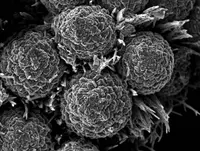
Chaetosphaerella phaeostroma
Chaetosphaerella phaeostroma
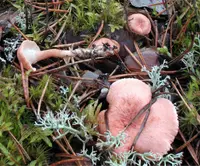
Aphroditeola
Aphroditeola olida
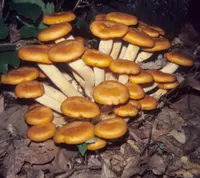
jack-o'-lantern mushroom
Omphalotus illudens
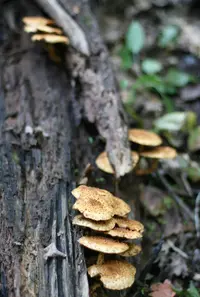
Pholiota adiposa
Pholiota adiposa
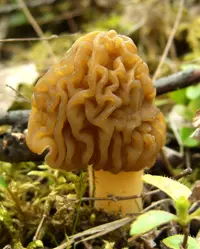
wrinkled thimble morel
Verpa bohemica
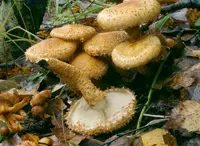
shaggy scalycap
Pholiota squarrosa
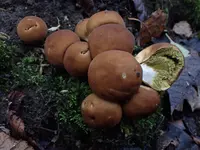
Pear-shaped Puffball
Apioperdon pyriforme
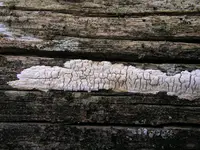
crescent crust
Chaetodermella luna