Substrate rotation
Rotate outdoor or bed substrates yearly, alternating between fresh hardwood chip mixes and rested ground, to reduce disease buildup and maintain consistent nutrients when growing wrinkled thimble morel.

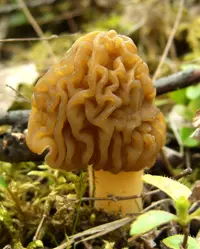
Wrinkled thimble morel (Verpa bohemica) is a spring-fruiting fungus, not a leafy plant. It produces slender, hollow stems topped with a loose, wrinkled cap that hangs like a thimble. The cap surface is yellow-brown to olive-brown, while the stem is pale and often slightly fuzzy near the top.
This mushroom naturally occurs in temperate forests of Europe and North America, especially in moist river bottoms and poplar or cottonwood stands. It can be challenging to cultivate because it forms complex relationships with soil and tree roots. Anyone who wants to care for wrinkled thimble morel should know it generally prefers cool spring temperatures, moist but not waterlogged soil, and light shade similar to an open woodland edge.

Care Difficulty
Hard Care

Light Preference
Partial Shade

Water Requirements
Keep Soil Moist

Temperature Preference
Cool Climate

Hardiness Zone
3–7

Soil Texture
Loamy, Silty, Organic-rich

Soil pH
Acidic (5.5–6.5), Slightly acidic (6.5–7.0)

Soil Drainage
Moist but well-drained

Fertilization
Minimal (feed rarely)
Scan your plant to receive care tips personalized for your specific plant
Available on iOS and Android
This spring-fruiting fungus thrives in cool, dappled woodland light rather than direct open sun.
Moist but not waterlogged soil is essential for stable fruiting conditions in this early spring morel.
This species fruits in cool spring conditions and declines as temperatures rise toward early summer.
This fungus fruits best in consistently moist air, but humidity is usually managed by site moisture rather than room humidity.
This species prefers loose, moist, organic-rich ground that drains freely yet never dries out completely.
This species is generally unsuitable for long-term container growing, since it depends on complex soil and root interactions in the ground.
Verpa bohemica is a woodland fungus that performs best in undisturbed, low-input soil and usually does not benefit from targeted fertilization.
Pruning is not relevant for Verpa bohemica, as it is a mushroom-forming fungus rather than a woody or leafy plant.
Transplanting this spring-fruiting fungus is rarely successful, so it is usually managed by preserving or recreating its preferred woodland habitat instead of moving it.
Propagation of Verpa bohemica is difficult for home growers and is generally left to natural spore spread in suitable woodland conditions.
This cold-hardy spring morel relative survives winter in the soil with no special care needed in most climates where it naturally occurs.

Plant Health Check
Not sure what's wrong with your plant? Check your plant's health inside the app.
This species typically fruits very early in spring, often appearing along stream banks and in moist woodlands shortly after snowmelt, before many other macrofungi are visible.
The cap is only attached to the stem at the very top, with the lower part hanging freely like a thimble, which helps distinguish it from true morels whose caps are fully fused or broadly attached to the stem.
Unlike true morels with deep honeycomb-like pits, this fungus has irregularly wrinkled or folded surfaces, an important field feature for careful foragers when learning how to take care of wrinkled thimble morel identification and handling.

This species has a long history of regional use as an edible mushroom in parts of Central and Eastern Europe, but it is now considered potentially risky because some studies report gastrointestinal and neurological symptoms in certain individuals, leading many modern field guides to classify it as edible with caution or not recommended.
This species is considered edible by some foragers only after thorough cooking, but it is associated with reports of gastrointestinal and possible neurological symptoms. Many experts recommend avoiding it and choosing true morels instead.
Keep your plants happy and healthy with plant identification, disease detection, and easy care guidance.