Use host trees
Introduce spores or mycelium only near suitable host trees such as birch, pine, or spruce, since this species is mycorrhizal and will not complete its life cycle in isolated pots or sterile beds.

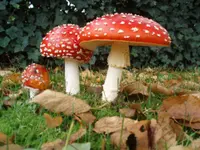
Fly agaric, Amanita muscaria, is a mycorrhizal mushroom, not a typical houseplant. It forms a symbiotic relationship with tree roots, especially birch, pine, and spruce. The classic form shows a bright red cap with white warts, white gills, and a sturdy white stem. It normally appears in forests and woodland edges across the Northern Hemisphere and in some introduced regions. Because it depends on specific tree partners and soil fungi communities, it is difficult to cultivate in pots or standard garden beds. Those who explore how to care for fly agaric usually focus on recreating cool, moist, well-drained woodland conditions near suitable host trees outdoors.

Care Difficulty
Hard Care

Light Preference
Partial Shade

Water Requirements
Keep Soil Moist

Temperature Preference
Cool Climate

Hardiness Zone
2–9

Soil Texture
Loamy, Sandy, Organic-rich

Soil pH
Acidic (5.5–6.5), Slightly acidic (6.5–7.0)

Soil Drainage
Moist but well-drained

Fertilization
Minimal (feed rarely)
Scan your plant to receive care tips personalized for your specific plant
Available on iOS and Android
This ectomycorrhizal mushroom prefers cool, dappled forest light rather than open sun.
Watering should keep the host tree’s root zone evenly moist without saturating the soil.
This species favors cool to mild climates with distinct seasonal shifts.
This species prefers cool, moist air and reacts quickly to dry conditions.
This ectomycorrhizal fungus depends on the right soil around host tree roots rather than a standalone substrate.
This species is generally unsuitable for container growing because it needs a long-term mycorrhizal partnership with living trees in open soil.
Amanita muscaria forms a mycorrhizal partnership with trees and generally should not be fertilized directly.
Pruning is not applicable to Amanita muscaria because it is a mushroom, not a woody or leafy plant.
Transplanting Amanita muscaria is rarely successful because its underground mycelium depends on a stable partnership with host tree roots.
Propagation of Amanita muscaria is biologically complex and not recommended for casual growers, so it is rarely attempted at home.
Amanita muscaria is naturally cold hardy in its native climates and needs no special winter care in the ground.

Plant Health Check
Not sure what's wrong with your plant? Check your plant's health inside the app.
This species forms an ectomycorrhizal symbiosis with certain trees, especially birch, pine, and spruce, exchanging mineral nutrients from the soil for sugars from the host tree’s roots.
Its main psychoactive compounds are ibotenic acid and muscimol, but their concentrations vary widely between populations and even between individual mushrooms, so effects are highly unpredictable.
Its bright red cap with white warts became a standard reference image for a “mushroom” in Western art, children’s books, and video games, influencing how many people visually imagine fungi in general.

This fungus has independently acquired a red-and-white warning coloration similar to some toxic animals, and there is evidence that its striking appearance may function as an aposematic signal that discourages mammals from consuming it.
Yes, this species is toxic to both humans and pets if eaten. It can cause nausea, vomiting, confusion, hallucinations, and, in severe cases, seizures. Always prevent children and animals from accessing caps or fragments.
Keep your plants happy and healthy with plant identification, disease detection, and easy care guidance.