
fly agaric Identification (Amanita muscaria)

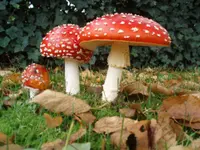
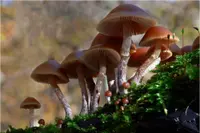
To recognize fly agaric, look first for a cap that is bright red to orange-red with scattered white warty patches, usually 3 to 8 inches (8 to 20 cm) across.

Check the white stem below it for a skirt-like ring and a distinctly bulbous base with concentric rings of tissue.

Amanita muscaria Identification

Identify a Plant by Photo

Use a clear photo to confirm what plant you have.

Clear images work best. Avoid photos taken too close or too far away

Use these quick visual checks for Amanita muscaria.

  • Cap is bright red to orange-red, usually dotted with scattered white wart-like patches.
  • Cap is broad and often 3–8 inches (8–20 cm) across, with a rounded to flat shape.
  • Gills are white, crowded, and free from the stem rather than attached to it.
  • Stem is white with a skirt-like ring near the upper part.
  • Base is bulbous and sits in concentric ring-like bands of tissue around the bottom.

Check the stem base carefully, since that lower structure is one of the most useful visible clues.

Amanita muscaria shows clear, useful visual shifts from button stage to expanded mushroom.

  • Young plant: Very young fruiting bodies emerge as rounded buttons, partly enclosed by a white universal veil, with little cap expansion and no clearly exposed gills.
  • Mature plant: As expansion begins, the cap becomes convex to broadly flattened, often 3-8 inches (8-20 cm) across, while white warts remain scattered over the colored surface.
  • Fruiting stage: Fully developed fly agaric shows free white gills under the cap, a distinct ring on the stem, and a bulbous base with concentric veil remnants.

Several named forms of fly agaric are separated mainly by cap color and wart color.

  • Amanita muscaria var. alba: Cap white to whitish rather than red, usually with white warts; the overall mushroom appears pale from a distance.
  • Amanita muscaria var. flavivolvata: Cap bright red to orange-red with contrasting white warts, giving a cleaner red-and-white look than the typical form.
  • Amanita muscaria var. guessowii: Cap yellow to yellow-orange instead of red, often with white warts; mature caps can reach about 8-12 inches (20-30 cm) wide.
  • Amanita muscaria var. persicina: Cap peach to pinkish buff rather than bright red, usually with pale yellowish to white warts.

Fly agaric is most noticeable from late summer into fall, when its mushrooms emerge above ground. Fresh caps are bright red to orange-red with white warty patches, making the species much easier to spot than at other times. Outside the fruiting period, the mushroom is usually not visible at all, since the main body remains hidden in the soil and in association with tree roots.

A few red-capped amanitas can be mistaken for fly agaric at a glance.

American Caesar's mushroom(Amanita jacksonii)

Both can show a bright red to orange cap. Amanita jacksonii usually lacks the scattered white warts and has a yellow stem, while the cap margin is often clearly lined or grooved.

Panther cap(Amanita pantherina)

This species also has a cap with white warty patches and a ringed stem. It differs by having a brown to olive-brown cap rather than red, plus a more distinct cup-like bulb at the stem base.

Amanita muscaria is native across temperate and boreal parts of the Northern Hemisphere, including much of Europe, Asia, and North America. It is most often found in forests, especially under birch, pine, and spruce, because it grows in close association with tree roots. Finding it in woodland, rather than open grassland or wetlands, helps narrow the identification.

  • Toxic if eaten: The fruiting body of Amanita muscaria is poisonous to humans and pets if ingested. It contains psychoactive and toxic compounds that can cause serious poisoning.
  • High misidentification risk: Wrong mushroom identification is a major safety issue. Amanita muscaria can be confused with other Amanita species; deadly death cap relatives typically lack the white wart-like patches on the cap.

Scan. Check. Confirm.

Use Botan to identify or confirm a plant from a photo when you want a quicker second opinion.

FAQ

The clearest mark is the bright red to orange cap covered with white wart-like patches, plus white gills and a white stem with a skirt-like ring. This combination is central to how to identify fly agaric.

More Plant Identification Guides

Scan Your Plant. Get the Details.

Identify a plant from a photo with Botan, then review its profile, care information, and common problems.

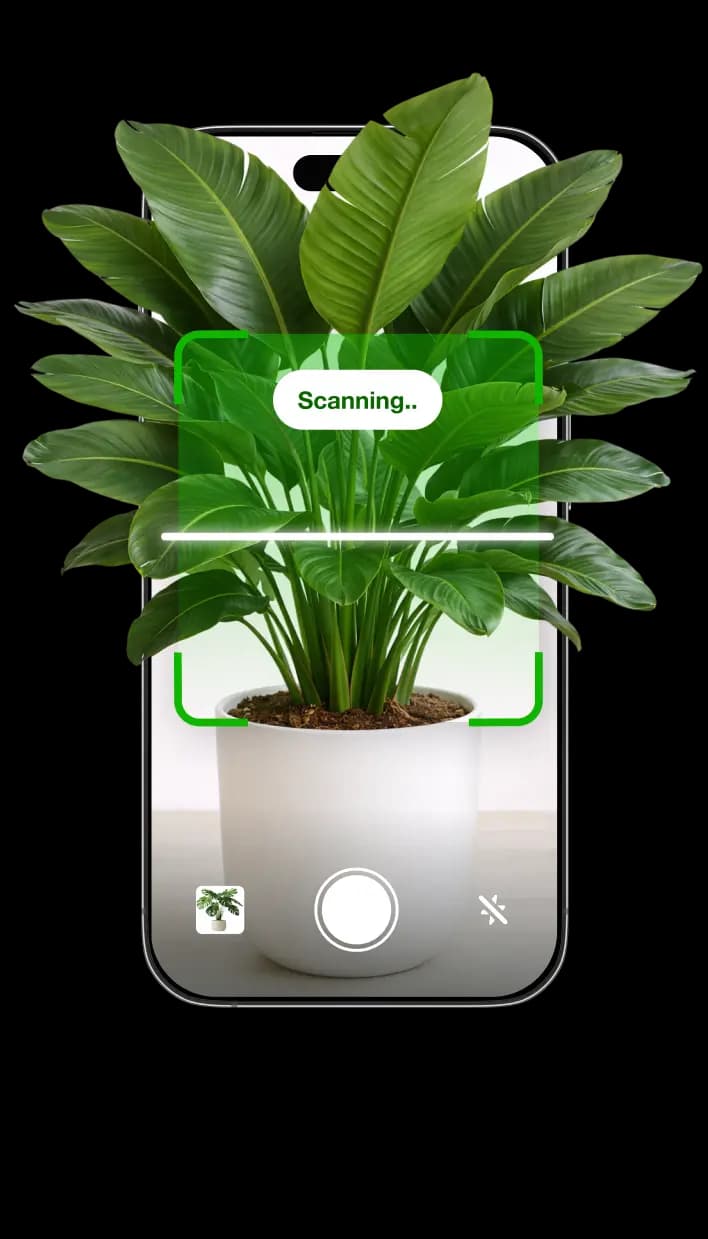
Botan app identifying a plant from a photo
How Often to Water Fruit Trees

7 min read · 11 Aug 2026

How Often to Water Fruit Trees

Irrigation needs change as roots establish and weather shifts. This guide gives practical starting intervals, explains how soil and tree type change them, and shows how to recognize both excess moisture and drought stress.

Plant Care
How Often to Water Fruit Trees
12 Most Wanted Rare Houseplants to Grow at Home

6 min read · 21 Sept 2026

12 Most Wanted Rare Houseplants to Grow at Home

Rare houseplants can turn an ordinary corner in your apartment into a living botanical collection. This guide covers 12 most admired picks, what makes them special, and how to grow them successfully at home.

Plant Recommendations
12 Most Wanted Rare Houseplants to Grow at Home
Best Water for Plants – How to Choose the Right Type

7 min read · 13 Aug 2026

Best Water for Plants – How to Choose the Right Type

Rainwater, filtered, distilled, and tap water affect plants differently. Learn which types support healthy growth and which cause slow damage. Match each to your plants and discover how to easily improve tap water quality.

Plant Care
Best Water for Plants – How to Choose the Right Type