flowerpot parasol Identification (Leucocoprinus birnbaumii)

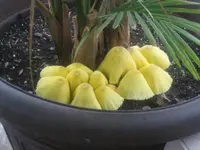
Recognize flowerpot parasol by its lemon-yellow cap, usually 1–2 inches (2.5–5 cm) across, with fine powdery or granular surface and a slightly darker center. The cap is thin and umbrella-shaped, carried on a slender yellow stem with a small ring.

It often appears in clusters, with free gills packed tightly under the cap.

Leucocoprinus birnbaumii Identification

Scan to Confirm flowerpot parasol

Upload a clear photo to check your plant identification with Botan.

Clear images work best. Avoid photos taken too close or too far away

Check the mushroom’s overall form, color, and gill placement.

  • Cap is lemon yellow, thin, and parasol-like, usually 1-2 inches (2.5-5 cm) wide, with a slightly darker center.
  • Cap surface often shows fine powdery or granular texture, with faint radial lines toward the edge.
  • Gills are crowded, free from the stem, and yellow to pale yellow.
  • Stem is slender, yellow, and upright, often with a small ring near the upper part.

Clusters of several stems rising together are common.

This fungus shows clear visual shifts from button stage to fully expanded spore-bearing fruitbody.

  • Young plant: Earliest mushrooms appear as small, egg-shaped yellow buttons, with the cap still closed and the stalk short, so gills are hidden.
  • Mature plant: As Leucocoprinus birnbaumii expands, the cap opens into a thin parasol 1-2 inches (2.5-5 cm) wide, exposing crowded yellow gills and a slender stalk.
  • Fruiting stage: Older fruitbodies flatten further, often showing a darker central disc; cap edges become more delicate, and the overall form looks less compact than younger mushrooms.

The main seasonal clue is the sudden appearance of bright yellow mushrooms in warm, humid periods, often in spring through fall indoors or in greenhouses. Leucocoprinus birnbaumii may show up in clusters, making the potting mix look dotted with small yellow caps and stems. Outside tropical settings, there is no useful seasonal leaf, fruit, or dormant-stage change because this species is a fungus, not a leafy plant.

A few yellow potted mushrooms can be mistaken for Leucocoprinus birnbaumii at a glance.

yellow parasol(Leucocoprinus straminellus)

Similar because both are small yellow mushrooms in potting mix. L. straminellus is usually paler, often straw yellow rather than bright sulfur yellow, and its cap surface is smoother with less obvious powdery granules.

dapperling(Leucocoprinus cepistipes)

Young specimens can look similar in shape and size in houseplant pots. This species is whitish to buff instead of clear yellow, and the cap center is typically darker brownish rather than uniformly yellow.

Leucocoprinus birnbaumii is widely reported from tropical regions, but its exact native range is uncertain. For identification, habitat is more useful than origin. It commonly appears in greenhouses, potted plants, compost-rich potting mix, and other humid indoor settings, and outdoors in frost-free tropical and subtropical sites. Finding it in potting soil or greenhouse beds strongly supports the ID, since this species is especially associated with warm, organic, cultivated substrates.

  • Toxic if eaten: Leucocoprinus birnbaumii is poisonous if the fruiting body is eaten. The concern is ingestion by humans and pets, including dogs and cats.
  • Indoor potting-soil mushroom: It often appears in houseplant pots. Bright yellow caps and stems help identify it, but it should still be treated as inedible and kept away from children and pets.

Confirm It from a Photo

Use Botan to identify or verify the plant in your picture, which helps reduce mix-ups with similar-looking species.

FAQ

The fastest clue is the bright sulfur-yellow mushroom in potting soil, often with a powdery to finely granular cap and a slender yellow stalk bearing a small ring. That combination is central to identifying flowerpot parasol.

More Plant Identification Guides

Find the Plant. Get the Details.

Upload a photo to identify it with Botan, then see plant details, care information, and common problems.

Botan app identifying a plant from a photo
12 Best Plants That Repel Spiders For Your Home and Garden

8 min read · 24 Jul 2026

12 Best Plants That Repel Spiders For Your Home and Garden

Spiders constantly appear in places you don't want them. A few common plants can help repel them using scent alone. Here are 12 options suitable for both indoors and outdoors, plus care tips for each.

Plant Recommendations
12 Best Plants That Repel Spiders For Your Home and Garden
Planting Grass Seed in Summer – What Works and What Fails

7 min read · 6 Aug 2026

Planting Grass Seed in Summer – What Works and What Fails

Summer seeding succeeds when the grass type suits the season, and the soil stays moist. Find out how to prepare the seedbed and choose a safe window for planting.

Plant Care
Planting Grass Seed in Summer – What Works and What Fails
Best Time to Water Grass in Summer – Lawn Watering Tips

5 min read · 21 Jul 2026

Best Time to Water Grass in Summer – Lawn Watering Tips

Summer watering is easy to get wrong. This guide explains when to turn on your sprinkler, how much liquid your grass needs each week, and how to tell if you're overwatering or underwatering.

Plant Care
Best Time to Water Grass in Summer – Lawn Watering Tips