
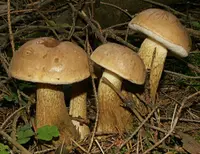
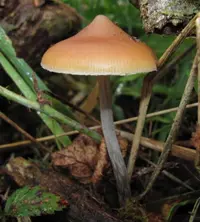

False Morel Identification (Gyromitra esculenta)

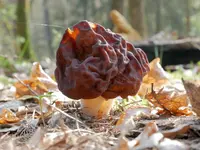
To recognize False Morel, look first for a deeply folded, brain-like cap that sits irregularly on a short, stout stem. Fruiting bodies are often 2 to 4 inches (5 to 10 cm) tall, with a reddish-brown cap and pale stem.

The cap is lobed rather than pitted, and its wrinkled surface forms broad, twisted folds.

Gyromitra esculenta Identification

Identify Your Plant with Botan

Check your plant ID by uploading a clear photo to Botan.

Clear images work best. Avoid photos taken too close or too far away

Check the cap, stem, and overall proportions of Gyromitra esculenta.

  • Cap is strongly folded and brain-like, not evenly lobed, usually wider than the stem.
  • Cap color is chestnut to reddish brown, with deep wrinkles and irregular hollows.
  • Stem is short, thick, and pale cream to whitish, often with grooves or folds.
  • Fruiting body is typically about 2-4 inches (5-10 cm) tall, with a cap roughly 1-4 inches (3-10 cm) across.

A sliced specimen often shows the cap attached at several points to the stem.

Gyromitra esculenta shows clear age-related changes in cap shape, surface folding, and stem proportions.

  • Young plant: New fruit bodies emerge compact, with a rounded to irregular cap that is only lightly wrinkled and sits close against a short, thick pale stem.
  • Mature plant: The cap expands to about 2-4 inches (5-10 cm) wide, becoming strongly brain-like with deep convolutions, while the stem appears relatively longer and more distinct below.
  • Fruiting stage: At full fruiting, the fungus presents its most diagnostic form: a lobed, chestnut-brown cap above a hollow, whitish stem, often with more open folds than younger specimens.

In spring, Gyromitra esculenta appears as a short-lived fruiting body on the forest floor, often soon after snowmelt. The wrinkled, brain-like cap is the key seasonal clue, with colors usually in the reddish-brown to dark brown range. Later in the season, that fruiting body collapses, darkens, and disappears. There is no persistent leafy or woody structure to find afterward, so its brief spring appearance is the main identification window.

Several spring fungi can be mistaken for Gyromitra esculenta.

elfin saddle(Helvella lacunosa)

Both can look dark, folded, and irregular. Helvella lacunosa usually has a saddle-shaped cap with 2 to 3 distinct lobes, not a brain-like mass, and a deeply grooved stem.

morel(Morchella esculenta)

Both appear in spring and can have a wrinkled cap. Morel caps are pitted like a honeycomb, with regular ridges and pits, rather than the twisted, lobed folds of the false morel.

beefsteak morel(Discina perlata)

It shares a reddish brown, wavy cap. Discina perlata is more saucer-like to flattened, often broader than tall, instead of forming a compact, inflated, brain-like head.

Gyromitra esculenta is native across temperate and boreal Europe and northern North America. Range matters because reports cluster in cool regions rather than subtropical ones. It is most often found on the ground in sandy soil in conifer woods, especially pine, and in disturbed forest sites such as trailsides, cutovers, and burned areas. That habitat can help separate it from similar spring fungi of richer hardwood woods.

  • Toxic mushroom: Gyromitra esculenta contains toxins in the fruiting body. The risk is from ingestion by humans and pets.
  • Serious mix-up risk: Its wrinkled, brain-like cap can be mistaken for morels. True morels have a honeycomb cap with deep pits and ridges, not folded lobes. A wrong identification can lead to poisoning if eaten.

Check Your Plant ID

Use Botan to compare a photo and get a second check when you want more confidence before labeling what you found.

FAQ

Yes. This species is most often found on the ground in spring in conifer woods, especially near pines, and on sandy or disturbed soil. Habitat helps narrow options, but cap shape and the hollow stem-cavity pattern still matter most.

More Plant Identification Guides

Find the Plant. Get the Details.

Identify it from a photo with Botan, then see plant details, safety notes, and common problems matched to the result.

Botan app identifying a plant from a photo
12 Most Wanted Rare Houseplants to Grow at Home

6 min read · 21 Sept 2026

12 Most Wanted Rare Houseplants to Grow at Home

Rare houseplants can turn an ordinary corner in your apartment into a living botanical collection. This guide covers 12 most admired picks, what makes them special, and how to grow them successfully at home.

Plant Recommendations
12 Most Wanted Rare Houseplants to Grow at Home
Planting Grass Seed in Summer – What Works and What Fails

7 min read · 6 Aug 2026

Planting Grass Seed in Summer – What Works and What Fails

Summer seeding succeeds when the grass type suits the season, and the soil stays moist. Find out how to prepare the seedbed and choose a safe window for planting.

Plant Care
Planting Grass Seed in Summer – What Works and What Fails
Top 5 Best Indoor Plants for Air Quality

5 min read · 11 Sept 2026

Top 5 Best Indoor Plants for Air Quality

Indoor plants can make a room feel fresher thanks to their air-purifying qualities. Here are 5 of the most suitable choices for your routine and living space.

Plant Recommendations
Top 5 Best Indoor Plants for Air Quality