


Use Host Trees
Establish patches near mature conifers such as pine or spruce, leaving surface roots undisturbed, since this fungus typically forms mycorrhizal associations with these trees rather than thriving in isolated beds.

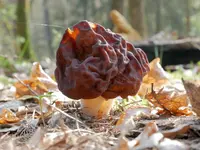
False morel (Gyromitra esculenta) is a spring-fruiting mushroom, not a true plant, known for its irregularly wrinkled, brain-like cap. It often appears brown to reddish-brown with a pale, brittle stem.
This fungus is native to coniferous and mixed forests across North America and Europe, typically emerging on sandy or disturbed soils. It usually grows singly or in small groups near pines.
Gyromitra esculenta is considered difficult and unpredictable to cultivate, so most information comes from wild specimens rather than deliberate growing. Anyone wanting to care for False Morel in a controlled setting must accept that its growth is highly variable and often unreliable.
It favors cool spring conditions, moist but not waterlogged substrates, and partial shade, generally under trees or forest edges.

Care Difficulty
Hard Care

Light Preference
Partial Shade

Water Requirements
Keep Soil Moist

Temperature Preference
Cool Climate

Hardiness Zone
Unknown

Soil Texture
Loamy, Sandy, Organic-rich

Soil pH
Acidic (5.5–6.5)

Soil Drainage
Moist but well-drained

Fertilization
Minimal (feed rarely)
Scan your plant to receive care tips personalized for your specific plant
Available on iOS and Android
This spring-fruiting fungus prefers cool, forest-like light rather than open, direct sun.
This fungus needs consistently moist but not soggy soil in its fruiting zone.
This species fruits best in cool spring conditions with moderate daily temperature swings.
Humidity is not a primary controllable factor for cultivating Gyromitra esculenta at home, as it is a forest-floor fungus with very specific wild microclimate needs.
Gyromitra esculenta relies on natural forest substrates rather than conventional garden soil, so purposeful home cultivation is rarely successful.
This species is not suitable for container growing, as its life cycle depends on complex soil and tree-root interactions that containers cannot reproduce.
Gyromitra esculenta is a wild ectomycorrhizal fungus and should not be fertilized like a garden plant.
Gyromitra esculenta does not require or benefit from pruning in the usual horticultural sense.
This fungus is not suited to conventional repotting and is rarely maintained in containers.
Gyromitra esculenta is not typically propagated by home growers due to complex ecological requirements and serious toxicity.
This species is naturally cold hardy in its native range and does not need active winter care in gardens or forests.

Plant Health Check
Not sure what's wrong with your plant? Check your plant's health inside the app.
This false morel contains the toxin gyromitrin, which can be converted in the body to monomethylhydrazine, a compound used in rocket fuel and highly damaging to the liver and nervous system.
Despite its known toxicity, it has a long cultural history as a spring delicacy in parts of Finland and eastern Europe, where people traditionally parboil it repeatedly to reduce toxins, although modern food safety authorities strongly advise against eating it at all.
The fungus typically fruits in early spring in coniferous or mixed forests on sandy or disturbed soils, often appearing soon after snowmelt when soil temperatures begin to rise.

Some individuals show much higher sensitivity to gyromitrin than others, and documented poisonings include cases where only a small portion of improperly prepared false morels caused severe or even fatal liver and nervous system damage while others at the same meal were affected less or not at all.
This species is highly poisonous to both humans and animals, even after cooking. It contains gyromitrin, a toxin that can damage the liver, kidneys, and nervous system. Handling with bare hands is also discouraged.
Keep your plants happy and healthy with plant identification, disease detection, and easy care guidance.

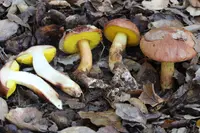
viscid bolete
Aureoboletus flaviporus
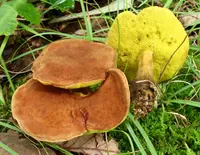
clustered brown bolete
Aureoboletus innixus
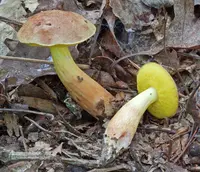
sour gold-pored bolete
Aureoboletus auriporus
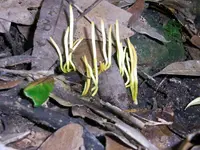
yellow coral fungus
Clavulinopsis amoena
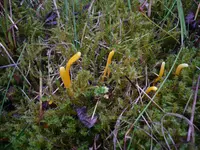
Yellow Club
Clavulinopsis helvola
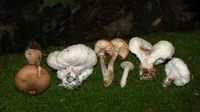
Aborted entoloma
Entoloma abortivum
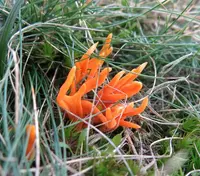
Apricot Club
Clavulinopsis luteoalba
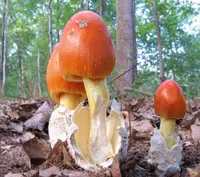
Jackson's slender Caesar
Amanita jacksonii