Spore-based propagation
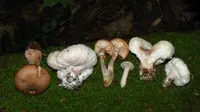
Collect mature, rust-orange spores on clean parchment under the cap, then gently tap them onto a moist, well-decayed hardwood leaf layer to encourage mycelium establishment in a controlled woodland-style bed.

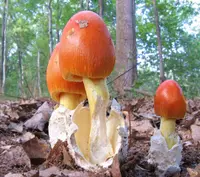
Jackson's slender Caesar, Amanita jacksonii, is a striking gilled mushroom, not a true plant, valued by some for its vivid red-orange cap and yellow stem. It appears in forests where it forms symbiotic relationships with tree roots, especially oaks, helping trees absorb nutrients while drawing sugars from them.
This species is native to eastern North America and usually fruits from the ground in warm, moist conditions after rain. It is considered a challenging species to cultivate because it depends on specific tree partners and soil fungi, so attempts to care for Jackson's slender Caesar at home rarely succeed.

Care Difficulty
Hard Care

Light Preference
Partial Shade

Water Requirements
Keep Soil Moist

Temperature Preference
Warm Climate

Hardiness Zone
Unknown

Soil Texture
Loamy, Sandy, Organic-rich

Soil pH
Strongly acidic (4.5–5.5), Acidic (5.5–6.5)

Soil Drainage
Moist but well-drained

Fertilization
Minimal (feed rarely)
Scan your plant to receive care tips personalized for your specific plant
Available on iOS and Android
This ectomycorrhizal fungus prefers light conditions similar to an open woodland edge rather than full exposure.
This species depends on consistently moist but not waterlogged soil within its forest habitat.
This mushroom develops best in mild to warm conditions typical of late spring to early fall woodlands.
Humidity levels are not a meaningful cultivation factor because this fungus does not adapt to typical home or greenhouse conditions.
This ectomycorrhizal mushroom cannot be grown reliably in artificial substrates, since it requires a living tree host and complex forest soil conditions.
This species is not suitable for container growing because its life cycle depends on symbiosis with tree roots in undisturbed soil.
Amanita jacksonii is a mycorrhizal fungus that relies on its tree partners, so direct fertilization is neither necessary nor recommended.
Amanita jacksonii is a wild ectomycorrhizal mushroom, not a garden plant, so it is not pruned in the usual horticultural sense.
This mushroom forms essential root partnerships with trees, so Amanita jacksonii is not suited to normal repotting or transplanting.
Propagation of Amanita jacksonii is specialized and not a practical task for home growers, since it depends on complex mycorrhizal relationships with trees.
This species persists as underground mycelium and requires no active winter care from gardeners or foragers.

Plant Health Check
Not sure what's wrong with your plant? Check your plant's health inside the app.
This species is part of the Amanita caesarea complex but is native to eastern North America, where it has independently evolved features similar to the European Caesar’s mushroom while remaining genetically distinct.
It forms ectomycorrhizal partnerships with oaks and some other hardwoods, exchanging mineral nutrients and water from the soil for sugars from the tree, and is most often found in mixed hardwood forests rather than conifer stands.
Its gills and cap margin often show a gradual color transition from yellow to orange-red as the fruiting body matures, which helps field mycologists separate it from several toxic red amanitas with different color patterns.

In several regions of eastern Canada and the northeastern United States, this species has expanded its range northward over recent decades, and long-term fungal surveys use its shifting distribution as one indicator of how ectomycorrhizal fungi may be responding to climate change.
No. This species is sometimes confused with other red amanitas, including deadly ones. Identification errors are common, even among experts. For safety, it should not be collected or eaten under any circumstances.
Keep your plants happy and healthy with plant identification, disease detection, and easy care guidance.