Black-staining Polypore Care (Meripilus sumstinei)

Also known as: Giant Polypore, Rooster of the Woods
Black-staining Polypore

About Black-staining Polypore

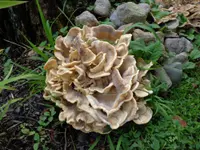
Black-staining polypore, Meripilus sumstinei, is a large, perennial bracket fungus rather than a typical leafy plant. It forms dense, overlapping rosettes of fan-shaped caps that bruise or age to a dark black color, especially on the pore surface.

This species usually appears at the base of hardwood trees, particularly oaks, in eastern and central North America. It is saprobic, meaning it feeds on dead or dying wood, and can be quite long-lived in the same spot.

In cultivation, it is considered specialized and not ideal for beginners. Successful attempts to care for Black-staining Polypore require consistently moist, woody substrate, shaded conditions, and good airflow without strong drying winds.

Main Plant Requirements

Care Difficulty

Moderate Care

Light Preference

Partial Shade

Water Requirements

Regular Water

Temperature Preference

Cold Hardy

Hardiness Zone

4–9

Soil Texture

Loamy, Clay, Organic-rich

Soil pH

Acidic (5.5–6.5), Slightly acidic (6.5–7.0)

Soil Drainage

Moist but well-drained

Fertilization

Minimal (feed rarely)

Get Personalized Care Plan

Scan your plant to receive care tips personalized for your specific plant

Available on iOS and Android

How to Care for the Black-staining Polypore

This wood-decay fungus prefers light conditions similar to those of mature deciduous forests.

  • Provide dappled or filtered light under trees, with 2–4 hours of gentle morning sun and shade in the hottest afternoon hours.
  • Meripilus sumstinei tolerates deep shade but fruits more strongly in bright shade or light woodland edges, where indirect light reaches it most of the day.
  • Avoid full, exposed sun, which can dry substrate and scorch fruiting bodies, especially in late summer; shelter from strong midday sun in open sites.

This species relies on consistently moist, not saturated, woody or soil substrates.

  • Aim for evenly moist soil around host tree roots; the surface 2–5 cm should feel slightly damp, never powder-dry or waterlogged.
  • In dry spells, especially summer, irrigate the surrounding root zone deeply when the top layer begins to dry, then allow excess water to drain away.
  • Signs of excess moisture include sour odor and standing water, while shrinking, cracked soil and slow or aborting fruit bodies suggest insufficient moisture for Meripilus sumstinei.

This fungus is adapted to temperate climates with cool to warm growing seasons.

  • Active growth and fruiting occur mainly around 55–75°F (13–24°C), typical of late spring to early fall in many temperate forests.
  • It tolerates short dips near 32°F (0°C) in soil or wood but fruiting bodies are easily damaged by hard frosts below 28°F (-2°C).
  • In hot periods above 85°F (29°C), locate in shaded, humid microsites to reduce drying; colonized wood survives heat better than exposed fruit bodies.

Humidity is not a key factor for Meripilus sumstinei, which naturally fruits in variable outdoor conditions.

This wood-decaying fungus depends more on host wood and site moisture than on traditional garden soil, but substrate conditions still matter around the base.

  • Favor a moist, humus-rich, loamy substrate around host roots, using well-rotted leaf litter and hardwood chips.
  • Ensure excess water drains away; avoid compacted clay that stays waterlogged for long periods.
  • Maintain slightly acidic to neutral conditions, roughly pH 5.5–7.0, to support natural fungal activity.
  • Improve aeration by mixing in coarse bark or chunky wood chips rather than fine peat-based materials.

This species is not realistically suited to container growing, as it relies on colonizing substantial woody roots or stumps in the ground.

This native wood-decay fungus usually gains nutrients from host tree roots and soil, so Black-staining Polypore rarely benefits from added fertilizer.

Pruning is not relevant for Meripilus sumstinei, as it is a wild, short-lived fungal fruiting body rather than a managed garden plant.

Transplanting is generally unsuitable because this fungus depends on an established tree root system and complex soil ecology.

  • Leave clusters undisturbed; disturbance often disrupts the hidden mycelium that supports future fruiting.
  • Transplant attempts usually fail, even if some soil and wood are moved with the fungus.
  • If removal is necessary, cut fruiting bodies at the base rather than digging, to reduce root and soil disturbance.
  • For study, collect only a small portion and leave the main colony intact to maintain its role in the ecosystem.

Intentional propagation of Meripilus sumstinei is rarely attempted outside research or advanced cultivation settings because it requires live tree hosts and specific soil fungi communities.

No active winter care is needed, as this fungus survives as mycelium in wood and soil and fruits seasonally when conditions suit it.

Care Tips

Use host stumps

Establish the fungus on large, freshly cut hardwood stumps or buried logs (oak, beech, maple) rather than loose chips, since thick wood provides a stable, long-term food source and better fruiting potential.

Control competition

Before inoculation, remove thick turf, aggressive groundcovers, and dense shrub roots around the stump so the fungus does not have to compete heavily for moisture and nutrients in the upper soil layer.

Moisture buffering mulch

After colonization starts, add a 5–8 cm layer of coarse, undecorated wood chips or leaf litter around the stump to buffer soil moisture without smothering developing fruiting bodies.

Minimize physical disturbance

Mark the inoculated zone and avoid foot traffic, raking, or dog activity there, because repeated soil and mycelium disturbance can reduce or delay fruiting when caring for Black-staining Polypore.

Seasonal fruiting checks

Begin checking likely host stumps in late summer after rain events and note where and when clusters appear, then record this pattern so future irrigation or shading adjustments can be timed to match that site’s typical fruiting window.

Common Pests and Diseases

White rot

This disease causes rapid decay of infected hardwood roots and lower trunks, leading to a soft, fibrous texture and structural weakness in the host tree that supports the fungus.

Solution

Remove and properly dispose of heavily colonized, unsafe trees or stumps, and avoid injuring nearby tree roots to limit new infection points; do not move contaminated wood or soil to new sites, and when planting replacement trees, choose species and locations with good drainage to reduce future white-rot pressure as part of long-term Meripilus sumstinei care instructions.

Armillaria root disease

This disease competes with Meripilus sumstinei on stressed hardwoods, breaking down roots and lower stems and sometimes killing the supporting tree, which then alters habitat and moisture conditions for the fungus.

Solution

Excavate and remove as much infected root and stump material as practical, improve site drainage and reduce soil compaction, and avoid overwatering; in high-value sites, maintain host trees as vigorous as possible to limit Armillaria expansion and preserve stable substrate for the fungus.

Wood-boring beetles

These insects tunnel into decaying or stressed hardwood where Meripilus sumstinei fruits, increasing internal wood breakup and changing moisture levels around the fungal colony.

Solution

Promptly remove and chip or burn heavily infested logs or stumps, store cut firewood off the ground and away from desired fungal patches, and maintain surrounding trees in good health to reduce fresh breeding material for beetles near established Meripilus clumps.

Slugs and snails

These pests feed on young or waterlogged fruiting bodies, leaving ragged holes and slime trails that can accelerate breakdown of the mushroom surface.

Solution

Hand-pick slugs and snails in the evening or early morning, reduce dense groundcover and wet debris around fruiting sites, and where necessary use iron phosphate bait placed away from non-target wildlife to limit grazing on new Meripilus clusters.

Interesting Facts

Distinct black staining

When the fresh, pale brown pore surface or flesh is bruised or ages, it quickly turns dark brown to black, a reliable macroscopic feature used to separate it from similar polypores.

Root disease indicator

It is a parasitic fungus on the roots and lower trunks of living hardwoods, especially oaks, and its presence often indicates significant root decay that can increase the risk of tree failure.

Massive rosette fruiting

The fungus forms large, multi-layered rosettes of overlapping caps at the tree base, and a single mature fruiting body can weigh many kilograms and recur from the same location for multiple years.

Botan icon

Did you know?

Genetic and morphological studies support that this North American species is distinct from the superficially similar European Meripilus giganteus, which is why it now carries its own species name, sumstinei, in honor of American mycologist Lucien M. Underwood’s student George Sumstine.

FAQs about Black-staining Polypore

This fungus can form large clusters around hardwood stumps or roots and may recur for several years. It does not spread quickly through soil like invasive plants, but it can slowly expand as the wood decays.

Grow Healthy Plants with Botan Care

Keep your plants happy and healthy with plant identification, disease detection, and easy care guidance.

Botan plant care app — identify plants on mobile

Explore More Plants