Use stable substrate
Mount colonies on long-lasting, rough materials such as seasoned hardwood, natural cork, or unglazed stone to avoid frequent disturbance, which Calicium viride tolerates poorly.

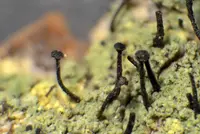
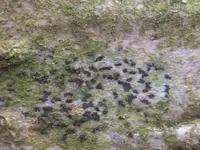
Spike lichen (Calicium viride) is a crustose lichen, not a true plant, that forms small greenish patches with tiny dark stalks topped by spore-bearing heads. It typically grows on shaded, decaying conifer wood and old bark in cool, moist forests across parts of Europe, North America, and other temperate regions.
This species is slow-growing and sensitive to air pollution and habitat disturbance, which makes it challenging to keep outside its natural conditions. Those wanting to learn how to care for spike lichen should aim to mimic its cool, humid, low-light forest environment as closely as possible.

Care Difficulty
Hard Care

Light Preference
Partial Shade

Water Requirements
Low Water

Temperature Preference
Cold Hardy

Hardiness Zone
3–8

Soil Texture
Rocky, Loamy, Organic-rich

Soil pH
Acidic (5.5–6.5)

Soil Drainage
Well-drained

Fertilization
Minimal (feed rarely)
Scan your plant to receive care tips personalized for your specific plant
Available on iOS and Android
Calicium viride prefers low to moderate, indirect light similar to shaded forest conditions.
Moisture for Calicium viride is supplied mainly by rain and ambient humidity rather than direct watering.
This lichen favors cool to mild conditions but tolerates a broad outdoor temperature range.
This crustose lichen has very low direct humidity requirements and instead depends on periodic surface moisture from rain, fog, or spray.
Calicium viride does not use soil in the usual sense and instead anchors to bark or wood, so focus on the support surface rather than a substrate layer.
This species is not naturally suited to conventional container growing, but small mounts can be kept in shallow trays mainly for display or study.
Calicium viride is a nutrient-efficient lichen that usually grows well without added fertilizer in natural or outdoor settings.
Calicium viride requires no active pruning; it should be left undisturbed on its natural substrate.
This lichen is usually grown on bark or stone and is not suited to conventional repotting.
Propagation of Calicium viride is specialized and generally left to natural dispersal or expert cultivation.
This species is cold hardy in temperate climates and normally needs no special winter care when established outdoors.

Plant Health Check
Not sure what's wrong with your plant? Check your plant's health inside the app.
This species is named for its distinctive bright green, powdery crust (the thallus) that coats the bark or wood beneath the black spore stalks, a color linked to specific light-absorbing pigments and its algal partner.
It occurs mainly on old, often mossy trunks and decaying wood in long‑established, humid forests, and is widely used in Europe and parts of North America as an indicator of old‑growth or near‑natural woodland continuity.
Its reproductive structures form tiny black, pin-shaped stalks only a few millimeters tall that release spores from a small cap, making it a classic example of a pin lichen visible only at close range or with a hand lens.

Calicium viride has been included on regional Red Lists in several European countries, where its presence or loss is used in conservation assessments to help evaluate the ecological quality and historical continuity of forest habitats.
This lichen grows very slowly, usually only a few millimeters per year. Growth depends on clean air, stable humidity, and an undisturbed surface. Any physical damage, pollution, or extended drought can significantly reduce its growth rate.
Keep your plants happy and healthy with plant identification, disease detection, and easy care guidance.