Retain Natural Substrate
When collecting a sample, keep the original bark or twig segment intact and avoid scraping, since the lichen’s fungal layer is tightly fused to its substrate and disturbance can kill the colony.

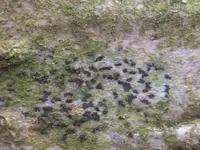
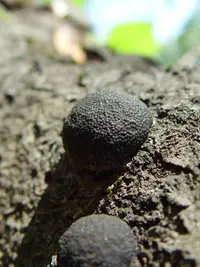
Dot lichen (Arthonia didyma) is a crustose lichen, not a true plant, formed by a partnership between a fungus and microscopic algae. It grows tightly attached to bark, usually on smooth twigs and branches. Small, dark, dot-like fruiting bodies scattered over a pale or grayish patch give it a speckled appearance, which is where the common name comes from. It occurs mainly in temperate regions, especially on broadleaf trees in woodlands and hedgerows. Arthonia didyma is sensitive to air pollution and disturbance, so it is not simple to keep in artificial conditions. Those who want to care for dot lichen should provide clean air, stable moisture, and a bark-like surface rather than typical potting soil.

Care Difficulty
Moderate Care

Light Preference
Partial Shade

Water Requirements
Moderate Water

Temperature Preference
Cool Climate

Hardiness Zone
Unknown

Soil Texture
Loamy

Soil pH
Slightly acidic (6.5–7.0)

Soil Drainage
Well-drained

Fertilization
Minimal (feed rarely)
Scan your plant to receive care tips personalized for your specific plant
Available on iOS and Android
Arthonia didyma grows on bark or rock and relies on cool, stable, indirect light rather than strong direct sun.
This lichen uses ambient moisture from rain, fog, and humidity rather than regular soil watering.
This species tolerates a wide temperature range but performs best in cool to mild conditions without abrupt extremes.
This crustose lichen tolerates a wide humidity range but remains most stable in moderately moist air.
Arthonia didyma grows on bark or rock rather than soil, so focus on a stable, well-aerated mounting substrate.
This species is not naturally suited to conventional containers, but it can be maintained on mounted substrates placed within a pot or tray system.
Arthonia didyma, a crustose lichen on bark, does not benefit from conventional fertilizing because it absorbs nutrients directly from rainwater and dust.
Pruning is not used as a management tool for Arthonia didyma because it is a crustose lichen tightly attached to tree bark.
Transplanting is rarely successful for this bark-dwelling lichen and is generally not recommended.
Propagation of Arthonia didyma is slow and mainly ecological rather than horticultural.
This lichen is naturally cold hardy and needs no special winter care in typical outdoor conditions.

Plant Health Check
Not sure what's wrong with your plant? Check your plant's health inside the app.
This lichenicolous fungus grows mainly on the thalli of specific crustose lichens, especially species of Opegrapha and related genera, rather than directly on bark or rock like many other lichens.
Its fertile structures appear as very small, often clustered black dots on the host lichen surface, which is why it is commonly called dot lichen.
The species is considered lichenicolous and often parasitic, meaning it lives in close association with a host lichen and can damage or deform the host thallus as it develops.
This species grows very slowly, usually expanding only a few millimeters per year. Growth depends on stable moisture, clean air, and low disturbance of the bark or substrate where it is attached.
Keep your plants happy and healthy with plant identification, disease detection, and easy care guidance.