Mounting substrate choice
Attach the lichen to rough, untreated conifer bark or natural cork rather than smooth wood or plastic, as the irregular surface traps moisture films and gives the holdfasts better anchoring points.

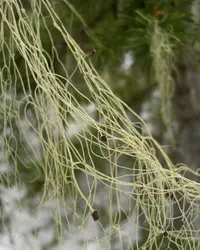
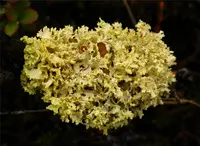
Witch's hair lichen, Alectoria sarmentosa, is a fruticose lichen, not a true plant, formed by a partnership between a fungus and an alga. It hangs in long, hair-like strands from branches, creating pale green, tangled curtains.
This lichen is common in cool, moist conifer forests of North America and parts of northern Europe and Asia, where air quality is relatively clean. It is slow-growing and sensitive to pollution and drying, which makes it difficult to cultivate at home.
Those who wish to learn how to care for witch's hair lichen should know it prefers cool, humid air, gentle light, and stable, natural surfaces rather than regular potting soil.

Care Difficulty
Hard Care

Light Preference
Partial Shade

Water Requirements
Low Water

Temperature Preference
Cold Hardy

Hardiness Zone
4–9

Soil Texture
Rocky, Sandy, Organic-rich

Soil pH
Strongly acidic (4.5–5.5), Acidic (5.5–6.5)

Soil Drainage
Well-drained

Fertilization
Minimal (feed rarely)
Scan your plant to receive care tips personalized for your specific plant
Available on iOS and Android
This lichen prefers cool, bright, open conditions that mimic moist conifer forests.
This epiphytic lichen absorbs moisture from rain, fog, and humid air rather than from soil.
This lichen is naturally adapted to cool, moist, oceanic and montane climates.
This lichen needs consistently high atmospheric humidity to survive and cannot adapt to dry indoor air.
Alectoria sarmentosa does not use typical soil but anchors loosely on bark, rock, or other rough, well-aerated surfaces.
This species is only marginally suitable for containers and is best treated as a mounted lichen rather than a potted plant.
This lichen does not need added fertilizer and usually performs best on nutrient-poor bark or rock surfaces.
Alectoria sarmentosa needs only minimal pruning, aimed at safety and light maintenance rather than shaping.
Transplanting witch's hair lichen is rarely successful, as it depends on specific host trees, clean air, and stable humidity.
Propagation of this lichen is specialized and usually left to natural dispersal or expert conservation projects.
This cold-hardy lichen tolerates typical outdoor winters in its native range and needs no special winter care.

Plant Health Check
Not sure what's wrong with your plant? Check your plant's health inside the app.
This lichen occurs mainly in cool, humid old-growth conifer forests, where it drapes from branches of spruce, hemlock, and fir, and its presence is often used as an indicator of relatively undisturbed, long-standing forest ecosystems.
It is highly sensitive to atmospheric pollutants, especially sulfur dioxide and some heavy metals, so its decline or absence in former habitats can signal long-term air quality problems.
By trapping fog and rainfall and slowly decomposing, this lichen helps cycle nitrogen and other nutrients from the forest canopy back to the soil, subtly supporting tree and understory growth over time.

In parts of the Pacific Northwest and boreal regions, this lichen is an important winter food for woodland caribou, which selectively browse the long, hair-like strands when other food sources are covered by snow.
Growth is slow. Branching strands usually lengthen only a few millimeters per year, sometimes up to 1–2 cm in very clean, humid air. Growth rate depends strongly on air quality, moisture, and stable, cool temperatures.
Keep your plants happy and healthy with plant identification, disease detection, and easy care guidance.