


Rock Substrate Choice
Attach thalli only to stable, non-calcareous rocks (like granite or basalt) rather than limestone, which can shift pH at the surface and slow establishment.

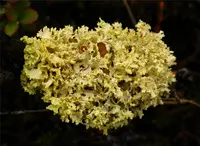
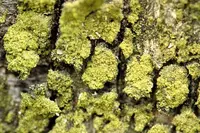
Yellow lichen, Vulpicida juniperinus, is a foliose lichen, not a true plant, formed by a partnership between a fungus and photosynthetic algae. It typically forms bright yellow to yellow-green patches with lobed, leafy structures on rocks, soil, or bark.
This species is most often found in cool, open habitats in northern and montane regions, especially in areas with clean air. It tends to grow slowly and is sensitive to air pollution and heavy disturbance, which makes it challenging to keep in typical home conditions.
Those who wish to care for Yellow Lichen should know it prefers bright, indirect light, constant gentle air flow, and a stable, slightly moist but not waterlogged surface.

Care Difficulty
Hard Care

Light Preference
Partial Sun

Water Requirements
Low Water

Temperature Preference
Cold Hardy

Hardiness Zone
Unknown

Soil Texture
Rocky, Sandy

Soil pH
Acidic (5.5–6.5)

Soil Drainage
Well-drained

Fertilization
Minimal (feed rarely)
Scan your plant to receive care tips personalized for your specific plant
Available on iOS and Android
This lichen prefers cool, bright outdoor conditions rather than intense, direct heat.
Vulpicida juniperinus relies mainly on natural rainfall and air moisture rather than frequent direct watering.
This lichen is adapted to cool, temperate climates with significant seasonal variation.
This lichen tolerates a wide humidity range but grows best in cool, consistently moist air.
This species is typically saxicolous or corticolous, so it does not require conventional potting soil but can be mounted or placed on inert substrates.
This lichen is not well suited to conventional container growing, but shallow trays or mounts can be used for display if conditions stay cool and airy.
Vulpicida juniperinus is a nutrient-efficient lichen that normally grows on nutrient-poor bark or wood and does not need added fertilizer.
Pruning is not part of normal care for Vulpicida juniperinus, as it is a lichen growing on host trees rather than a shrub or houseplant.
Transplanting this bark-dwelling lichen is rarely successful, so it is usually left undisturbed on its natural substrate.
Propagation of this lichen is specialized and generally left to natural processes or research settings rather than routine home culture.
This lichen is naturally cold hardy across a wide range of climates and needs no special winter care when growing outdoors on suitable hosts.

Plant Health Check
Not sure what's wrong with your plant? Check your plant's health inside the app.
The lichen’s upper surface is a bright, sulfur-yellow to greenish yellow caused by secondary compounds such as vulpinic acid, which protect the symbiotic algae from intense light and UV radiation.
This species typically grows on bark and wood of conifers, especially junipers and spruces, in boreal and subalpine regions of the Northern Hemisphere, reflecting a strong adaptation to cold, nutrient-poor forest habitats.
The thallus is foliose (leaf-like) with small, overlapping lobes and a paler underside, a structure that increases surface area for photosynthesis while allowing efficient attachment to vertical trunks and branches.

Vulpicida juniperinus produces vulpinic acid, a bright yellow lichen compound historically noted as toxic to some animals and used as a natural pigment in traditional dyes in parts of its northern range.
This lichen performs better outdoors on rough bark, old wood, or rock where air movement, light, and natural moisture cycles are stable. Yellow Lichen indoor care is difficult because indoor air and surfaces rarely mimic its natural habitat.
Keep your plants happy and healthy with plant identification, disease detection, and easy care guidance.

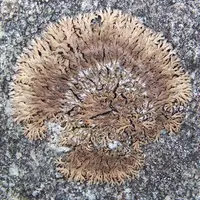
Anaptychia runcinata
Anaptychia runcinata
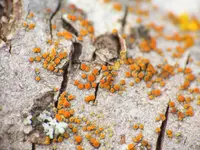
Flaming Firedot Lichen
Athallia pyracea
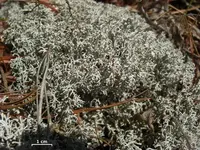
gray reindeer lichen
Cladonia rangiferina
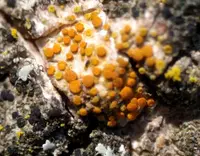
Athallia cerinella
Athallia cerinella
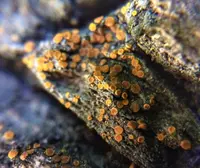
Firedot Lichen
Athallia holocarpa
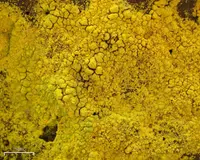
dust lichen
Chrysothrix candelaris
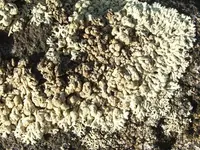
arctoparmelia lichen
Arctoparmelia incurva
Candelariella reflexa
Candelariella reflexa