


Substrate selection
Encourage healthy thalli by providing hard, stable, low-nutrient surfaces such as unsealed stone, old concrete, or weathered terracotta instead of nutrient-rich bark or soil, which favor mosses and algae over this lichen.

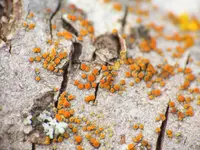
Flaming firedot lichen (Athallia pyracea) is a crustose lichen, not a true plant, forming thin, flat patches tightly attached to bark or rock. It shows bright orange to yellow fruiting dots that create a vivid speckled surface.
This species is common in temperate regions, often found on tree trunks, old fence posts, and sometimes stone in open, well-lit sites. It tolerates a wide range of conditions but establishes best where air is clean and surfaces remain relatively dry and stable.
Because it grows very slowly and relies on natural colonization, it is not easy to cultivate in a controlled setting. Enthusiasts who want to care for Flaming Firedot Lichen usually focus on protecting suitable host surfaces and avoiding disturbance.

Care Difficulty
Moderate Care

Light Preference
Full Sun

Water Requirements
Low Water

Temperature Preference
Cool Climate

Hardiness Zone
4–8

Soil Texture
Rocky, Sandy

Soil pH
Slightly acidic (6.5–7.0), Neutral (7.0)

Soil Drainage
Well-drained

Fertilization
Minimal (feed rarely)
Scan your plant to receive care tips personalized for your specific plant
Available on iOS and Android
This crustose lichen prefers stable, open light but tolerates a range of sun exposures on bark or rock.
This lichen absorbs water from rain, dew, and humidity rather than from soil like a typical plant.
This species is broadly cold-hardy and heat-tolerant when attached to stable outdoor surfaces.
This crustose lichen tolerates a wide humidity range but performs best with moderate ambient moisture and periodic wetting-drying cycles.
This species is not grown in soil but on hard substrates, so any artificial base should mimic a firm, mineral surface rather than a conventional potting mix.
This lichen can be kept in containers only by mounting it on a stable substrate placed inside a pot or tray, rather than rooting it in potting mix.
Athallia pyracea, often called Flaming Firedot Lichen, normally grows on nutrient-poor bark or rock and does not need added fertilizer.
Athallia pyracea requires virtually no intentional pruning in cultivation or in natural settings.
This lichen is rarely grown in containers, so care focuses on transplanting small colonized pieces to new substrates when necessary.
Propagation of Athallia pyracea is slow and technically demanding, so it is seldom attempted by casual growers.
This lichen is naturally cold hardy and typically requires no special winter care in outdoor conditions.

Plant Health Check
Not sure what's wrong with your plant? Check your plant's health inside the app.
This species is one of the most common bright yellow to orange crustose lichens on nutrient-rich bark along busy roads and urban trees, often indicating higher nitrogen input from air pollution.
It shows a strong tolerance to elevated nitrogen compounds, such as ammonia and nitrate from traffic or agriculture, so its frequent presence often points to nitrogen-enriched environments rather than clean-air sites.
The tiny orange apothecia, which are the disc-shaped fruiting bodies, often cover much of the thallus surface and are the main visible feature, making this lichen look almost like a scattering of colored dust on bark.
This crust lichen expands very slowly, often only 1–2 mm per year under good conditions. Growth is usually faster on stable, nutrient-rich bark or stone and slower on very exposed, dry, or polluted surfaces.
Keep your plants happy and healthy with plant identification, disease detection, and easy care guidance.

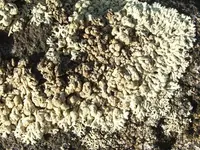
arctoparmelia lichen
Arctoparmelia incurva
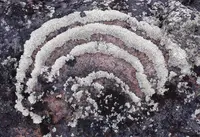
arctoparmelia lichen
Arctoparmelia centrifuga
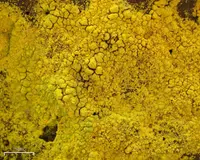
dust lichen
Chrysothrix candelaris
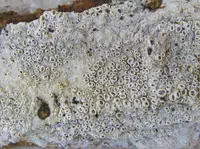
Bark barnacles
Thelotrema lepadinum
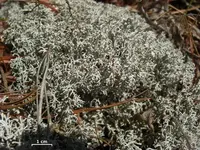
gray reindeer lichen
Cladonia rangiferina
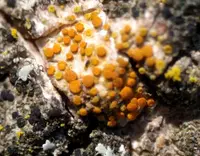
Athallia cerinella
Athallia cerinella
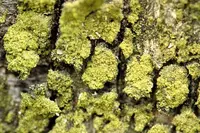
Candelariella reflexa
Candelariella reflexa
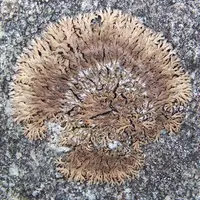
Anaptychia runcinata
Anaptychia runcinata