Substrate selection
Mount the lichen on untreated, rough-barked hardwood (such as old willow or aspen) or weathered conifer wood, since its spores anchor best on stable, slowly decaying substrates with some texture.

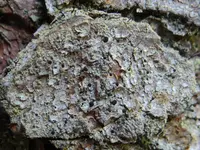
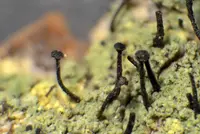
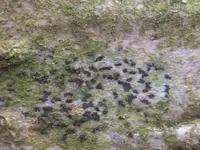
Spike lichen (Calicium salicinum) is a small, crust-like lichen that grows on bark and old wood, forming tiny dark stalks topped with powdery spore heads. It is not a true plant but a partnership between a fungus and an alga, which allows it to survive in nutrient-poor, exposed sites.
This species is found mainly in cool, temperate forests across Europe and North America, often on shaded trunks of conifers and hardwoods. Its very slow growth and sensitivity to air pollution make it challenging for anyone who wants to care for spike lichen.
In general, it prefers stable, humid air, low light, and undisturbed, naturally weathered bark rather than typical potting substrates or indoor conditions.

Care Difficulty
Hard Care

Light Preference
Partial Shade

Water Requirements
Low Water

Temperature Preference
Cold Hardy

Hardiness Zone
3–8

Soil Texture
Rocky, Sandy

Soil pH
Acidic (5.5–6.5)

Soil Drainage
Well-drained

Fertilization
Minimal (feed rarely)
Scan your plant to receive care tips personalized for your specific plant
Available on iOS and Android
This crustose lichen prefers stable, subdued light similar to what it receives on shaded bark or old wood.
This lichen relies on periodic surface moisture rather than deep or frequent watering.
This species is adapted to cool to mild outdoor climates with moderate seasonal variation.
This species is adapted to cool, consistently moist air and is sensitive to prolonged dryness.
This lichen does not grow in conventional potting soil but on bark or rock surfaces with very little fine substrate.
This species is only marginally suitable for container growing and is better treated as a mounted specimen on bark or rock.
Calicium salicinum generally gains nutrients from its substrate and surrounding environment, so fertilizing is rarely required for healthy growth.
Calicium salicinum needs almost no deliberate pruning, as it naturally maintains its form on bark or wood.
This lichen is usually left undisturbed, but limited transplanting is possible when moving suitable substrate pieces.
Propagation of Calicium salicinum is specialized and slow, so it is seldom attempted outside scientific or conservation contexts.
This species is naturally cold hardy in temperate climates and typically needs no special winter care once established outdoors.

Plant Health Check
Not sure what's wrong with your plant? Check your plant's health inside the app.
This species most frequently colonizes old bark of trembling aspen and related Salix and Populus hosts in boreal and temperate forests, making it a useful indicator of older, relatively undisturbed stands where such trees are present.
Its tiny stalked fruiting bodies, called mazaedia, can persist for many years on the same spot of bark, allowing lichenologists to read a long-term history of habitat continuity from a single trunk.
Populations decline sharply in areas with elevated sulfur dioxide and other air pollutants, so its presence is often used in biomonitoring studies as evidence of good long-term air quality.

The species forms part of a highly specialized microcommunity on old tree bark, where its persistent, sooty spore masses provide a stable microhabitat that supports certain rare lichen-feeding mites and other invertebrates that are largely absent from younger or more disturbed bark surfaces.
Growth is very slow. New colonies typically expand only a few millimeters per year, depending on moisture, air quality, and substrate stability. Even under favorable conditions, this species may take many years to noticeably increase in coverage.
Keep your plants happy and healthy with plant identification, disease detection, and easy care guidance.