


Sterilize Substrate
Before inoculation, pasteurize or sterilize the growth medium (such as a sand–loam mix with added organic matter) to reduce competing fungi and bacteria and improve the chances of successful Clavulinopsis luteoalba establishment.

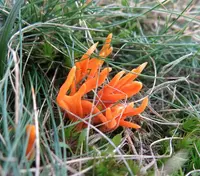
Apricot club (Clavulinopsis luteoalba) is a small club-shaped fungus, not a leafy houseplant. It forms dense clusters of slender, upright orange to yellow clubs that emerge from the soil or moss. Each fruiting body is smooth and simple, without a cap or gills.
This species is typically found in grasslands, lawns, and mossy areas, especially in temperate regions. It often appears in late summer to autumn when conditions are cool and moist.
For those who want to care for Apricot Club indoors, it is important to know that it is a saprophytic fungus, meaning it feeds on decaying organic matter and needs consistently damp, well-aerated substrate.

Care Difficulty
Hard Care

Light Preference
Partial Shade

Water Requirements
Keep Soil Moist

Temperature Preference
Cool Climate

Hardiness Zone
Unknown

Soil Texture
Loamy, Organic-rich, Peaty

Soil pH
Acidic (5.5–6.5)

Soil Drainage
Moist but well-drained

Fertilization
Minimal (feed rarely)
Scan your plant to receive care tips personalized for your specific plant
Available on iOS and Android
This small coral fungus prefers gentle woodland-style light rather than strong, open sun.
Moist, well-drained soil is essential for consistent fruiting of this fungus.
This species favors cool to mild conditions typical of shaded forest floors.
This fungus prefers consistently moist, cool air with moderate to high humidity.
This saprotrophic fungus fruits best in consistently moist, organic-rich, well-drained soil or leaf litter.
This species is challenging but possible to maintain in containers set up as moist microhabitats.
Clavulinopsis luteoalba is a saprophytic fungus that usually gains enough nutrients from decaying organic matter and needs no routine fertilization in gardens or containers.
Clavulinopsis luteoalba does not require true pruning, but spent fruiting bodies can be removed for tidiness and monitoring.
This species is rarely grown in pots; management focuses on transplanting or establishing suitable outdoor sites rather than routine repotting.
Propagation of Clavulinopsis luteoalba is challenging and usually indirect, relying on spores and careful habitat recreation rather than simple garden techniques.
This fungus is naturally cold hardy in temperate climates and generally needs no special winter care once established in the soil.

Plant Health Check
Not sure what's wrong with your plant? Check your plant's health inside the app.
This species is notable for its distinct color gradient, with white to pale yellow bases that shift to bright orange-yellow tips, giving individual fruiting bodies a two-toned, coral-like appearance in mossy lawns and pastureland.
It is strongly associated with unimproved, low-nutrient grasslands and mossy lawns, where it fruits scattered or in small groups, often indicating relatively undisturbed turf with low fertilizer input.
The clubs are very slender, typically only a few millimeters thick, with smooth, unbranched axes and easily broken tissue, which makes them short-lived and often overlooked among grasses and mosses.

Molecular studies have helped separate this species from several similar yellow and orange club fungi, revealing that some older records in Europe and North America actually refer to different taxa that were once lumped together under the same name.
Growth is relatively slow and seasonal. Fruiting bodies usually appear only once conditions are right, often in late summer to autumn, then disappear quickly. The underground mycelium persists longer, expanding gradually through suitable mossy or grassy substrates.
Keep your plants happy and healthy with plant identification, disease detection, and easy care guidance.

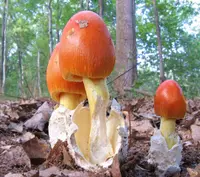
Jackson's slender Caesar
Amanita jacksonii
dot lichen
Arthonia didyma
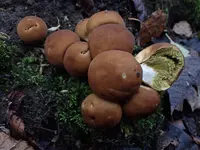
Pear-shaped Puffball
Apioperdon pyriforme
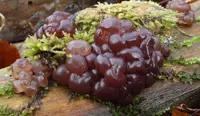
Ascotremella faginea
Ascotremella faginea
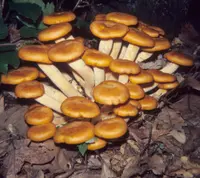
jack-o'-lantern mushroom
Omphalotus illudens
Ascobolus furfuraceus
Ascobolus furfuraceus
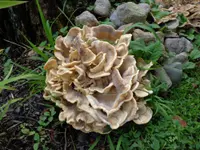
Black-staining Polypore
Meripilus sumstinei
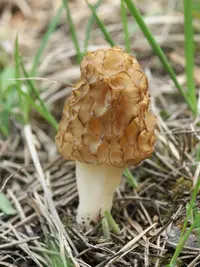
Yellow Morel
Morchella esculenta