Use host grasses
Establish a low-cut, unfertilized sward of fine grasses or mosses, as these create the lean, stable turf structure that supports fungal fruiting rather than dense, lush lawn growth.

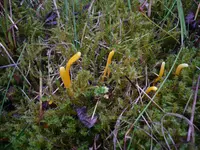
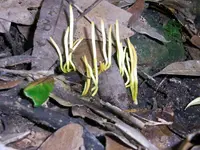
Yellow club, Clavulinopsis helvola, is a small club-shaped fungus rather than a true leafy plant. It usually appears as clusters of slender, bright yellow clubs emerging from mossy or grassy soil.
This species is most often found in temperate regions, especially in unimproved grasslands, lawns, and mossy woodland edges with low to moderate disturbance. It depends on healthy soil life, which can make it sensitive to heavy fertilizing or compacted ground.
Because it prefers undisturbed, moist, well-drained soil and natural organic matter, it is not commonly cultivated indoors. Gardeners who wish to care for Yellow Club usually focus on maintaining a stable, low-chemical habitat where the fungus can establish naturally.

Care Difficulty
Hard Care

Light Preference
Partial Shade

Water Requirements
Keep Soil Moist

Temperature Preference
Cool Climate

Hardiness Zone
Unknown

Soil Texture
Loamy, Silty, Organic-rich

Soil pH
Strongly acidic (4.5–5.5), Acidic (5.5–6.5)

Soil Drainage
Moist but well-drained

Fertilization
Minimal (feed rarely)
Scan your plant to receive care tips personalized for your specific plant
Available on iOS and Android
This small grassland fungus prefers cool, bright conditions without intense midday exposure.
This species thrives in consistently moist, but not waterlogged, soil.
This fungus favors cool, temperate conditions and reacts quickly to temperature extremes.
This fungus prefers cool, moist air but tolerates a moderate humidity range if its substrate stays damp.
This species develops best in loose, organic-rich, consistently moist soil that mimics forest leaf litter.
This species is challenging but possible to grow in shallow containers that replicate moist woodland litter.
This woodland fungus typically needs no fertilizer when growing in a natural, undisturbed soil community, so Yellow Club is best left unfed.
Pruning is not applicable to Clavulinopsis helvola, as its fruiting bodies are temporary fungal structures rather than true plant shoots or branches.
Transplanting is rarely appropriate, since this fungus depends on specific soil microbes and conditions to fruit.
Propagation of this fungus is mainly ecological rather than horticultural and is not reliably achieved through simple home techniques.
No special winter care is needed, as the fungus survives underground and the visible clubs are seasonal.

Plant Health Check
Not sure what's wrong with your plant? Check your plant's health inside the app.
The fruiting bodies are small, simple club-shaped structures in a uniform waxy yellow, typically only a few cm tall, which helps distinguish it from similar coral fungi with branched forms or mixed colors.
The clubs are ephemeral and often disappear within days, so the same patch of mossy grass or pasture may look completely bare shortly after a flush of fruiting.
This species is most often recorded in short, unimproved grasslands, lawns, and mossy turf, where low competition from taller plants and a stable surface layer favor its sporocarp development.
This fungus is best grown outdoors in soil or naturalistic woodland-style beds, since it relies on decaying organic matter and soil microbes. Yellow Club indoor care is difficult and usually unsuccessful beyond short-term display of collected specimens.
Keep your plants happy and healthy with plant identification, disease detection, and easy care guidance.