clustered brown bolete Care (Aureoboletus innixus)

clustered brown bolete

About clustered brown bolete

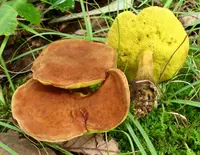
The clustered brown bolete, Aureoboletus innixus, is a fleshy, pore-bearing fungus rather than a leafy plant. It forms dense clusters of medium-sized, brown caps with thick stems.

This species is typically found on the ground in woodlands, often near trees with which it forms a mycorrhizal partnership, meaning it exchanges nutrients with their roots. Its growth depends heavily on suitable tree partners, natural leaf litter, and stable soil moisture, which makes it difficult to cultivate deliberately.

For most home growers, it is more practical to observe and care for clustered brown bolete in its natural habitat rather than try to raise it indoors or in containers.


Main Plant Requirements

Care Difficulty

Moderate Care

Light Preference

Partial Shade

Water Requirements

Regular Water

Temperature Preference

Warm Climate

Hardiness Zone

Unknown

Soil Texture

Loamy, Organic-rich

Soil pH

Acidic (5.5–6.5)

Soil Drainage

Moist but well-drained

Fertilization

Minimal (feed rarely)

Get Personalized Care Plan

Scan your plant to receive care tips personalized for your specific plant

Available on iOS and Android

How to Care for the clustered brown bolete

This mycorrhizal fungus prefers bright, gentle woodland light rather than direct, open sun.

  • Provide dappled or filtered light under deciduous trees, with roughly 2–4 hours of soft morning sun and shade or broken light for the rest of the day.
  • Avoid strong midday and afternoon sun, which can overheat the soil surface, dry leaf litter, and reduce fruiting of the clustered brown bolete.
  • In summer, prioritize partial shade; in spring and fall, slightly more open canopy light is acceptable as long as the site does not dry out rapidly.

This species depends on consistently moist, well‑drained forest soil rather than direct watering like a typical garden plant.

  • Maintain evenly moist but not saturated soil, allowing the top 2–5 cm of leaf litter and humus to feel slightly dry before the next rainfall or irrigation.
  • Ensure excellent drainage with loose, organic‑rich soil; standing water, foul odor, or slimy litter indicate overwatering and poor aeration that harm fungal mycelium.
  • In dry, hot periods, supplemental site watering can help: moisten the upper 5–10 cm of soil slowly, then allow excess water to drain fully before repeating.

This fungus fruits best in mild to warm conditions typical of temperate woodlands.

  • Aim for an active growth and fruiting range around 60–77°F (16–25°C), with stable soil temperatures supported by leaf litter or mulch cover.
  • Aureoboletus innixus tolerates cool spells down to about 40°F (4°C) in the soil, but hard frost below 32°F (0°C) can damage exposed fruiting bodies.
  • Prolonged heat above 86°F (30°C) with dry soil reduces fruiting; provide shade, organic mulch, and moisture to buffer temperature swings through summer.

Humidity is not a significant factor for Aureoboletus innixus, which is managed as a wild ectomycorrhizal fungus rather than a conventional cultivated plant.

Soil conditions matter mainly in natural or habitat-support settings for Aureoboletus innixus rather than in typical garden cultivation.

  • Aim for a loose, well-drained, humus-rich forest-type soil that mimics mixed woodland leaf litter and decaying wood.
  • Maintain consistently moist but never waterlogged conditions, as prolonged saturation reduces oxygen and harms the fungal mycelium.
  • A slightly acidic soil, around pH 5.0–6.5, best supports the associated tree roots that this bolete depends on.
  • In managed sites, top-dress with leaf mold, fine bark, and woody compost to increase organic matter and improve aeration without heavy digging.

This species is not suitable for container growing because it requires a stable ectomycorrhizal relationship with host tree roots in open ground.

This mycorrhizal fungus associates with tree roots and generally does not need direct fertilization.

Pruning is not a standard practice for Aureoboletus innixus, as it is a wild, short-lived mushroom body rather than a woody or leafy plant.

This species grows in soil with host trees, so management focuses on site conditions rather than true repotting.

  • Transplant only when establishing or adjusting host trees, choosing a similar soil type and drainage to the original site.
  • Move material in cool, moist weather to reduce stress on tree roots and the fungal partner.
  • Avoid disturbing the root zone more than necessary; keep as much native soil around roots as possible.
  • Water host trees after transplanting and maintain even moisture so the fungal association can re-establish.

Propagation of this bolete is specialized and not typically managed by home growers, since it depends on complex spore and root interactions.

No special winter care is required, as this fungus survives in the soil and fruits seasonally when conditions suit it.

Care Tips

Substrate rotation

Rotate your fruiting containers or trays between production cycles, disposing of fully exhausted substrate and replacing it with freshly prepared material to reduce pathogen buildup and maintain reliable flushes when growing clustered brown bolete.

Clean harvesting

Twist and gently lift each mushroom at the base rather than cutting, then promptly remove any remaining stem tissue from the substrate to limit bacterial soft rot and mold entry points.

Targeted ventilation

Provide gentle cross-ventilation at substrate level during pinning and fruiting using a small fan on a low, indirect setting to keep caps dry, reduce CO2 pockets, and prevent long, weak stems.

Slug and snail barriers

In outdoor beds, create a 5–10 cm ring of coarse sand or fine gravel around the colonized area and check it after rain to deter slugs and snails from reaching young fruiting bodies.

Moisture mapping

Place several shallow markers such as labeled wooden stakes at different points in a bed or tray and check the feel of the substrate at each spot daily to identify consistently dry edges or overly wet zones and adjust misting or irrigation pattern accordingly.

Common Pests and Diseases

mycelial parasitism

This disease involves invasion of the bolete mycelium by other competitive fungi in the soil or wood substrate, leading to weak, patchy fruiting or distorted caps. Symptoms include poor or no mushroom formation where it previously fruited well.

Solution

Reduce disturbance of the fruiting site, avoid compaction, and do not overharvest so enough tissue remains to regenerate. Remove obviously contaminated or off-colored fungal masses, maintain a diverse leaf-litter layer around host oaks, and avoid adding fungicidal chemicals or high-salt fertilizers that stress the Aureoboletus innixus mycelium while favoring more aggressive competitors.

slime mold colonization

This disease occurs when slime molds overrun the surface of developing boletes, covering caps and stems with slimy, often brightly colored growth. Symptoms include rapid breakdown of tissue and loss of normal cap texture.

Solution

Harvest healthy mushrooms as soon as they reach usable size to limit the window for colonization, and discard any fruiting bodies showing slimy or granular surface films. Improve air movement at ground level by thinning dense groundcover and excess debris, which helps the bolete fruit bodies dry faster after rain and makes conditions less favorable for slime molds.

fungus gnat larvae

This pest refers to small fly larvae that tunnel through the stems and caps, leaving brownish tunnels and soft, water-soaked tissue. Symptoms include caps that feel spongy and show small entry holes or visible maggots when sliced.

Solution

Check fruiting bodies frequently and harvest promptly when caps are firm, then cool them quickly to slow larval development. Remove and discard heavily infested mushrooms on-site to reduce breeding populations, and if cultivating in a controlled bed, use fine mesh over the area during peak fly activity to reduce egg laying on young fruit bodies.

slugs and snails

These pests feed on the soft mushroom tissue, often overnight, leaving large ragged holes, slime trails, and partially eaten caps. Symptoms include missing sections of the cap margin and damage concentrated near moist, shaded edges of the patch.

Solution

Hand-pick slugs and snails in the evening or early morning and relocate or destroy them away from the fruiting area. Encourage surface drying by reducing dense groundcover, use copper tape or shallow rough barriers around small cultivated patches, and remove heavily damaged mushrooms promptly to avoid attracting more grazers.

Interesting Facts

Yellow-olive pore surface

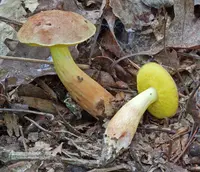
Mature caps show a yellow to olive-yellow pore surface rather than gills, with small, angular pores typical of boletes, which gradually bruise slightly darker but not deep blue, helping distinguish it from many blue-staining relatives.

Sticky, reddish-brown cap

The cap is often distinctly viscid to sticky when moist and ranges from warm yellow-brown to reddish-brown, a combination of texture and color that field mycologists use to separate it from similar brown boletes.

Mycorrhizal hardwood partner

This species forms ectomycorrhizal associations with hardwood trees, especially oaks, exchanging mineral nutrients and water from the soil for sugars from the host tree, and is typically found fruiting on the ground in mixed or deciduous forests in eastern North America.

FAQs about clustered brown bolete

This species is generally regarded as inedible or of very poor culinary value. Identification of wild fungi is complex, and misidentification can be dangerous, so it should not be collected or eaten as food.

Grow Healthy Plants with Botan Care

Keep your plants happy and healthy with plant identification, disease detection, and easy care guidance.

Botan plant care app — identify plants on mobile

Explore More Plants