Substrate depth control
Use a shallow tray with only 2–4 cm of loose, well-drained substrate so the star-like fruiting bodies can expand fully on the surface instead of being buried or deformed.

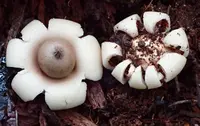
Elegant earthstar, Geastrum elegans, is a small saprophytic fungus, not a typical leafy houseplant. It grows on decaying wood or rich forest litter, helping to break down organic matter.
The fruiting body opens into a star-shaped structure that lifts a central spore sac above the ground, giving it a distinct and decorative appearance. It is mostly observed in warm to subtropical forests.
Because it relies on complex soil fungi relationships and specific woodland conditions, it is challenging to cultivate indoors or in regular garden beds. For most plant owners, it is easier to appreciate than to care for Elegant Earthstar.
In nature, it favors undisturbed, humus-rich, lightly shaded sites that stay evenly moist but not waterlogged.

Care Difficulty
Moderate Care

Light Preference
Partial Shade

Water Requirements
Moderate Water

Temperature Preference
Warm Climate

Hardiness Zone
Unknown

Soil Texture
Loamy, Sandy, Organic-rich

Soil pH
Acidic (5.5–6.5), Slightly acidic (6.5–7.0)

Soil Drainage
Well-drained

Fertilization
Minimal (feed rarely)
Scan your plant to receive care tips personalized for your specific plant
Available on iOS and Android
This soil-dwelling fungus prefers dappled woodland-style light rather than direct, open sun.
This fungus relies on consistently moist, well-drained soil rather than direct watering to its fruiting bodies.
This species performs best in mild, stable conditions typical of temperate woodlands.
Humidity is rarely a limiting factor for Elegant Earthstar, which tolerates a wide range of ambient conditions.
Geastrum elegans prefers a loose, free-draining, organic-rich substrate that mimics forest litter.
This species is generally unsuitable for long-term container growing and is best observed in natural or semi-natural substrates.
This fungus is typically not fertilized in cultivation, since Elegant Earthstar gains nutrients from decaying organic matter in the soil.
Pruning is not a standard practice for Geastrum elegans, as the fruiting bodies are short-lived and naturally decompose.
Transplanting Geastrum elegans is rarely successful because this earthstar depends on complex soil fungi relationships.
Propagation of Geastrum elegans is generally left to natural spore dispersal, and intentional methods are unreliable.
No special winter care is required, as this earthstar survives in soil as mycelium and fruits seasonally.

Plant Health Check
Not sure what's wrong with your plant? Check your plant's health inside the app.
This fungus begins as a closed, onion-like structure, then the outer layer splits and peels back into several pointed rays, lifting the central spore sac above the ground to aid wind dispersal of spores.
Geastrum elegans is recorded mainly from warm-temperate to subtropical regions, including parts of Europe, North Africa, Asia, and the Americas, where it typically grows on soil rich in decaying organic matter.
As a saprotroph, it feeds on dead plant material in leaf litter and soil, helping decompose organic debris and recycle nutrients in woodland and scrub ecosystems.
Yes, this fungus can be cultivated in shallow, well‑drained containers that mimic its natural leaf‑litter habitat. Use a loose, woody substrate, maintain steady moisture without saturation, and protect the container from direct sun and strong drying winds.
Keep your plants happy and healthy with plant identification, disease detection, and easy care guidance.