Use breathable trays
Grow the fungus on shallow, wide, unglazed clay or plastic trays with drainage holes so the mycelium has a stable, aerated base and the fruiting bodies can expand fully without deforming against pot walls.

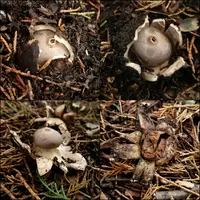
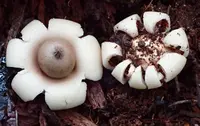
Crowned earthstar, Geastrum coronatum, is a small, star-shaped fungus rather than a typical leafy houseplant. It develops a central spore sac surrounded by pointed rays that open from a rounded ball. This gives it a distinctive, sculptural look on the soil surface.
It usually appears on rich, decaying organic matter in woodlands and gardens in temperate regions, including parts of Europe and North America. Because it relies on specific soil fungi relationships and decomposing material, it is challenging to cultivate deliberately. Gardeners interested in how to care for crowned earthstar mainly focus on maintaining a moist, undisturbed, organic-rich woodland or mulched bed environment.

Care Difficulty
Moderate Care

Light Preference
Partial Shade

Water Requirements
Moderate Water

Temperature Preference
Warm Climate

Hardiness Zone
Unknown

Soil Texture
Loamy, Sandy, Organic-rich

Soil pH
Slightly acidic (6.5–7.0)

Soil Drainage
Well-drained

Fertilization
Minimal (feed rarely)
Scan your plant to receive care tips personalized for your specific plant
Available on iOS and Android
This fungus prefers dappled woodland light rather than full, open sun.
Moist but not waterlogged soil supports reliable fruiting for this woodland fungus.
This species is adapted to mild, temperate conditions with cool to warm seasons.
Humidity plays a minor role for this hardy, soil-dwelling fungus.
This earthstar prefers loose, well-drained, organic-rich soil that mimics forest litter.
This species is not well suited to conventional decorative container growing, but can be kept in pots for observation or study.
This fungus is a decomposer that takes nutrients from decaying organic matter and does not need targeted fertilization in cultivation.
Geastrum coronatum does not require structured pruning, but minor cleanup helps maintain a tidy display in collections or educational plantings.
This species is seldom grown in standard pots; management focuses on transplanting substrate or relocating colonized material when necessary.
Reproducing this star-shaped fungus is specialized work, mainly carried out by spore or mycelium handling rather than typical garden propagation.
In most temperate regions this fungus is naturally cold hardy and requires no active winter care beyond conserving its habitat conditions.

Plant Health Check
Not sure what's wrong with your plant? Check your plant's health inside the app.
The fruiting body starts as a round, partially buried structure that splits into several pointed rays, lifting the inner spore sac above the soil surface as the rays reflex and press against the ground.
This species typically appears on nutrient-rich, humus-heavy soils in deciduous or mixed woodlands, often among thick leaf litter where it breaks down organic matter as a saprotroph, meaning it feeds on dead plant material.
When mature, the outer layer forms a pronounced collar-like zone around the central spore sac, a feature that helps distinguish it from several other similar earthstar species in the field.

Geastrum coronatum is considered uncommon across much of its known range, and mycologists often record it only sporadically, so many long-term woodland surveys treat each new find as a notable record for local fungal diversity monitoring.
This fungus is best grown outdoors or in controlled laboratory-style conditions, as it needs cool, humid, well-ventilated environments and natural seasonal changes. Typical home interiors are usually too dry and warm for consistent development and fruiting.
Keep your plants happy and healthy with plant identification, disease detection, and easy care guidance.