

Wood selection
Use well-seasoned oak, beech, or other hardwood stumps or logs rather than fresh-cut wood, since slightly aged wood with intact bark provides a more stable food source and better colonization for growing Spindleshank.

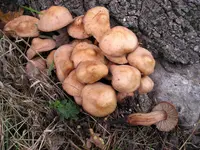
Spindleshank, Gymnopus fusipes, is a saprotrophic mushroom that lives on decaying roots and wood, especially around oak and other broadleaf trees. It forms tight clusters of narrow, spindle-shaped stems topped with brown caps, often appearing at the base of living trees or old stumps.
This fungus is native to Europe but has been reported in other temperate regions with similar woodland habitats. It tends to fruit in late summer to autumn, depending on local climate.
Because it relies on buried wood rather than typical potting soil, it is not a practical subject for indoor cultivation, and detailed guidance on how to care for Spindleshank in home settings is limited.

Care Difficulty
Moderate Care

Light Preference
Partial Shade

Water Requirements
Keep Soil Moist

Temperature Preference
Cool Climate

Hardiness Zone
Unknown

Soil Texture
Loamy, Organic-rich

Soil pH
Acidic (5.5–6.5)

Soil Drainage
Moist but well-drained

Fertilization
Minimal (feed rarely)
Scan your plant to receive care tips personalized for your specific plant
Available on iOS and Android
This wood-rotting fungus prefers low, forest-like light rather than direct open sun.
Moist, never stagnant, conditions support reliable fruiting of this woodland fungus.
This species fruits best in mild, temperate conditions and is adapted to outdoor woodland climates.
This fungus forms and fruits best in consistently moist, humid conditions rather than dry air.
Gymnopus fusipes needs a consistently moist, organic-rich substrate that drains freely yet does not dry out quickly.
This species can be grown in containers if given a deep, stable, wood-based substrate that stays evenly moist.
In natural settings Gymnopus fusipes fruits well without added fertilizer, so extra feeding is usually unnecessary.
Pruning needs for Gymnopus fusipes are minimal and mainly relate to hygiene rather than shaping growth.
This fungus is best managed by adjusting its woody substrate rather than traditional repotting.
Propagation of Gymnopus fusipes in gardens is uncommon and technically demanding, so it is rarely attempted by home growers.
This woodland fungus is naturally cold hardy in temperate climates and generally needs no special winter care.

Plant Health Check
Not sure what's wrong with your plant? Check your plant's health inside the app.
The species name fusipes refers to its often twisted, spindle-shaped stem, which can become swollen and irregular where multiple fruiting bodies arise from a shared base.
This mushroom is strongly associated with oaks and other broadleaf trees, frequently appearing in tight clusters at the base of living trunks, on buried roots, or around old stumps in oak-dominated woodlands.
Gymnopus fusipes is a saprotroph and weak parasite, meaning it both decomposes dead wood and can slowly invade stressed living roots, contributing to root and butt rot while recycling nutrients back into the forest soil.

Molecular studies have shown that populations previously split into separate genera and species across Europe have been brought back together under Gymnopus fusipes, making it a good example of how DNA sequencing can overturn older, morphology-only mushroom classifications.
The fruiting bodies are considered inedible due to tough texture and poor flavor. Identification errors with look-alike fungi also pose risk. For safety, do not eat this species and avoid offering it as food.
Keep your plants happy and healthy with plant identification, disease detection, and easy care guidance.

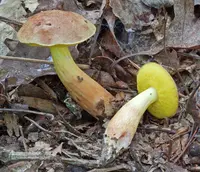
sour gold-pored bolete
Aureoboletus auriporus
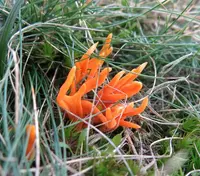
Apricot Club
Clavulinopsis luteoalba
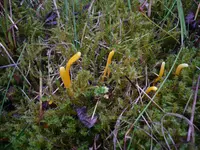
Yellow Club
Clavulinopsis helvola
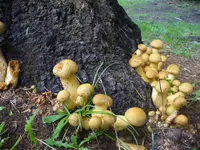
Western Jumbo Gym
Gymnopilus ventricosus
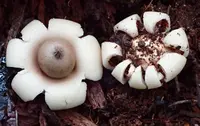
Elegant Earthstar
Geastrum elegans
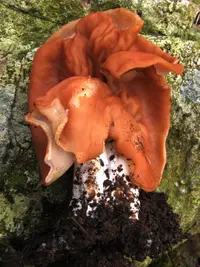
Gyromitra fastigiata
Gyromitra brunnea
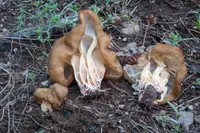
Gyromitra californica
Gyromitra californica
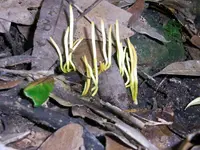
yellow coral fungus
Clavulinopsis amoena