
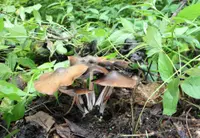

lobster mushroom Identification (Hypomyces lactifluorum)

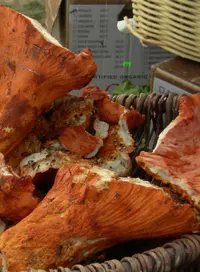
Recognize lobster mushroom by its bright orange to red outer coating that completely covers a Russula or Lactarius host, turning the cap and stem into a dense, irregular mass.

At first glance, look for a thick, often lopsided fruiting body, a pitted or cracked surface, and no visible true gills.

Hypomyces lactifluorum Identification

Check Your Plant ID

Use a clear photo to confirm what plant you have.

Clear images work best. Avoid photos taken too close or too far away

Check the fruiting body shape and surface first on Hypomyces lactifluorum.

  • Cap and stem are often fused into a thick, irregular mass rather than a neat mushroom outline.
  • Outer surface is bright orange to reddish orange and usually matte, not glossy.
  • Underside lacks normal gills; it looks blunt, wrinkled, or pitted instead of finely lined.
  • Stem is stout and solid-looking, often widening into the distorted cap.
  • Fruiting bodies are often 2 to 6 inches (5 to 15 cm) across, with a heavy, compact build.

A firm, misshapen orange body with no true visible gills is the main visual clue.

Hypomyces lactifluorum shows clear visual changes as the parasite overtakes and reshapes its host.

  • Young plant: Early infection starts as scattered bright orange to red patches on the host mushroom, while original gills or pores remain partly visible between uncoated areas.
  • Mature plant: As coverage expands, the host becomes distorted and dense, often with a blunt, irregular cap. The surface turns matte orange-red and develops fine pimply texture.
  • Fruiting stage: At full development, the lobster mushroom is completely enveloped, usually 2-8 inches (5-20 cm) across, with gills obscured and a hard, shell-like exterior.

Most visible seasonal clues appear in summer through fall, when lobster mushroom fruits are present on the ground. Fresh specimens are bright orange to red-orange and irregularly lobed. As they age in the fruiting season, the surface often becomes duller, patchy, or cracked, and older examples may fade toward pale orange while keeping their dense, distorted shape.

A few bright orange fungi can be mistaken for lobster mushroom.

jack-o'-lantern mushroom(Omphalotus illudens)

Both are vivid orange. Jack-o'-lantern keeps true gills under a cap and grows in clusters from wood. Lobster mushroom is misshapen, with no normal gills visible and a thicker, irregular surface.

false chanterelle(Hygrophoropsis aurantiaca)

Its orange cap can suggest the same color at a glance. False chanterelle has a regular cap with many thin, forked gills. Lobster mushroom is denser, unevenly lumpy, and lacks that orderly cap-and-gill shape.

Hypomyces lactifluorum is known from North America, especially eastern and central forests and parts of the Pacific Northwest. Geography helps because reports are tied to regions where suitable host mushrooms occur, rather than open country or dry habitats. It is most often found on the ground in deciduous or mixed woodland, commonly near oaks, birches, and conifers, during the mushroom season. Finding it in forest leaf litter on a Russula or Lactarius host helps narrow identification.

  • Misidentification risk: This mushroom is safety-relevant because wrong identification can involve ingestion of a different fungus by humans. It should show a firm red to orange crust covering a Russula or Lactarius host; a red surface alone is not enough.
  • Key dangerous confusion: Do not confuse it with red or orange cup fungi such as Sarcoscypha species. Cup fungi form an open cup with no gills or mushroom cap underneath, while Hypomyces lactifluorum covers an existing gilled mushroom.

Confirm the Species with Botan

Upload a photo to compare key features and get help identifying or double-checking what you found.

FAQ

It appears as a bright orange to red-orange crust covering a host mushroom, often irregular and lumpy. The surface becomes matte and pitted, and the original gills are distorted or nearly hidden during lobster mushroom identification.

More Plant Identification Guides

Identify Your Plant and Learn More

Upload a photo with Botan to identify it, then get species-specific care information, safety notes, and common problems.

Botan app identifying a plant from a photo
Can Plants Grow With Artificial Light?

6 min read · 15 Sept 2026

Can Plants Grow With Artificial Light?

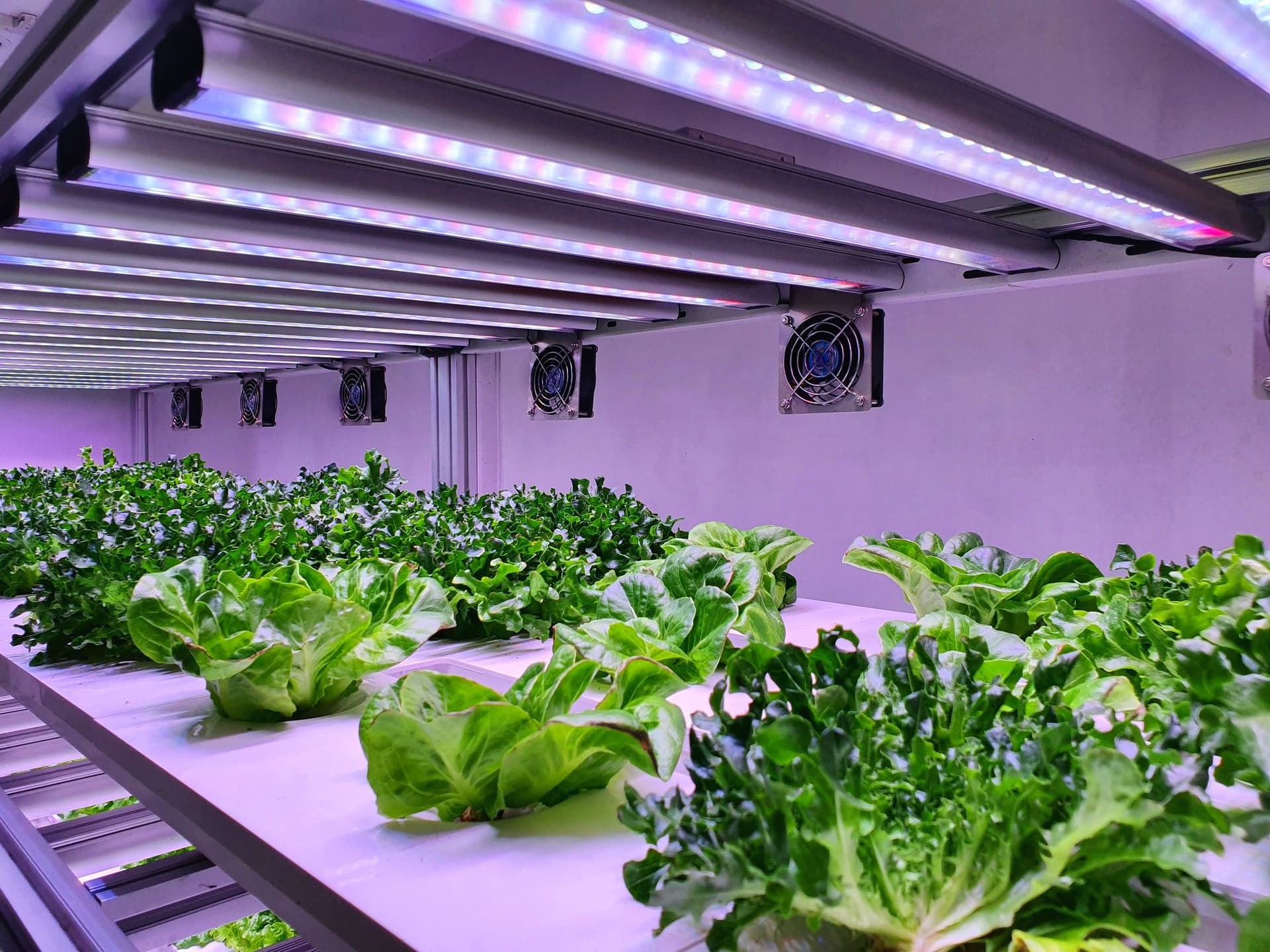
Plants can grow under artificial light when the setup provides a suitable spectrum, enough intensity, and sufficient daily exposure. This guide explains how artificial lighting compares with sunlight, which options work indoors, and how to match a setup to houseplants.

Plant Care

Can Plants Grow With Artificial Light?
When to Harvest Carrots: Timing, Signs, and How to Pick Them

6 min read · 23 Oct 2026

When to Harvest Carrots: Timing, Signs, and How to Pick Them

Carrots are usually ready 60-80 days after sowing them in the soil, depending on the variety. Learn how to recognize maturity signs, choose the right harvest season, pull carrots without damaging them, and store roots after picking.

Plant Care
When to Harvest Carrots: Timing, Signs, and How to Pick Them
How to Use a Moisture Meter for Plants

5 min read · 4 Sept 2026

How to Use a Moisture Meter for Plants

Watering by feel kills plenty of houseplants. A moisture meter checks the soil for you, and takes the guesswork out of it. This guide will show you how to use it correctly, from the first touch to the final reading.

Beginner Guides
How to Use a Moisture Meter for Plants