
landslide mushroom Identification (Psilocybe caerulescens)

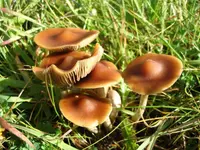
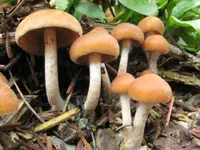
To recognize Psilocybe caerulescens, look first for a smooth caramel- to chestnut-brown cap about 1-3 inches (2.5-8 cm) wide, often with a low central bump, plus crowded dark purplish-brown gills.

The stem is usually slender, pale, and 2-5 inches (5-13 cm) long, and the flesh and stem bruise blue where handled or damaged.

Psilocybe caerulescens Identification

Check Your Plant ID

Not sure about your plant ID? Upload a photo and check it with Botan.

Clear images work best. Avoid photos taken too close or too far away

Check a few visible features together before relying on color alone.

  • Cap is broadly convex to nearly flat, often with a low bump, usually 1.5-5 inches (4-12 cm) across.
  • Gills are close together and attached to the stem, starting pale and becoming dark purplish brown.
  • Stem is slender, roughly even in width, and lacks a ring.
  • Flesh and stem bruise blue where handled or damaged, often most visible near the base.

Use several traits together, especially cap shape, attached gills, ringless stem, and blue bruising.

Psilocybe caerulescens shows useful visual changes as the fruiting body expands and ages.

  • Young plant: Very young mushrooms appear as rounded buttons, with the cap still closed over the gills and the stalk short, thick, and compact.
  • Mature plant: As it matures, the cap expands to broadly convex or nearly flat, about 1-3 inches (2.5-7.5 cm) across, and the stalk lengthens.
  • Fruiting stage: In fruiting bodies, exposed gills darken as spores mature, while bruised areas on the cap or stalk often turn blue, unlike younger closed buttons.

Psilocybe caerulescens is reliably recorded from Mexico and parts of Central America, especially humid montane areas. Geography can help narrow identification because this species is best known from that region rather than from broad temperate forests elsewhere. It typically fruits on disturbed, muddy ground, clay-rich banks, landslides, roadcuts, and similar open sites, often near streams or in cloud forest and subtropical woodland settings. Finding it in exposed soil rather than directly on wood is a useful habitat clue.

  • Psychoactive ingestion risk: The fruiting body contains psilocybin and psilocin. Ingestion affects the nervous system in humans and can cause poisoning in pets.
  • Serious misidentification risk: Wrong identification is a major safety issue with mushrooms. Deadly Galerina marginata can occur on wood; unlike Psilocybe caerulescens, it usually has a persistent ring on the stem and does not bruise blue.

Not Sure About the ID?

Botan can compare a photo and help identify or confirm the plant, which is useful when field notes or images leave room for doubt.

FAQ

Yes. This species is strongly associated with disturbed, humid ground, especially clay-rich soil on landslides, road cuts, trailsides, and similar banks. Habitat is one of the best clues for Psilocybe caerulescens identification.

More Plant Identification Guides

Know What Plant You Have

Use a photo to identify it with Botan, then review plant details, safety notes, and common problems for that species.

Botan app identifying a plant from a photo
Plant Pot Sizes: How to Choose the Right Plant Container

7 min read · 20 Aug 2026

Plant Pot Sizes: How to Choose the Right Plant Container

Plant pot sizes can be confusing because the number on the label only tells you part of the required information. A container may look spacious but actually be too shallow. So, how to choose pot size for plant species?

Beginner Guides
Plant Pot Sizes: How to Choose the Right Plant Container
10 Easy Garden Flowers to Grow

8 min read · 10 Sept 2026

10 Easy Garden Flowers to Grow

Discover 10 garden flowers that require minimal care. Learn which characteristics make plants easy to grow and follow tips on how to create a beautiful corner from beginner-friendly blooms on your property.

Beginner Guides
10 Easy Garden Flowers to Grow
How to Use a Moisture Meter for Plants

5 min read · 4 Sept 2026

How to Use a Moisture Meter for Plants

Watering by feel kills plenty of houseplants. A moisture meter checks the soil for you, and takes the guesswork out of it. This guide will show you how to use it correctly, from the first touch to the final reading.

Beginner Guides
How to Use a Moisture Meter for Plants