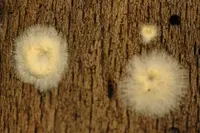


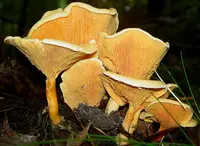


wet rot Identification (Coniophora puteana)

Recognize Coniophora puteana by its thin, crust-like fruiting body spread flat on wood, its smooth to finely bumpy brown surface, and its pale to yellowish margin that stays distinctly lighter than the center.

It forms broad, attached patches rather than caps or shelves, often only a few millimeters thick.

Coniophora puteana Identification

Check Your Plant with Botan

Use a clear photo to confirm what plant you have.

Clear images work best. Avoid photos taken too close or too far away

Check the wood surface and spread pattern first.

  • Forms a thin, flat crust on timber rather than caps, shelves, or stems.
  • Patch edges often creep irregularly across the wood in broad, uneven outlines.
  • Surface is usually smooth to slightly wrinkled, with a close, skin-like look.
  • Color commonly ranges from yellow-brown to olive-brown, often darker toward older areas.
  • Fruiting patches can extend several inches across when visible, sometimes merging into larger sheets.

Visible patches on structural wood are a practical clue when checking indoor decay.

Coniophora puteana shows useful visual changes as the fruiting surface develops and ages.

  • Young plant: Early growth appears as a thin, pale buff to brown film on wood, often patchy and flat, with little surface texture and no obvious margin.
  • Mature plant: Older patches spread into broader, more continuous crusts that can reach several inches across, turning darker brown and developing a more uneven, slightly wrinkled surface.
  • Fruiting stage: At the fertile stage, the crust becomes distinctly granular to warty, sometimes with a whitish actively growing edge, making the spore-bearing surface easier to recognize.

Coniophora puteana is widespread across temperate regions of the Northern Hemisphere and is also common well beyond that range in buildings and other timber structures. Geography alone rarely confirms identification because this fungus is broadly distributed. Habitat is more useful. It is associated with damp, enclosed wood, especially conifer timber in buildings, crawl spaces, basements, and other persistently wet structural sites. Finding it on wet indoor wood helps narrow identification more than outdoor location does.

Scan. Check. Confirm.

Use Botan to compare a photo and confirm the identification, helping avoid mix-ups before you label it or look up the right information.

FAQ

The most reliable sign is a thin, flat fruiting crust on damp wood, usually olive-brown to dark brown, with a smooth to finely warty surface and a distinct white growing margin when fresh.

More Plant Identification Guides

Scan Your Plant. Get the Details.

Use Botan to identify it from a photo, then see plant details, care information, and common problems for that species.

Botan app identifying a plant from a photo
Best Time to Water Grass in Summer – Lawn Watering Tips

5 min read · 21 Jul 2026

Best Time to Water Grass in Summer – Lawn Watering Tips

Summer watering is easy to get wrong. This guide explains when to turn on your sprinkler, how much liquid your grass needs each week, and how to tell if you're overwatering or underwatering.

Plant Care
Best Time to Water Grass in Summer – Lawn Watering Tips
Top 15 Plants That Don’t Need Sunlight

8 min read · 17 Sept 2026

Top 15 Plants That Don’t Need Sunlight

Some plants thrive in dim rooms, shaded corners, and places with indirect light. In this guide, you’ll explore the top 15 species best suited to low-light conditions and how to care for them.

Plant Recommendations
Top 15 Plants That Don’t Need Sunlight
12 Best Cold-Hardy Vegetables for Cold Weather

7 min read · 13 Oct 2026

12 Best Cold-Hardy Vegetables for Cold Weather

Cold-hardy vegetables can keep a garden productive through chilly fall, winter, and early spring weather. This guide covers 12 reliable crops, their frost tolerance, and practical growing tips for better cold-season harvests.

Plant Recommendations
12 Best Cold-Hardy Vegetables for Cold Weather