

False Chanterelle Identification (Hygrophoropsis aurantiaca)

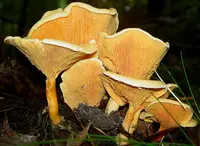
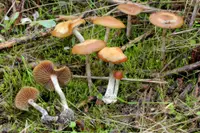
To recognize False Chanterelle, look for a bright orange cap with a shallow central depression, thin crowded gills that repeatedly fork and run down the stem, and a slender orange stem without a ring.

Caps are often 2 to 5 inches (5 to 12 cm) across and usually grow in loose groups.

Hygrophoropsis aurantiaca Identification

Check Your Plant with Botan

Upload a plant photo and check the identification in seconds.

Clear images work best. Avoid photos taken too close or too far away

Use these visible features to check Hygrophoropsis aurantiaca in the field.

  • Cap is orange to yellow-orange, often with a shallow funnel shape and a slightly darker center.
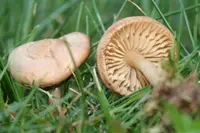
  • Underside shows many thin, crowded gills that fork and branch repeatedly as they run down the stem.
  • Cap is usually about 1.5-4 inches (4-10 cm) across, with an inrolled margin when viewed from the side.
  • Stem is central, fairly slender, and usually similar in color to the cap or a bit paler.

Check several parts at once, especially the crowded, branching gills and funnel-like cap.

Hygrophoropsis aurantiaca shows useful visual changes as the fruiting body expands and ages.

  • Young plant: Very young fruit bodies appear as small orange buttons, with the cap strongly inrolled and the gills still crowded into a tight, shallow fold beneath.
  • Fruiting stage: As it expands, the cap becomes funnel-like, often 1.5-4 inches (4-10 cm) across, and the thin orange gills run clearly down the stem.
  • Mature plant: Older specimens usually show a deeper central depression, a flatter or wavy margin, and a softer tan-orange cap center than younger fruit bodies.

False Chanterelle is mainly a late-summer to fall find, when its orange to orange-brown cap and crowded, forked gills become conspicuous on woodland debris. Fresh fruiting bodies are often brightest in this period, which makes the species easier to spot. As the season progresses, older caps usually fade slightly and become more irregular or wavy at the margin. Outside the fruiting period, there is no persistent above-ground structure to identify.

A few orange, gill-like mushrooms are commonly confused with False Chanterelle.

chanterelle(Cantharellus cibarius group)

Similar orange color and funnel shape can mislead. Chanterelles have blunt, thick ridges that fork and run down the stem, not thin, crowded true gills. Their caps are usually more irregularly wavy.

jack-o'-lantern mushroom(Omphalotus illudens)

Also bright orange and vase-shaped. It usually grows in dense clusters from wood or buried roots, while Hygrophoropsis aurantiaca is more often scattered on forest litter or decaying wood. Its gills are thicker and the stem is usually more robust.

Hygrophoropsis aurantiaca is widespread in Europe and occurs in similar temperate parts of North America. Geography alone is not enough for identification, but region helps when paired with habitat. It is typically found in conifer woodland, especially on decaying wood, woodchips, or thick needle litter. Finding it in forest debris, rather than directly from soil, helps narrow the ID.

  • Misidentification risk: This mushroom is sometimes confused with chanterelles during collection. The safety concern is ingestion by humans if a wrong identification leads to eating the wrong species.
  • Key separating feature: Unlike true chanterelles, Hygrophoropsis aurantiaca has many thin, blade-like gills that fork and crowd together, rather than blunt, thick ridges. Check the underside carefully before any handling for food use.

Does Your Plant Match?

Use Botan to compare a photo and help confirm the identification before you label it or move on to care.

FAQ

The clearest feature is its many thin, crowded, orange gills that fork and run down the stem. In contrast to true chanterelles, these are blade-like gills, not blunt, wrinkled ridges.

More Plant Identification Guides

Find Out What Plant It Is

Identify it from a photo with Botan, then review plant details, care information, and common problems for that species.

Botan app identifying a plant from a photo
12 Best Plants That Repel Spiders For Your Home and Garden

8 min read · 24 Jul 2026

12 Best Plants That Repel Spiders For Your Home and Garden

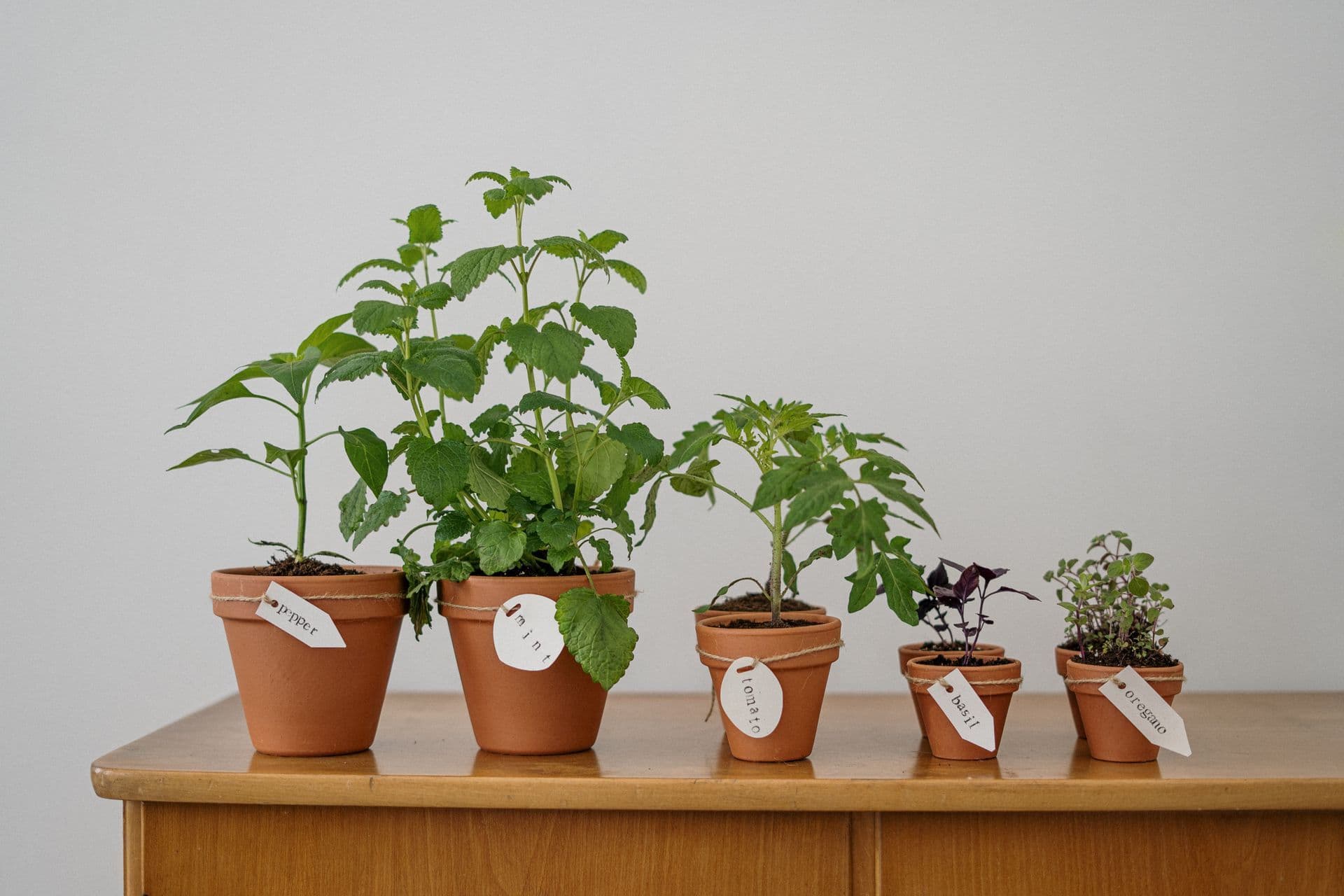
Spiders constantly appear in places you don't want them. A few common plants can help repel them using scent alone. Here are 12 options suitable for both indoors and outdoors, plus care tips for each.

Plant Recommendations
12 Best Plants That Repel Spiders For Your Home and Garden
Plant Pot Sizes: How to Choose the Right Plant Container

7 min read · 20 Aug 2026

Plant Pot Sizes: How to Choose the Right Plant Container

Plant pot sizes can be confusing because the number on the label only tells you part of the required information. A container may look spacious but actually be too shallow. So, how to choose pot size for plant species?

Beginner Guides
Plant Pot Sizes: How to Choose the Right Plant Container
When to Harvest Tomatillos: How to Tell When They're Ripe

4 min read · 20 Oct 2026

When to Harvest Tomatillos: How to Tell When They're Ripe

Tomatillos grow inside papery husks, making it hard to judge ripeness at a glance. This guide explains how to know when tomatillos are ripe and offers practical advice on harvesting and storage.

Plant Recommendations
When to Harvest Tomatillos: How to Tell When They're Ripe