


Dryad's Saddle Identification (Cerioporus squamosus)

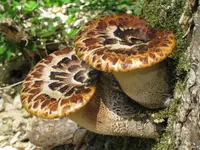
Recognize Dryad's Saddle by its large, kidney- to fan-shaped caps, often 4 to 12 inches (10 to 30 cm) across, attached laterally like shelves. The cap surface shows dense brown scales on a pale background.

Turn one over and check for broad, elongated pores underneath rather than gills.

Cerioporus squamosus Identification

Identify Your Plant with Botan

Upload a clear image to check whether your plant ID is correct.

Clear images work best. Avoid photos taken too close or too far away

Check the fruiting body shape, attachment, and pore surface first.

  • Caps are broad and fan- to kidney-shaped, often overlapping in shelves on wood.
  • A single cap is often 4-12 inches (10-30 cm) across, with a thick, rounded outer edge.
  • The top is pale tan to cream with darker brown scales, giving a mottled, pheasant-back pattern.
  • Instead of gills, the underside has large, angular pores that run slightly down the short stem.

A dark, off-center stem attached to wood supports the cap rather than a central stalk from soil.

Dryad's Saddle shows clear visual changes as each fruiting body expands and ages.

  • Young plant: New fruiting bodies begin as thick, rounded knobs or fan-shaped buds. The upper surface is pale and only lightly patterned before the dark scales stand out clearly.
  • Mature plant: At maturity, the cap broadens into a shelf or semicircle, often 4-12 inches (10-30 cm) across, with distinct brown scales over a tan background.
  • Fruiting stage: The underside starts with very fine pores, then develops larger angular pores that become easier to see. The flesh also shifts from tender to tougher with age.

Dryad's Saddle is most noticeable in spring and early summer, when fresh brackets appear on trunks, stumps, or fallen wood. Young caps look pale tan with dark brown scales and a thick, rolled edge. As they age into summer, the caps broaden, flatten, and often fade. Older fruiting bodies become tougher and less distinct, so the fresh spring stage is the clearest seasonal clue.

A few bracket fungi can be mistaken for Dryad's Saddle at a glance.

pheasant back polypore(Polyporus tuberaster)

Both form tan, scaly caps on wood. P. tuberaster is usually smaller and has a dark central stem, while Cerioporus squamosus often has a short, off-center stem and larger pores underneath.

berkeley's polypore(Bondarzewia berkeleyi)

Both can appear as large, pale rosettes at tree bases. Berkeley's polypore lacks the brown scale pattern and has many fanlike lobes, not a single broad cap with a scaly top.

Cerioporus squamosus is native across much of Europe, Asia, and North America. It is usually found in deciduous woodland, parks, and along streams or roadsides where broadleaf trees are present. For identification, habitat is useful because this fungus grows on living or dead hardwood, especially trunks and large fallen logs. Finding it on hardwood in these settings helps separate it from similar bracket fungi more often tied to conifers or drier sites.

This mushroom is not a skin-contact hazard, but identification matters because mushrooms can be confused and some look-alikes cause poisoning if eaten.

  • Misidentification risk: Ingestion is the main concern for humans and pets. Cerioporus squamosus grows on wood and has large pores under the cap, not gills. Confusion with gilled mushrooms on wood is a more serious safety issue because some are poisonous.

Not Sure About the ID?

Botan can identify or confirm it from a photo, helping you avoid mix-ups before you label or log your find.

FAQ

Yes. This species is associated with dead or dying hardwood, especially standing trunks, fallen logs, and large limbs. It commonly appears in spring on elm, maple, box elder, and other broadleaf trees rather than soil.

More Plant Identification Guides

Find the Plant. Get the Details.

Identify it from a photo with Botan, then see plant details, care information, and common problems matched to the result.

Botan app identifying a plant from a photo
How to Repot a Plant: A Step-by-Step Guide

7 min read · 28 May 2026

How to Repot a Plant: A Step-by-Step Guide

In spring, many plants need repotting—an essential part of care. To avoid stress, consider the plant’s type and size. This article offers a step-by-step guide for repotting indoors or outdoors and shows how to check plant health and get care tips using the Botan app.

Plant Care
How to Repot a Plant: A Step-by-Step Guide
How to Use a Moisture Meter for Plants

5 min read · 4 Sept 2026

How to Use a Moisture Meter for Plants

Watering by feel kills plenty of houseplants. A moisture meter checks the soil for you, and takes the guesswork out of it. This guide will show you how to use it correctly, from the first touch to the final reading.

Beginner Guides
How to Use a Moisture Meter for Plants
12 Best Landscaping Trees for Your Garden

8 min read · 6 Oct 2026

12 Best Landscaping Trees for Your Garden

Choosing the landscape tree depends on what your garden needs most. These 12 options include compact flowering specimens, colorful deciduous trees, shade varieties, and evergreens suitable for screening and year-round structure.

Plant Recommendations
12 Best Landscaping Trees for Your Garden