

wavy cap Identification (Psilocybe cyanescens)

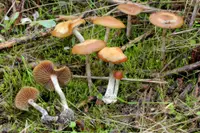
Recognize Psilocybe cyanescens by its distinctly wavy cap margin, especially at maturity, a smooth chestnut-brown cap about 1-4 inches (3-10 cm) wide, and slender whitish stems roughly 2-6 inches (5-15 cm) tall.

It often appears in dense clusters, with caps broader than the stems are tall around the base.

Psilocybe cyanescens Identification

Identify Your Plant with Botan

Take or upload a photo to confirm your plant ID with Botan.

Clear images work best. Avoid photos taken too close or too far away

Check the cap, gills, stem, and how the mushrooms cluster.

  • Cap margins are often strongly wavy or undulating, especially on mature specimens.
  • Caps are usually about 1 to 4 inches (2.5 to 10 cm) across, broad and smooth.
  • Gills are close together and attached to the stem, partly hidden by the cap edge.
  • Stems are slender, pale, and usually 2 to 6 inches (5 to 15 cm) tall, often curved.
  • Fruiting bodies commonly appear in dense clusters rather than singly.

Use several visible traits together before making an identification.

Psilocybe cyanescens shows useful visual shifts as fruiting bodies expand, flatten, and age.

  • Young plant: Pins begin as small, rounded buttons with a smooth chestnut-brown cap and a proportionally thick stem; the cap margin stays strongly inrolled.
  • Mature plant: As the mushroom expands, the cap broadens to about 1-4 inches (3-10 cm), becoming convex to flatter, with the margin developing the distinct wavy outline.
  • Fruiting stage: Fully developed specimens show attached gills that darken to purplish brown as spores mature, while bruised areas on the cap and stem often turn blue.

Psilocybe cyanescens is most recognizable in late fall through winter, when fresh mushrooms appear in clusters and the cap margin often develops the distinct wavy shape that gives the species its common name. During wet fruiting periods, caps look smooth and chestnut to caramel brown when moist, then fade paler as they dry. Outside the fruiting season, those visible mushrooms are usually absent.

A few brown wood-chip mushrooms are often mistaken for wavy cap.

funeral bell(Galerina marginata)

It can share a caramel-brown cap and wood-chip habitat. It usually lacks the strongly undulating cap margin and has a persistent ring on the stem; Psilocybe cyanescens typically has no ring.

brick cap(Hypholoma lateritium)

Young caps can be similarly chestnut brown in clusters on wood. Brick cap usually fruits in tighter tufts, keeps a smoother cap edge, and has gray to purple-brown gills rather than the dark purplish-brown spore color seen at maturity.

Psilocybe cyanescens is widely documented from temperate coastal parts of Europe and the Pacific Coast of North America, though its original native range is uncertain. That uncertainty limits native-range value, but habitat still helps narrow identification. It most often fruits in wood-chip beds, mulched landscaping, garden edges, and debris-rich soils, especially in cool, damp autumn weather. Finding it in disturbed, chip-rich urban or suburban sites is a stronger clue than broad geography alone.

  • Psychoactive ingestion risk: The fruiting body contains psilocybin and psilocin. Ingestion affects humans and can cause intoxication. Pets are also at risk if they eat the mushroom.
  • Dangerous misidentification: Wrong identification is a serious risk because Psilocybe cyanescens can be confused with deadly Galerina marginata. A key visible difference is Galerina marginata usually has a ring on the stem, while Psilocybe cyanescens does not.

Check Your Plant ID

Upload a photo to Botan to help identify it or confirm the match before you rely on your conclusion.

FAQ

It produces no fruit. This species is a mushroom, so the visible structure is a fruiting body with a cap, gills, and stem, not berries, pods, or cones used in plant-based wavy cap identification.

More Plant Identification Guides

Identify the Plant and Get Its Profile

Use Botan to identify it from a photo, then review species-specific plant details, safety notes, and common problems.

Botan app identifying a plant from a photo
How to Mist Plants – Proper Technique and Common Mistakes

7 min read · 30 Jul 2026

How to Mist Plants – Proper Technique and Common Mistakes

Find out when misting works well and when to avoid it. Here, you’ll find detailed information about compatible and incompatible species, tips on how often to mist plants and do it correctly, and some great alternatives for raising humidity.

Beginner Guides
How to Mist Plants – Proper Technique and Common Mistakes
What Plants Don't Like Epsom Salt?

11 min read · 29 Jul 2026

What Plants Don't Like Epsom Salt?

Learn which plants can be seriously damaged by Epsom salt and which will thrive on it. We’ll explain when and how to use it properly, provide tips for indoor & outdoor plants — read on and enjoy a healthy garden.

Plant Care
What Plants Don't Like Epsom Salt?
Banana Peel Water for Plants: 5 Things to Know Before Trying It

5 min read · 9 Jul 2026

Banana Peel Water for Plants: 5 Things to Know Before Trying It

Banana water can provide potassium and some nutrients that may support plant growth, but it is not a universal fix. Use it carefully and only when the plant actually shows signs of nutrient deficiency rather than as a routine treatment.

Plant Care
Banana Peel Water for Plants: 5 Things to Know Before Trying It