
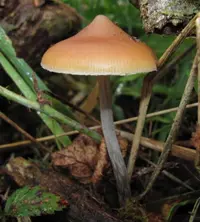
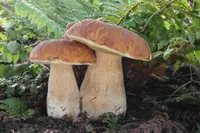

Fried Chicken Mushroom Identification (Lyophyllum decastes)

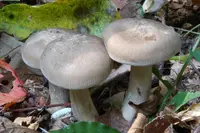
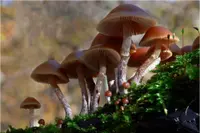
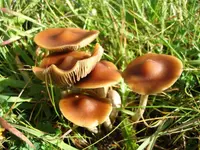
To recognize Lyophyllum decastes, look first for dense, fused clusters of mushrooms growing from a shared base. Caps are smooth and rounded to broadly convex, often 2-5 inches (5-13 cm) across, with crowded white gills beneath.

The stems are stout, pale, and tightly packed together, which gives the whole cluster a compact, many-stemmed form.

Lyophyllum decastes Identification

Is This Fried Chicken Mushroom?

Take a photo and use Botan to confirm your plant identification.

Clear images work best. Avoid photos taken too close or too far away

Use these quick visual cues to assess Lyophyllum decastes at a glance.

  • Grows in dense, crowded clusters, with many stems tightly joined at the base.
  • Caps are smooth and rounded to broadly convex, often flattening with age, usually 2-5 inches (5-13 cm) across.
  • Cap color is gray-brown to tan-brown, often darker at the center than at the edge.
  • Gills are pale to whitish, close together, and attached to the stem rather than hanging free.
  • Stems are stout, pale, and fibrous-looking, usually without a ring.

A tight cluster with attached pale gills and gray-brown caps is a useful visual combination.

Lyophyllum decastes shows useful visual changes as clustered fruiting bodies expand and age.

  • Young plant: Very young buttons appear as tight, rounded caps in dense clusters, with margins strongly inrolled and gills mostly hidden beneath short, thick stems.
  • Mature plant: As caps expand to about 2-4 inches (5-10 cm), they flatten or become slightly uneven, and crowded white gills show clearly under longer stems.
  • Fruiting stage: Older fruiting bodies darken gray-brown, cap edges often split or lift, and the cluster looks less compact as individual mushrooms spread apart.

The main seasonal clue in Lyophyllum decastes is when the fruiting bodies appear. Dense clusters of caps and stems usually become visible from late summer into fall, often around paths, lawns, or disturbed ground. Outside the fruiting period, this mushroom is often absent from view rather than changing form gradually. That makes its sudden clustered appearance in the cooler part of the year the most useful seasonal identification feature.

A few clustered brown mushrooms are regularly mistaken for Lyophyllum decastes.

the Miller(Clitopilus prunulus)

Both can appear in groups with pale to gray-brown caps. The Miller usually has crowded pinkish gills from pink spores and a strong mealy odor. Fried Chicken Mushroom keeps white gills and lacks that distinctly flour-like smell.

clouded agaric(Clitocybe nebularis)

Both may form dense troops and have gray to brown caps. Clouded agaric is usually larger, with thicker, decurrent gills that run down the stem. Lyophyllum decastes has attached gills that do not run noticeably downward.

Lyophyllum decastes is widely reported from temperate parts of Europe, Asia, and North America, though its exact native range is uncertain because it is also spread by human activity. For identification, habitat is useful. It often fruits in dense clusters on soil in disturbed ground, lawns, roadsides, paths, garden edges, and open woodland, rather than directly from wood. Finding it in compacted, human-influenced sites helps narrow it down.

Lyophyllum decastes is a mushroom, so identification has a real safety implication. Edibility reports exist, but visual identification alone is not enough because harmful mix-ups can happen.

  • Dangerous misidentification risk: Confusion with toxic brown mushrooms can affect humans through ingestion. A key check is the spore print: Lyophyllum decastes has a white spore print, unlike deadly Galerina marginata, which has a rusty brown spore print.

Confirm the Species with Botan

Upload a photo to compare key details and help verify the identification before you label it or keep researching.

FAQ

The best field mark is its dense, fused clusters of several caps growing from one base, usually with crowded pale gills and stout stems. For identifying Fried Chicken Mushroom, the clustered habit is especially useful.

More Plant Identification Guides

Identify First. Learn What Comes Next.

Use Botan to identify it from a photo, then get plant details, care information, and common problems for that species.

Botan app identifying a plant from a photo
Plants That Repel Bugs – 20 Effective Options

12 min read · 16 Jul 2026

Plants That Repel Bugs – 20 Effective Options

Mosquitoes on the patio? Gnats in the kitchen? Some plants keep them away with the scent of their own leaves. Here are 20 that deal with mosquitoes, flies, aphids, and more, plus where to put them so they help.

Plant Recommendations
Plants That Repel Bugs – 20 Effective Options
Top 5 Best Indoor Plants for Air Quality

5 min read · 11 Sept 2026

Top 5 Best Indoor Plants for Air Quality

Indoor plants can make a room feel fresher thanks to their air-purifying qualities. Here are 5 of the most suitable choices for your routine and living space.

Plant Recommendations
Top 5 Best Indoor Plants for Air Quality
13 Best Front Yard Trees for Every Home and Yard

12 min read · 7 Aug 2026

13 Best Front Yard Trees for Every Home and Yard

A front yard tree can stay for decades. Therefore, choosing one deserves serious consideration. Here are 13 trees that have proven themselves, sorted by their purpose. You'll also find five species to avoid and basic planting information.

Plant Recommendations
13 Best Front Yard Trees for Every Home and Yard