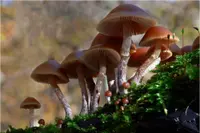

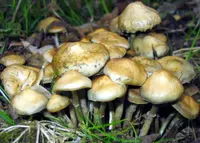
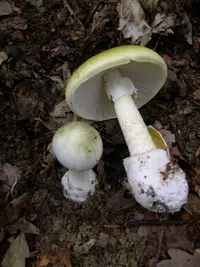
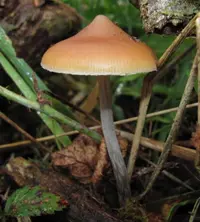
deadly galerina Identification (Galerina marginata)

Recognize Galerina marginata by its small brown cap, usually 1-3 inches (2.5-7.5 cm) across, attached to a slender stem with a distinct ring high on the stalk.

The gills are crowded and cinnamon-brown, and fruiting bodies often appear in tight clusters from decaying wood.

Galerina marginata Identification

Check Your Plant ID

Not sure about your plant ID? Upload a photo and check it with Botan.

Clear images work best. Avoid photos taken too close or too far away

Check the mushroom’s cap, gills, stem, and clustered growth.

  • Cap is small, usually 1-4 inches (3-10 cm) wide, convex to flat, often with a slight central bump.
  • Cap surface is smooth and moist-looking, honey-brown to yellow-brown, often darker toward the center.
  • Gills are close together and attached to the stem, becoming rusty brown as spores mature.
  • Stem is slender and pale to brownish, often with a faint ring zone near the upper part.
  • Galerina marginata often appears in tight groups, with several stems rising close together.

Check all features together before relying on a visual ID.

Deadly galerina shows clear visual shifts as caps expand and veil remnants disappear.

  • Young plant: Very young mushrooms are buttonlike, with a convex cap and the partial veil still covering the gills or hanging at the cap edge.
  • Mature plant: As it expands, the cap becomes broadly convex to nearly flat, often 1-4 inches (2.5-10 cm) across, with a thinner, more even outline.
  • Fruiting stage: Fully developed fruiting bodies show exposed rusty-brown gills and a stem ring zone; the cap surface often dries paler than in younger specimens.

Deadly galerina is most often noticed from fall into mild winter, when fresh honey-brown caps and a ring on the stem are visible on decaying wood. In drier or colder periods, fruiting bodies may be absent or reduced to older, darker, collapsed mushrooms, so the species can be much less obvious.

Several small brown wood-growing mushrooms can be mistaken for Galerina marginata.

funeral bell(Gymnopilus junonius)

Both grow on wood and can be orange-brown. Gymnopilus junonius is usually much larger, often with caps 2-5 inches (5-13 cm) wide, and often grows in dense clusters. Its gills and stem are stouter.

sheathed woodtuft(Kuehneromyces mutabilis)

This also fruits in tight clusters on wood and has a brown cap with a ring on the stem. Kuehneromyces mutabilis usually shows a two-toned stem: pale above the ring and darker, scaly below. Deadly galerina is more evenly colored and less distinctly scaly.

Galerina marginata occurs across temperate regions of North America, Europe, and Asia. It is widely reported from conifer and mixed forests, and also from landscaped wood-chip beds. Habitat is a strong clue for identification because this species grows on decaying wood, buried roots, stumps, and woody debris, often in small groups. Finding it on wood helps separate it from many brown mushrooms that fruit from soil or grass.

  • Highly poisonous mushroom: The fruiting body is toxic if eaten by humans or pets. It contains amatoxins, which can cause severe liver poisoning.
  • Dangerous confusion with edible wood-growers: Misidentification is a serious ingestion risk. Galerina marginata can resemble honey mushrooms, but it usually has a rusty-brown spore print rather than a white one.

Does Your Plant Match?

Use Botan to compare a photo and help confirm the identification before you label or log it.

FAQ

The closest look-alikes are small brown wood-growing mushrooms, especially Kuehneromyces mutabilis and some Pholiota and Psathyrella species. Distinguishing features include a rusty-brown spore print, a thin ring, and growth on decaying wood.

More Plant Identification Guides

Identify First. Learn What Comes Next.

Use Botan to identify a plant from a photo, then get species-specific plant details, safety notes, and common problems.

Botan app identifying a plant from a photo
10 Easy Garden Flowers to Grow

8 min read · 10 Sept 2026

10 Easy Garden Flowers to Grow

Discover 10 garden flowers that require minimal care. Learn which characteristics make plants easy to grow and follow tips on how to create a beautiful corner from beginner-friendly blooms on your property.

Beginner Guides
10 Easy Garden Flowers to Grow
Planting Grass Seed in Summer – What Works and What Fails

7 min read · 6 Aug 2026

Planting Grass Seed in Summer – What Works and What Fails

Summer seeding succeeds when the grass type suits the season, and the soil stays moist. Find out how to prepare the seedbed and choose a safe window for planting.

Plant Care
Planting Grass Seed in Summer – What Works and What Fails
Best Time to Water Grass in Summer – Lawn Watering Tips

5 min read · 21 Jul 2026

Best Time to Water Grass in Summer – Lawn Watering Tips

Summer watering is easy to get wrong. This guide explains when to turn on your sprinkler, how much liquid your grass needs each week, and how to tell if you're overwatering or underwatering.

Plant Care
Best Time to Water Grass in Summer – Lawn Watering Tips