




lacquered bracket Identification (Ganoderma lucidum)

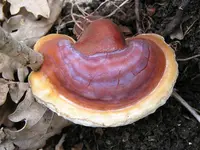
To recognize Ganoderma lucidum, look for a kidney- or fan-shaped bracket with a hard, shiny red-brown cap and a pale margin.

It usually grows on a short lateral stem, often in small clusters, and has a white pore surface underneath instead of gills.

Ganoderma lucidum Identification

Is This lacquered bracket?

Upload a plant photo and check the identification in seconds.

Clear images work best. Avoid photos taken too close or too far away

Check the fruiting body shape, attachment point, and pore surface first.

  • Shelf-like brackets grow from wood, usually singly or in small overlapping groups.
  • Caps are fan-shaped to kidney-shaped, often 2-10 inches (5-25 cm) across.
  • The upper surface looks varnished or lacquered, with reddish-brown zones and a pale edge.
  • Undersides are white to cream and finely pored, not gilled.
  • A short side stem may be present, dark and glossy, attaching the bracket off-center.

Look at several brackets if present, since size and stem development can vary.

Ganoderma lucidum shows clear visual changes as the fruiting body expands and ages.

  • Young plant: At first, the fruiting body appears as a small, pale knob or antler-like outgrowth, soft-looking and without the broad shelf shape seen later.
  • Mature plant: It expands into a fan- or kidney-shaped bracket, often 2-10 inches (5-25 cm) across, with a shiny reddish-brown cap and a distinct lateral stem.
  • Fruiting stage: The underside develops a white to cream pore surface instead of gills, while the margin stays lighter and actively growing compared with the darker cap center.

Fresh fruiting bodies usually appear from summer into fall. Young caps are soft, with a white growing edge and a varnished red to reddish-brown surface that becomes one of the clearest field marks for Ganoderma lucidum. As the fruiting body matures, the white margin narrows or disappears, and the bracket becomes harder and duller. Old brackets may persist for a time, but they often look weathered and less distinctly lacquered.

A few varnished Ganoderma brackets can be mistaken for Ganoderma lucidum.

artist’s conk(Ganoderma applanatum)

Both grow as shelf-like brackets on wood. Artist’s conk has a dull brown upper surface, not a shiny red to reddish-brown cap, and its underside bruises dark brown when scratched.

southern bracket(Ganoderma curtisii)

This species can show a similarly varnished reddish cap. It is usually thicker and broader, often with a yellow margin, while lacquered bracket more often has a distinct stalk and a kidney-shaped cap.

Ganoderma lucidum is native to parts of Europe and Asia, though the name has often been applied too broadly in older sources. In the wild, it occurs on hardwood logs, stumps, and the bases of broadleaf trees in temperate woodlands. Habitat is useful for identification because a shiny, varnished bracket on hardwood in a forest setting fits G. lucidum more closely than similar Ganoderma found on conifers or in different regions. Range alone is not enough to confirm it.

  • Serious mushroom mix-up risk: Ganoderma lucidum is a varnished bracket mushroom. Safety matters because mushrooms are often misidentified. Do not rely on a shiny cap alone.
  • Key look-alike check: Confusion with other bracket fungi can happen. Gilled mushrooms are not Ganoderma lucidum; this species has pores on the underside, not gills. The main concern is accidental ingestion by humans or pets after a wrong identification.

Confirm It from a Photo

Use Botan to identify or verify it from an image, helping avoid mix-ups with similar species before you label it.

FAQ

The most reliable feature is the hard, varnished cap surface. It looks shiny reddish to mahogany, often with a pale growing margin, and has a pore surface underneath instead of gills. That is central to Ganoderma lucidum identification.

More Plant Identification Guides

Find the Plant. Get the Details.

Identify it from a photo with Botan, then review plant details, care information, and common problems for that species.

Botan app identifying a plant from a photo
How Fast Does Bamboo Grow Per Day, Month, and Year

10 min read · 7 Jul 2026

How Fast Does Bamboo Grow Per Day, Month, and Year

Bamboo grows extremely fast: some species can reach 5-6 m in just 3-4 months under the right conditions. This guide explains how much bamboo can grow per day, week, and year, and what affects its growth rate.

Plant Recommendations
How Fast Does Bamboo Grow Per Day, Month, and Year
20 Most Popular Fruits Around the World

7 min read · 22 Jul 2026

20 Most Popular Fruits Around the World

Curious which fruits the world actually eats the most? Here's the top-20 by production volume, an overview of what people choose in each region, and a few figures that defy common assumptions.

Plant Recommendations
20 Most Popular Fruits Around the World
13 Best Front Yard Trees for Every Home and Yard

12 min read · 7 Aug 2026

13 Best Front Yard Trees for Every Home and Yard

A front yard tree can stay for decades. Therefore, choosing one deserves serious consideration. Here are 13 trees that have proven themselves, sorted by their purpose. You'll also find five species to avoid and basic planting information.

Plant Recommendations
13 Best Front Yard Trees for Every Home and Yard