


hawthorn Identification (Crataegus monogyna)

Recognize Crataegus monogyna by its small, deeply lobed leaves arranged alternately on thorny twigs, and by its dense, rounded branching habit as a shrub or small tree.

The flowers are typically white with five petals, and each leaf usually shows 3 to 7 narrow lobes cut close to the midrib.

Crataegus monogyna Identification

Check Your Plant with Botan

Not sure about your plant ID? Upload a photo and check it with Botan.

Clear images work best. Avoid photos taken too close or too far away

Use these quick visual checks for Crataegus monogyna.

  • Leaves are small, about 1-2.5 inches (2.5-6 cm) long, and deeply cut into 3-7 narrow lobes.
  • Twigs usually carry straight, sharp spines that project from the sides of the branch.
  • Flowers are white, flat-faced, and typically have 5 petals, grouped in small branched clusters.
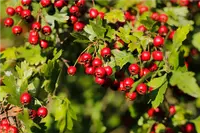
  • Fruits are small red pomes, roughly 1/4 inch (6-10 mm) across, hanging singly or in loose clusters.
  • The plant often forms a dense, much-branched crown as a large shrub or small tree.

Check several branches, since leaf lobing and spine density can vary across the plant.

Crataegus monogyna shows clear visual changes from thorny sapling to flowering, fruiting tree.

  • Young plant: Young plants are dense and twiggy, with longer, sharper thorns and relatively small, deeply lobed leaves spaced along slender stems.
  • Mature plant: Mature plants form a rounded small tree or large shrub, often 15-30 feet (4.5-9 m) tall, with a thicker trunk and broader crown.
  • Flowering stage: Flowering branches carry flat clusters of white five-petaled blossoms, making the crown look lighter and more layered than nonflowering shoots.
  • Fruiting stage: After flowering, the same clusters become hanging groups of red haws, each usually containing one seed, adding obvious dots of color.

Several named forms of hawthorn can be separated in the field by flower structure, habit, or leaf pattern.

  • Crataegus monogyna 'Stricta': Narrowly fastigiate, with strongly upright branches that make a columnar crown instead of the typical broad, rounded one.
  • Crataegus monogyna 'Pendula': Branches hang downward, forming a distinctly weeping canopy rather than an erect or spreading crown.
  • Crataegus monogyna 'Rosea Flore Pleno': Flowers are double and pink, replacing the typical single white blossoms and giving a fuller flower head.
  • Crataegus monogyna 'Variegata': Leaves show irregular cream-white variegation, unlike the plain green foliage of the usual form.

In spring, Crataegus monogyna leafs out with small, deeply lobed leaves, followed in late spring by clusters of white flowers that can make the crown look lightly frosted. By late summer to fall, bright red haws become easy to spot. After leaf drop, the dense, thorny branching and gray-brown bark are more visible, which helps with winter identification.

Several shrubs and small trees are regularly mistaken for hawthorn.

midland hawthorn(Crataegus laevigata)

Often confused because both have white spring flower clusters, red fruits, and thorny twigs. Midland hawthorn usually has shallower leaf lobes, often 3-5, while Crataegus monogyna has more deeply cut lobes. Flowers usually have 2-3 styles, not 1.

common blackthorn(Prunus spinosa)

Confusion happens in leafless bloom or from its thorny, twiggy habit. Blackthorn flowers open before the leaves and its leaves are simple, oval, and unlobed. Crataegus monogyna has lobed leaves and flowers with the young foliage.

Crataegus monogyna is native across most of Europe, northwest Africa, and western Asia. In North America it is widely introduced, so range alone does not confirm identity. Habitat is still useful. It commonly appears in hedgerows, woodland edges, scrub, old fields, and chalk or limestone slopes. Finding it in sunny, thorny field margins or mixed hedges helps separate it from less common hawthorns tied to wetter ground or narrower regions.

  • Sharp spines: Stems carry hard thorns that can puncture skin in humans and pets on contact. This is the main routine hazard when handling, pruning, or moving branches.
  • Fruit and seed caution: The red fruit is commonly called a haw, but the seeds should not be eaten by humans or pets. The concern is ingestion of the seed, not normal skin contact.

Confirm the Species with Botan

Upload a photo to help identify the plant or verify your ID before you label it or compare similar species.

FAQ

Look for a thorny small tree or hedge shrub with deeply lobed leaves, clusters of white five-petaled flowers, and red fruits called haws. A key clue is the fruit usually contains one seed, reflected in the name monogyna.

More Plant Identification Guides

Identify First. Learn What Comes Next.

Use Botan to identify a plant from a photo, then view species-specific care information, safety notes, and common problems.

Botan app identifying a plant from a photo
20 Most Popular Fruits Around the World

7 min read · 22 Jul 2026

20 Most Popular Fruits Around the World

Curious which fruits the world actually eats the most? Here's the top-20 by production volume, an overview of what people choose in each region, and a few figures that defy common assumptions.

Plant Recommendations
20 Most Popular Fruits Around the World
12 Best Plants That Repel Spiders For Your Home and Garden

8 min read · 24 Jul 2026

12 Best Plants That Repel Spiders For Your Home and Garden

Spiders constantly appear in places you don't want them. A few common plants can help repel them using scent alone. Here are 12 options suitable for both indoors and outdoors, plus care tips for each.

Plant Recommendations
12 Best Plants That Repel Spiders For Your Home and Garden
Is Sugar Water Good for Plants?

4 min read · 14 Sept 2026

Is Sugar Water Good for Plants?

Sugar water may sound like an easy boost, but most rooted plants do not need extra sucrose. This guide explains how green tissues produce carbohydrates, when a sweetened solution can be useful, and why too much can cause problems.

Plant Care
Is Sugar Water Good for Plants?