
belted panaeolus Identification (Panaeolus cinctulus)

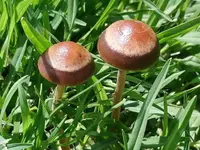
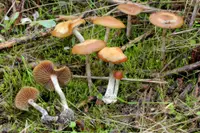
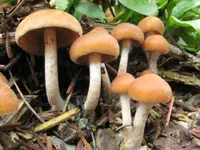
Recognize Panaeolus cinctulus by its small, broad bell-shaped to flat cap, usually 1-2 inches (2.5-5 cm) across, often with a darker band near the edge, plus crowded, dark mottled gills.

The stem is slender, pale, and ringless, usually 2-6 inches (5-15 cm) tall.

Panaeolus cinctulus Identification

Identify Your Plant with Botan

Check your plant ID by uploading a clear photo to Botan.

Clear images work best. Avoid photos taken too close or too far away

Check the cap, gills, and stem together for a quick read on Panaeolus cinctulus.

  • Cap small, about 1-2 inches (2.5-5 cm) across, bell-shaped to broadly convex with a low central bump.
  • Cap often shows a darker brown band around the margin, with a smoother, paler center.
  • Gills are crowded and mottled dark gray to black rather than evenly colored.
  • Stem is slender, pale, and usually ringless, often about 2-6 inches (5-15 cm) tall.

A dark spore print can support the visual check.

Panaeolus cinctulus shows useful visual changes as the fruiting body expands and ages.

  • Young plant: Very young mushrooms begin as small rounded caps on slender stems, with the margin still tucked inward and the gills not yet fully exposed.
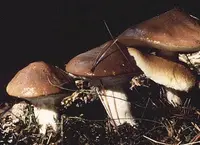
  • Mature plant: As the fruiting body expands, the cap flattens to broadly bell-shaped, often 1-3 inches (2.5-7.5 cm) wide, and the stem appears relatively longer and straighter.
  • Fruiting stage: At full spore maturity, gills darken to mottled blackish brown, and the cap margin often shows a darker band that is less obvious earlier.

Panaeolus cinctulus is most often noticed in warm, wet periods from spring through fall, when fresh fruiting bodies appear in lawns, compost, and manured ground. The cap can look darker when moist and paler as it dries, often making the darker belt near the margin easier to notice on aging mushrooms.

Several lawn and dung mushrooms can be mistaken for belted panaeolus.

Mower's mushroom(Panaeolina foenisecii)

Similar size and brown cap make confusion common. It usually has a duller cap without the distinct dark band at the margin when moist, and the gills become dark brown rather than blackish mottled.

Band mottlegill(Panaeolus fimicola)

This species shares a small brown, moisture-sensitive cap and dark mottled gills. It is usually darker overall and lacks the clearer chestnut cap with a pale drying center often seen in Panaeolus cinctulus.

Panaeolus cinctulus is widely reported from temperate regions and is now broadly distributed in North America, Europe, and other parts of the world. Its exact native range is unclear, so habitat is more useful than origin for identification. It typically appears in nutrient-rich grassland settings, especially lawns, pastures, compost-amended ground, and dung-enriched areas. Finding it in open, disturbed grassy places, rather than woodland or deep leaf litter, helps narrow it from many small brown mushrooms that favor forests.

  • Psychoactive compounds: The fruiting body contains psilocybin and related compounds. Ingestion can cause intoxication in humans; pets may also be affected if eaten.
  • High misidentification risk: This small lawn and dung mushroom can be confused with dangerous brown mushrooms, including Galerina marginata. A key visible difference is a dark brown to black spore print in Panaeolus cinctulus, versus a rusty brown spore print in Galerina marginata.

Check Your Plant ID

Use Botan to identify or confirm it from a photo when you want a quicker second opinion before labeling it.

FAQ

Yes. This species is commonly found in richly manured lawns, compost, garden mulch, and pasture edges rather than on wood. Habitat helps narrow belted panaeolus identification, but cap, gills, and spore print still matter.

More Plant Identification Guides

Find the Plant. Get the Details.

Identify it from a photo with Botan, then review plant details, care information, and common problems for that species.

Botan app identifying a plant from a photo
Plants That Repel Mosquitoes – 10 Effective Choices

8 min read · 6 Jul 2026

Plants That Repel Mosquitoes – 10 Effective Choices

Plants that repel mosquitoes can help mask human scent naturally and make outdoor spaces more comfortable. Explore the most effective options, their benefits and drawbacks, and choose the right plant for your space.

Plant Recommendations

Plants That Repel Mosquitoes – 10 Effective Choices
How Fast Does Bamboo Grow Per Day, Month, and Year

10 min read · 7 Jul 2026

How Fast Does Bamboo Grow Per Day, Month, and Year

Bamboo grows extremely fast: some species can reach 5-6 m in just 3-4 months under the right conditions. This guide explains how much bamboo can grow per day, week, and year, and what affects its growth rate.

Plant Recommendations
How Fast Does Bamboo Grow Per Day, Month, and Year
How to Increase Humidity for Plants – 8 Simple Ways That Work

8 min read · 14 Aug 2026

How to Increase Humidity for Plants – 8 Simple Ways That Work

Dry indoor air stresses a lot of houseplants. You usually notice it first in the browning leaf tips. This guide describes 8 simple ways to raise the moisture around your plants, from humidifiers to pebble trays.

Plant Care
How to Increase Humidity for Plants – 8 Simple Ways That Work