
death cap Identification (Amanita phalloides)

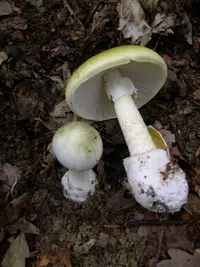
To recognize death cap, look first for a smooth cap, usually 2 to 6 inches (5 to 15 cm) wide, a white stem with a skirt-like ring, and a distinct cup-like volva at the stem base.

The gills are white and free from the stem, meaning they do not attach directly to it.

Amanita phalloides Identification

Check Your Plant ID

Use a clear photo to confirm what plant you have.

Clear images work best. Avoid photos taken too close or too far away

Check the whole mushroom for a pale cap, free gills, and a cup at the base.

  • Cap is smooth and usually olive-green to yellow-green, often 2-6 inches (5-15 cm) wide, with a rounded to flat shape.
  • Gills are white, crowded, and free from the stalk rather than attached to it.
  • Stalk is white to pale, upright, and usually carries a skirt-like ring below the cap.
  • Base is bulbous and sits in a white, sac-like volva, a cup wrapped around the bottom of the stalk.

Check the base carefully, since the volva is one of the most useful visible clues.

Amanita phalloides shows clear visual changes as the fruiting body expands and matures.

  • Young plant: Very young mushrooms are enclosed in a white universal veil, forming an egg-like button partly buried in soil before the cap and stem separate.
  • Mature plant: As expansion begins, the cap becomes convex to broadly flat, often 2-6 inches (5-15 cm) wide, while the white stem elongates and the ring becomes obvious.
  • Fruiting stage: Fully developed fruiting bodies show free white gills under the cap, a persistent skirt-like ring, and a saclike volva cupping the stem base.

Amanita phalloides is most likely to be seen from late summer into fall, when fresh mushrooms emerge and the species becomes much easier to spot in the field. In this period, look for newly formed caps, white gills, a skirt-like ring on the stem, and the cup-like volva at the base. Outside the fruiting season, these visible clues are usually absent because the mushroom is not present above ground.

Several Amanita mushrooms can be mistaken for death cap.

destroying angel(Amanita bisporigera)

Similar white cap, ring, and cup-like volva. It is usually pure white, while death cap often has an olive to yellow-green cap.

false death cap(Amanita citrina)

Shares a pale cap, ring, and bulbous base. It usually has a lemon-yellow cap and a distinctly margined bulb, with a rim around the bulb.

Amanita subjunquillea

Can overlap in cap color and overall shape. Check the cap: this species is often more yellow, and identification usually depends on finer features, so field separation is less reliable.

Amanita phalloides is native to Europe and occurs naturally in broadleaf and mixed woodlands, especially with oaks, beeches, chestnuts, and other hardwoods. It fruits from soil, often near established trees rather than on wood. Habitat is a strong identification clue. In North America it is introduced, but it is still most often found in landscaped areas or woods with imported or planted oaks and other broadleaf hosts, which helps narrow look-alikes.

  • Severe poisoning risk: All parts of Amanita phalloides, including the cap, gills, stem, and bulbous base, are highly poisonous if eaten by humans or pets.
  • Misidentification hazard: This mushroom is often mistaken for edible puffballs or edible Amanita species. A key warning sign is white gills plus a cup-like volva at the stem base; puffballs lack gills.

Not Sure About the ID?

Use Botan to identify or verify it from a photo, helping you compare results quickly and avoid confusion with similar plants.

FAQ

Look for a smooth cap that is olive-green to yellowish or tan, white gills, a white stem with a skirtlike ring, and a saclike volva at the bulbous base. Those features guide identifying death cap.

More Plant Identification Guides

Identify Your Plant and Learn More

Upload a photo to Botan for identification, then review species-specific plant details, care information, and safety notes.

Botan app identifying a plant from a photo
How Fast Does Bamboo Grow Per Day, Month, and Year

10 min read · 7 Jul 2026

How Fast Does Bamboo Grow Per Day, Month, and Year

Bamboo grows extremely fast: some species can reach 5-6 m in just 3-4 months under the right conditions. This guide explains how much bamboo can grow per day, week, and year, and what affects its growth rate.

Plant Recommendations
How Fast Does Bamboo Grow Per Day, Month, and Year
Best Time to Mow Lawn – A Complete Guide

5 min read · 10 Aug 2026

Best Time to Mow Lawn – A Complete Guide

Explore when to mow your lawn for its health and a pleasant green color. Find out the best time for this task during the summer heat, and follow practical tips for correctly cutting the grass, and learn common mistakes to avoid.

Plant Care
Best Time to Mow Lawn – A Complete Guide
Dill Companion Plants – What to Grow Next to Dill

9 min read · 17 Jul 2026

Dill Companion Plants – What to Grow Next to Dill

Dill is an easy-to-grow plant that gets along well with many vegetables. This guide describes 15 plants that can be planted alongside it, a few to avoid, and mistakes that can quietly sabotage the entire process.

Plant Recommendations
Dill Companion Plants – What to Grow Next to Dill