
chaga Identification (Inonotus obliquus)

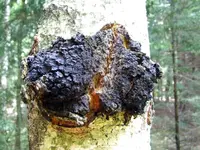
Recognize chaga by its hard, irregular sterile conk that projects from the trunk, usually on birch. It appears as a black, cracked, charcoal-like mass with a warm brown to orange interior visible in broken areas.

Most growths are several inches across and lack a cap, gills, or pores on the outside.

Inonotus obliquus Identification

Identify Your Plant with Botan

Take a photo and use Botan to confirm your plant identification.

Clear images work best. Avoid photos taken too close or too far away

Check the host trunk and the fungus body first.

  • Forms a hard, irregular, charcoal-black mass on the outside of the trunk, not a shelf or bracket.
  • Usually projects as a cracked, lumpy conk about 4-16 inches (10-40 cm) across.
  • The surface looks deeply fissured and burned, with no visible pores or gills.
  • Most often appears on birch trunks, attached directly to the bark as a sterile-looking growth.

A true fruiting layer is usually hidden until the host wood is dying or dead.

Visible age-related changes in Inonotus obliquus can help separate sterile and fertile forms.

  • Young plant: Early growth appears as a small, irregular black sterile mass on birch, with a cracked, charcoal-like surface and no organized pore layer.
  • Mature plant: The sterile conk enlarges into a harder, deeply fissured black mass, often 4-16 inches (10-40 cm) across, projecting unevenly from the trunk.
  • Fruiting stage: After the host weakens or dies, the fertile stage forms beneath bark as a thin brown to orange-brown crust with many tiny pores, unlike chaga's black exterior.

In winter, chaga is often easier to spot on bare birch trunks because the dark, cracked sterile mass stands out clearly once leaves are gone. Its charcoal-like surface and irregular, clumped shape remain visible year-round. A more seasonal clue appears when the fertile layer develops under bark, usually on dead or dying birch. It becomes visible after bark splits, exposing a rusty brown pore surface.

A few tree fungi and growths are regularly mistaken for chaga.

false tinder fungus(Phellinus igniarius)

Both form dark masses on hardwoods, especially birch. Phellinus igniarius usually makes a hoof-shaped shelf with a firmer, smoother crust. Chaga is more irregular, cracked, and charcoal-like, often without a clear shelf shape.

birch burl(Betula spp. burl)

Both appear as black, rough swellings on birch trunks. A burl is a woody growth with bark covering it and often stays rounded. Chaga is a fungal mass, brittle rather than woody, with a deeply cracked black exterior and rusty brown inside.

Inonotus obliquus occurs across cold-temperate to boreal parts of the Northern Hemisphere, including northern and eastern Europe, Russia, Korea, northern China, and parts of North America. It is most often found in birch forests, less often on other hardwoods, in cool woodlands rather than open sites. That setting helps with identification: a sterile black mass on a living birch in these regions is far more consistent with chaga than a similar growth on conifers or in dry, treeless habitats.

Identification matters because Inonotus obliquus is a wild mushroom, and serious errors with other fungi can affect humans through ingestion. Its hard, black sterile conk grows on living birch and lacks gills, pores, and a typical cap, which helps separate it from many dangerous mushrooms.

Does Your Plant Match?

Upload a photo to Botan to identify it or confirm the match before you spend more time researching.

FAQ

The key feature is the sterile conk: a hard, irregular mass with a black, charcoal-like cracked exterior and a rusty orange-brown interior. For how to identify chaga, this combination on living birch is the strongest clue.

More Plant Identification Guides

From Plant ID to Plant Info

Use a photo to identify it with Botan, then get plant details, care information, and common problems for that species.

Botan app identifying a plant from a photo
How Often to Water Fruit Trees

7 min read · 11 Aug 2026

How Often to Water Fruit Trees

Irrigation needs change as roots establish and weather shifts. This guide gives practical starting intervals, explains how soil and tree type change them, and shows how to recognize both excess moisture and drought stress.

Plant Care
How Often to Water Fruit Trees
How to Water Houseplants: Watering Guide

7 min read · 24 Aug 2026

How to Water Houseplants: Watering Guide

Learn how often to water indoor plants, key factors for proper watering, and how to adjust the care routine by plant type, season, pot size, light, and indoor conditions.

Plant Care
How to Water Houseplants: Watering Guide
How to Group Plants in Landscaping: A Practical Layout Guide

8 min read · 31 Aug 2026

How to Group Plants in Landscaping: A Practical Layout Guide

Good plant grouping can mean the difference between a well-planned garden and one that looks sloppy. This guide explores layers, spacing, cluster shapes, and the plants that thrive when you group them.

Plant Care
How to Group Plants in Landscaping: A Practical Layout Guide