
honey mushroom Identification (Armillaria ostoyae)

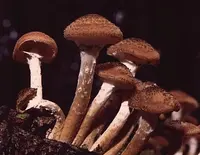
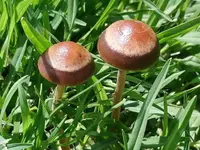
To recognize Armillaria ostoyae, look for dense clusters of mushrooms with honey-brown caps, pale gills attached to the stem, and a distinct white ring on the upper stem.

Caps are often 2-6 inches (5-15 cm) wide and usually show darker scales near the center, while stems are tough, fibrous, and commonly joined at the base.

Armillaria ostoyae Identification

Scan to Confirm honey mushroom

Check your plant ID by uploading a clear photo to Botan.

Clear images work best. Avoid photos taken too close or too far away

Check the mushroom cluster form and stem details first on Armillaria ostoyae.

  • Caps grow in tight clusters, usually with a rounded to broadly convex top.
  • Cap surfaces are honey-brown to darker brown with small, darker scales, strongest near the center.
  • A pale ring is visible on the upper stem, left from the partial veil.
  • Stems are often fibrous, somewhat tapered, and can reach about 4-8 inches (10-20 cm) tall.

A dense cluster with scaled brown caps and a clear stem ring is a useful visual combination.

Armillaria ostoyae shows useful visual changes mainly as its fruiting bodies expand and age.

  • Young plant: Early clusters begin as tight button-like caps emerging from wood or soil, with stems short and mostly hidden, so the grouped habit is clearer than cap shape.
  • Mature plant: As caps expand to about 2-6 inches (5-15 cm), stems elongate and separate visually, making the dense cluster, central stems, and broader cap outline easier to judge.
  • Fruiting stage: At full fruiting, caps are broadly convex to flatter, usually honey-brown with darker scales near the center, and pale gills are exposed beneath a distinct ring.

The clearest seasonal clue in Armillaria ostoyae is its fruiting period. Dense clusters of honey-brown mushrooms typically appear in fall, often at the base of trees, on roots, or from buried wood. Outside the fruiting season, those mushrooms are absent, so the species is much harder to recognize by sight alone. In affected sites, fall fruiting is the main visible seasonal change that aids identification.

Several clustered wood-rotting mushrooms can be mistaken for honey mushroom.

ringless honey mushroom(Desarmillaria tabescens)

Shares honey-brown caps and dense clusters on wood. Unlike Armillaria ostoyae, it lacks a stem ring, and caps are often more orange-brown and thinner-fleshed.

funeral bell(Galerina marginata)

Also fruits in brownish clusters on decaying wood. It is usually smaller, with a rusty-brown spore print; Armillaria has a white spore print and sturdier stems.

sheathed woodtuft(Kuehneromyces mutabilis)

Forms clustered brown caps on stumps. It usually has a strongly two-toned cap and a smoother stem below the ring, unlike the darker scaly stem of Armillaria ostoyae.

Armillaria ostoyae is native to temperate forests of Europe and North America. In western North America, it is especially noted from the Pacific Northwest into the Rocky Mountains. Habitat helps with identification because this species is tied to conifer woods and mixed mountain forests, often fruiting at the base of trees, on buried roots, or from stumps rather than in open grassland or wetlands.

  • Serious misidentification risk: Armillaria ostoyae is a mushroom, so wrong identification can be hazardous to humans and pets if eaten. It can be confused with deadly Galerina marginata, which is smaller and usually lacks the distinct ring on the stem seen on many Armillaria.
  • Ingestion concerns: Reports of edibility in honey mushrooms are inconsistent by species and person, so ingestion is the main safety concern for humans and pets. Identification should not be used as a basis for deciding that a wild mushroom is safe to eat.

Not Sure About the ID?

Use Botan to compare a photo and help confirm the plant, so you can move forward with more confidence.

FAQ

Young caps are more rounded, then flatten with age. The partial veil often leaves a ring on the stem. Older specimens usually darken toward the center and may lose fine cap scales, which affects honey mushroom identification.

Everything About honey mushroom

More Plant Identification Guides

Identify It. Learn More About It.

Upload a photo with Botan to identify the plant, then get species-specific care information, safety notes, and common problems.

Botan app identifying a plant from a photo
Best Fertilizer for Grass in Summer: How to Choose the Right One

6 min read · 18 Aug 2026

Best Fertilizer for Grass in Summer: How to Choose the Right One

The right fertilizer in summer can make a lawn thrive. The wrong one can damage it. Here, you’ll learn the best NPK ratios by grass type, when and how to apply your formula, and how to recognize the signs of over- or under-fertilizing.

Plant Care
Best Fertilizer for Grass in Summer: How to Choose the Right One
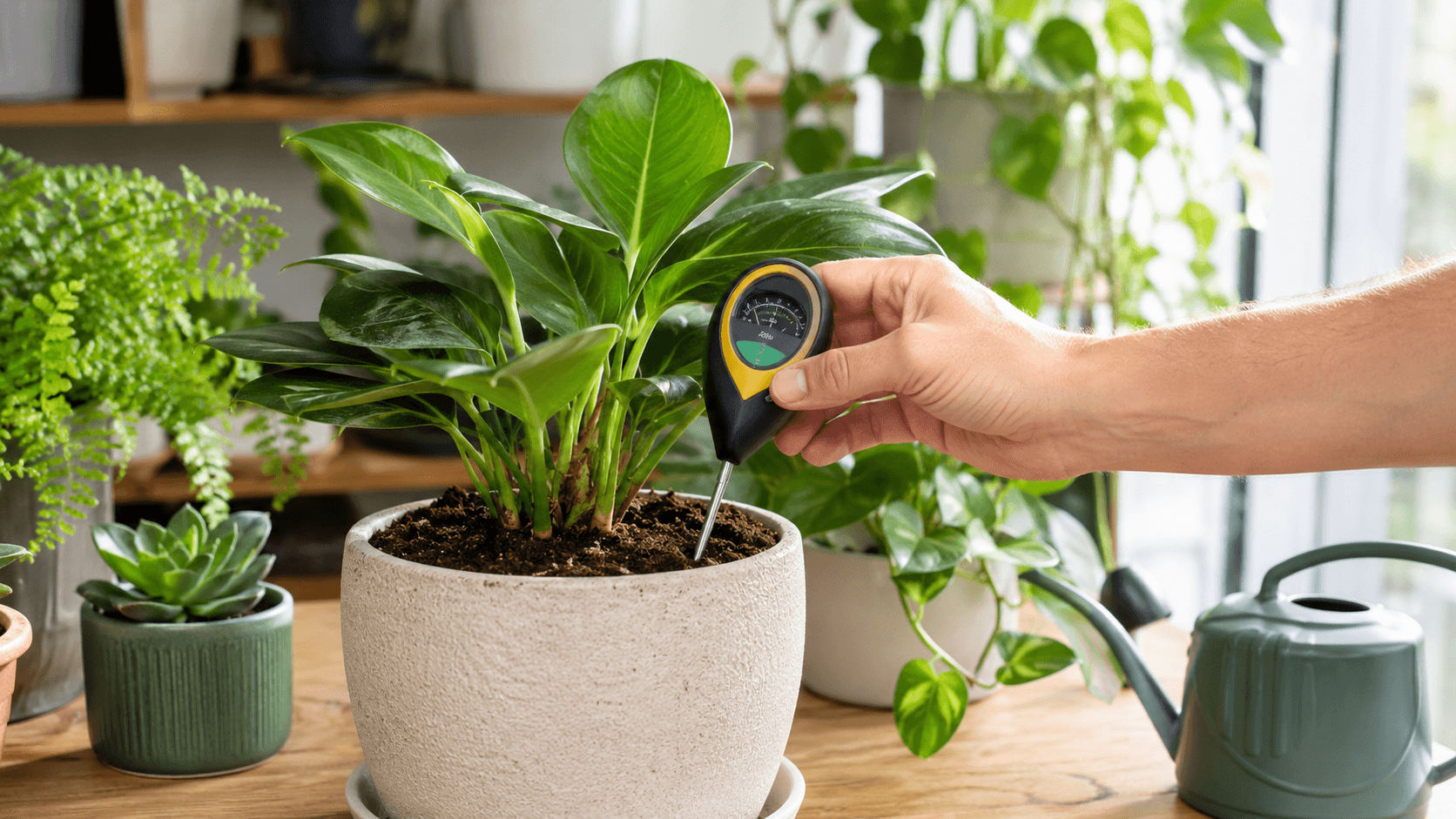
How to Use a Moisture Meter for Plants

5 min read · 4 Sept 2026

How to Use a Moisture Meter for Plants

Watering by feel kills plenty of houseplants. A moisture meter checks the soil for you, and takes the guesswork out of it. This guide will show you how to use it correctly, from the first touch to the final reading.

Beginner Guides
How to Use a Moisture Meter for Plants
Planting Grass Seed in Summer – What Works and What Fails

7 min read · 6 Aug 2026

Planting Grass Seed in Summer – What Works and What Fails

Summer seeding succeeds when the grass type suits the season, and the soil stays moist. Find out how to prepare the seedbed and choose a safe window for planting.

Plant Care
Planting Grass Seed in Summer – What Works and What Fails