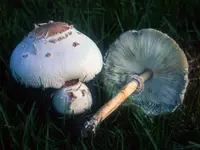

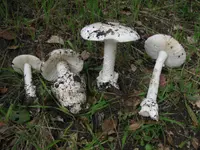
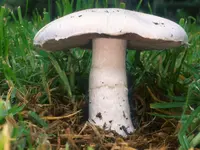
false parasol Identification (Chlorophyllum molybdites)

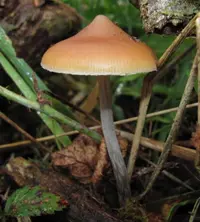
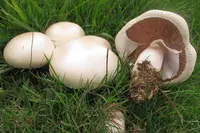
To recognize false parasol, look for a large white cap, often 4 to 12 inches (10 to 30 cm) across, covered with brownish scales and carried on a stout central stem with a distinct ring.

The gills are crowded and free from the stem, and mature specimens develop a green spore print.

Chlorophyllum molybdites Identification

Check Your Plant with Botan

Take or upload a photo to confirm your plant ID with Botan.

Clear images work best. Avoid photos taken too close or too far away

Check the mushroom’s cap, gills, stem, and ring at a glance.

  • Cap broad and round, often 4-12 inches (10-30 cm) across, white to tan with brownish scales concentrated toward the center.
  • Gills are crowded and free from the stem, with a greenish cast in mature false parasol specimens.
  • Stem tall and pale, usually with a swollen base and a thick, movable ring high on the stem.
  • Often appears in loose groups or rings, with caps held above the ground on long stems.

A greenish gill color and a large scaly cap are especially useful visual clues.

Chlorophyllum molybdites shows clear visual shifts from button stage to spore-releasing mature mushroom.

  • Young plant: The earliest visible stage is a rounded button, with the cap still closed over crowded white gills and a thick, short stem.
  • Mature plant: As it expands, the cap opens to a broad umbrella, often 4-12 inches (10-30 cm) wide, with a darker central disc and scaly surface.
  • Fruiting stage: At full maturity, the gills change from white to greenish as spores develop, and the ring remains visible around the upper stem.

Most identification clues appear in warm months. Chlorophyllum molybdites typically fruits from late spring through fall, often after rain, appearing suddenly in lawns as single mushrooms or loose groups. The cap expands from egg-shaped to broadly open, and mature gills turn greenish as spores develop. In colder periods, the fruiting bodies disappear, so the species is usually not visible then.

Several lawn mushrooms can be mistaken for Chlorophyllum molybdites.

shaggy parasol(Chlorophyllum rhacodes group)

Both are large, white to tan, scaly lawn mushrooms with a ring on the stalk. Shaggy parasol usually bruises orange to reddish where cut, while false parasol does not. Mature gills stay white to cream, not greenish.

parasol mushroom(Macrolepiota procera)

It shares a tall stalk, broad cap, and brownish scales. Parasol mushroom has a distinct snakeskin-like pattern on the stalk and a usually darker central cap bump. Its gills remain white as it ages.

Chlorophyllum molybdites is widely reported from subtropical to tropical regions and is now common across much of the southern United States. Exact native range is not settled, so habitat is often more useful than origin. It typically appears in lawns, pastures, parks, and other grassy, disturbed ground, often after warm-season rains. Finding it in open turf, rather than deep woods or on wood, helps narrow the identification.

  • Poisonous if eaten: The fruiting body is poisonous to humans and pets if ingested. It is a common cause of severe gastrointestinal poisoning, especially when mistaken for an edible lawn mushroom.
  • High misidentification risk: This mushroom is often confused with parasol-type edible mushrooms. A key visible clue is its greenish spore print, unlike the white spore print of true parasols.

Not Sure About the ID?

Upload a photo to Botan to identify the plant or confirm your find before you rely on a name.

FAQ

The most reliable field mark is the mature spore print, which turns dull green to grayish green. In false parasol identification, that color separates it from many similar white-spored lawn mushrooms.

More Plant Identification Guides

Identify It. Learn More About It.

Use Botan to identify a plant from a photo, then get species-specific plant details, care information, and safety notes.

Botan app identifying a plant from a photo
Plant Pot Sizes: How to Choose the Right Plant Container

7 min read · 20 Aug 2026

Plant Pot Sizes: How to Choose the Right Plant Container

Plant pot sizes can be confusing because the number on the label only tells you part of the required information. A container may look spacious but actually be too shallow. So, how to choose pot size for plant species?

Beginner Guides
Plant Pot Sizes: How to Choose the Right Plant Container
How Often to Water Fruit Trees

7 min read · 11 Aug 2026

How Often to Water Fruit Trees

Irrigation needs change as roots establish and weather shifts. This guide gives practical starting intervals, explains how soil and tree type change them, and shows how to recognize both excess moisture and drought stress.

Plant Care
How Often to Water Fruit Trees
Dill Companion Plants – What to Grow Next to Dill

9 min read · 17 Jul 2026

Dill Companion Plants – What to Grow Next to Dill

Dill is an easy-to-grow plant that gets along well with many vegetables. This guide describes 15 plants that can be planted alongside it, a few to avoid, and mistakes that can quietly sabotage the entire process.

Plant Recommendations
Dill Companion Plants – What to Grow Next to Dill