Honey Fungus Identification (Armillaria mellea)

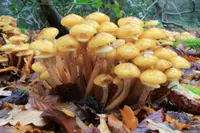
Recognize Honey Fungus by its dense clusters of honey-yellow to brown caps, each usually 2 to 6 inches (5 to 15 cm) wide, with white gills attached below and a distinct white ring on the upper stem.

Stems are slender and often fused at the base, creating tight tufted growth from one point.

Armillaria mellea Identification

Check Your Plant ID

Take or upload a photo to confirm your plant ID with Botan.

Clear images work best. Avoid photos taken too close or too far away

Check the mushroom cluster, cap, gills, stem, and ring by eye.

  • Mushrooms grow in dense clusters, with many stems arising from one point or crowded together.
  • Caps are honey-yellow to tan, often slightly darker in the center, and usually 2-6 inches (5-15 cm) across.
  • Gills are pale to whitish and run down the stem a little rather than ending cleanly at the top.
  • Stems are slender and fibrous, often thicker toward the base, with a noticeable white ring near the upper part.

A dark, root-like network at the base can support the ID if visible.

Armillaria mellea shows useful visual differences between its active mushroom and later fruiting stages.

  • Young plant: Young mushrooms begin as tight button-like caps with the margin rolled inward. The stem is stout, pale, and the ring may still be partly covered.
  • Mature plant: As they expand, caps flatten to broadly convex, often 2-6 inches (5-15 cm) across, with honey-yellow to brown surfaces and darker scales toward the center.
  • Fruiting stage: Older fruiting bodies often appear in dense clusters from wood or roots. Gills turn more evident beneath the cap, and stems elongate above a persistent ring.

In fall, Armillaria mellea often becomes easiest to spot when dense clusters of honey-colored mushrooms appear at the base of trees or from buried roots. Caps are usually most visible from late summer into fall. At the same time, black, shoestring-like rhizomorphs may be visible under loose bark or in nearby soil, adding a useful seasonal clue.

Several clustered woodland mushrooms can be mistaken for Honey Fungus.

sheathed woodtuft(Kuehneromyces mutabilis)

Both grow in dense clusters on wood and can be honey-brown. Sheathed woodtuft usually has a smooth stem with a clear ring zone and a darker, two-toned cap; Armillaria mellea typically shows small dark scales on the cap and a sturdier ring.

deadly galerina(Galerina marginata)

It also forms brownish clusters on decaying wood. The fastest check is the stem and cap texture: deadly galerina is usually smaller, more delicate, and lacks the coarse cap scales typical of Armillaria mellea.

Armillaria mellea is native across much of Europe and occurs in temperate woodlands, orchards, and other tree-covered areas. Geography alone is not enough, but a woodland setting is a useful clue. It typically fruits at the base of living or dead hardwoods, on roots, stumps, and buried wood. Finding dense clusters attached to wood, rather than scattered in open grassland, helps narrow the identification.

  • Ingestion risk: Armillaria mellea fruiting bodies can cause gastrointestinal upset in humans after ingestion, even though this mushroom is sometimes collected as food. The concern is the mushroom fruit body.
  • Dangerous misidentification: Wrong identification is a serious risk. Armillaria mellea has white spores and a ring on the stem; deadly Galerina marginata can look similar but usually has rusty-brown spores.

Does Your Plant Match?

Use Botan to compare a photo and help confirm the identification before spending more time on the wrong species.

FAQ

Look for dense clusters on wood or at tree bases, honey-yellow to brown caps with darker scales, white gills, and a white spore print. A persistent ring on the upper stem is a key part of identifying Honey Fungus.

More Plant Identification Guides

Identify Your Plant with Botan

Upload a photo to identify it, then get plant details, care information, and common problems for that species.

Botan app identifying a plant from a photo
Best Water for Plants – How to Choose the Right Type

7 min read · 13 Aug 2026

Best Water for Plants – How to Choose the Right Type

Rainwater, filtered, distilled, and tap water affect plants differently. Learn which types support healthy growth and which cause slow damage. Match each to your plants and discover how to easily improve tap water quality.

Plant Care
Best Water for Plants – How to Choose the Right Type
Best Fertilizer for Grass in Summer: How to Choose the Right One

6 min read · 18 Aug 2026

Best Fertilizer for Grass in Summer: How to Choose the Right One

The right fertilizer in summer can make a lawn thrive. The wrong one can damage it. Here, you’ll learn the best NPK ratios by grass type, when and how to apply your formula, and how to recognize the signs of over- or under-fertilizing.

Plant Care
Best Fertilizer for Grass in Summer: How to Choose the Right One
20 Most Popular Fruits Around the World

7 min read · 22 Jul 2026

20 Most Popular Fruits Around the World

Curious which fruits the world actually eats the most? Here's the top-20 by production volume, an overview of what people choose in each region, and a few figures that defy common assumptions.

Plant Recommendations
20 Most Popular Fruits Around the World