
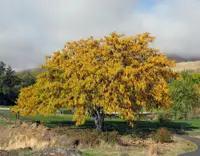

post oak Identification (Quercus stellata)

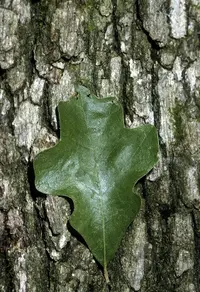
Recognize post oak by its leaves with five rounded lobes, usually forming a broad cross shape with a narrow middle and wide squared end lobes. Leaves are alternate on the twig.

Also check the thick, blocky bark on mature trunks and the stout, often crooked branches that give the crown a rugged structure.

Quercus stellata Identification

Is This post oak?

Check your plant ID by uploading a clear photo to Botan.

Clear images work best. Avoid photos taken too close or too far away

Use a few visible traits to check for Quercus stellata.

  • Leaves are simple and alternate, usually 4-8 inches (10-20 cm) long.
  • Most leaves have five broad, squared lobes, with the middle pair set nearly at right angles.
  • The blade often looks cross-shaped, with a wide, blunt tip and a narrowed middle.
  • Twigs are stout and gray-brown, and the bark is pale gray to brown with blocky ridges.
  • Acorns are oval to rounded, about 1/2-1 inch (1.3-2.5 cm) long, with a hairy cup covering about one-third to one-half.

Check several leaves on the same branch, since lobe depth can vary.

Post oak shows useful visual differences from sapling stages through acorn-bearing maturity.

  • Seedling: First leaves are small and alternate, with a simpler outline than later foliage; the stem is slender and upright, with few side branches.
  • Young plant: Leaves begin showing the species’ broad, squared middle lobes and narrower base, while branching increases and the crown stays narrow and upright.
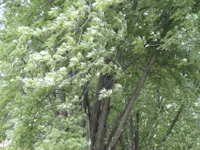
  • Mature plant: The crown becomes broad and irregular on a stout trunk, often 30 to 50 feet (9 to 15 m) tall, with thick limbs and blocky bark plates.
  • Fruiting stage: Acorns become visible singly or in pairs, oval to rounded, about 1/2 to 1 inch (1.3 to 2.5 cm) long, with a shallow cup.

In spring, new leaves emerge pale green and softly hairy, then expand into the species’ distinctive cross-shaped outline. At the same time, dangling male catkins become visible, with female flowers much less noticeable. By fall, leaves often turn yellow-brown to rusty brown before dropping. Through fall and into winter, the stout twigs, rounded buds, blocky bark, and acorns help identify Quercus stellata after the canopy thins or goes bare.

Several oaks can be mistaken for Quercus stellata at a glance.

blackjack oak(Quercus marilandica)

Often confused because both have broad, cross-like leaves. Blackjack oak usually has a more bell-shaped leaf with 3 broad terminal lobes and a much narrower base; post oak more often shows 5 lobes with a squarer middle pair.

white oak(Quercus alba)

Young trees can resemble it because both are in the white oak group. White oak leaves usually have 7 to 9 rounded lobes and much deeper sinuses; post oak has fewer, chunkier lobes and a distinctly cross-shaped outline.

Quercus stellata is native to the eastern and central United States, from southern New England west to Kansas and Oklahoma, and south to Florida and Texas. It is most often found in dry upland woods, open oak-pine woodland, sandy ridges, and rocky slopes, often on poor, well-drained soils. Seeing it in these drier inland habitats helps separate it from bottomland oaks and other species tied to wetter sites.

  • Acorns and young leaves: Quercus stellata contains tannins, especially in acorns and young leaves. Ingestion can be harmful to humans and pets, and larger amounts are a better known concern for livestock.
  • Pet exposure: Dogs and other pets may be affected by eating acorns, leaves, or bark. The risk relates to ingestion rather than skin contact.

Not Sure About the ID?

Use Botan to compare a photo and help identify or confirm the plant before you label it incorrectly.

FAQ

The standout trait is the thick, cross-shaped leaf. Most leaves have five broad lobes, with two large squared middle lobes and a smaller tip. Twigs are stout, and mature bark is gray-brown and blocky.

More Plant Identification Guides

Identify It. Learn More About It.

Use Botan to identify a plant from a photo, then view plant details, care information, and common problems.

Botan app identifying a plant from a photo
How to Use a Moisture Meter for Plants

5 min read · 4 Sept 2026

How to Use a Moisture Meter for Plants

Watering by feel kills plenty of houseplants. A moisture meter checks the soil for you, and takes the guesswork out of it. This guide will show you how to use it correctly, from the first touch to the final reading.

Beginner Guides
How to Use a Moisture Meter for Plants
How to Mist Plants – Proper Technique and Common Mistakes

7 min read · 30 Jul 2026

How to Mist Plants – Proper Technique and Common Mistakes

Find out when misting works well and when to avoid it. Here, you’ll find detailed information about compatible and incompatible species, tips on how often to mist plants and do it correctly, and some great alternatives for raising humidity.

Beginner Guides
How to Mist Plants – Proper Technique and Common Mistakes
Best Bedroom Plants – Top 10 to Grow in Your Space

8 min read · 8 Jul 2026

Best Bedroom Plants – Top 10 to Grow in Your Space

Discover the top 10 houseplants that are suitable for growing in your bedroom. Compare their light and water needs, pet safety, and benefits. Find out where best to place greenery in your relaxation space and what species to avoid.

Plant Recommendations
Best Bedroom Plants – Top 10 to Grow in Your Space