honey locust tree Identification (Gleditsia triacanthos)

To recognize honey locust tree, check for long, branched thorns on the trunk and branches, often in clusters, plus leaves that are pinnate or bipinnate with many small oval leaflets.

The crown is open, and the trunk commonly divides into several large ascending limbs.

Gleditsia triacanthos Identification

Scan to Confirm honey locust tree

Take or upload a photo to confirm your plant ID with Botan.

Clear images work best. Avoid photos taken too close or too far away

Check the trunk, leaves, and pods of Gleditsia triacanthos first.

  • Trunk and main branches often carry large, branched thorns, sometimes in clusters.
  • Leaves are alternate and finely textured, either once-pinnate or twice-pinnate.
  • A leaf is about 6-8 inches (15-20 cm) long and may have many small oval leaflets.
  • Seed pods are long, flat, and strap-like, usually 8-18 inches (20-46 cm) long.

Long pods plus branched trunk thorns make this tree easy to narrow down.

Gleditsia triacanthos shows clear age-related changes in leaves, armature, branching, flowers, and pods.

  • Seedling: First growth shows simple leaves before the familiar compound leaves dominate; stems are slender, green, and usually bear few or no obvious branched thorns.
  • Young plant: Saplings develop alternate pinnate or bipinnate leaves and a narrow, upright crown; branched thorns become more visible on stems and lower trunk.
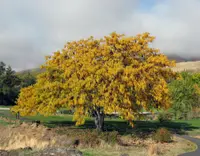
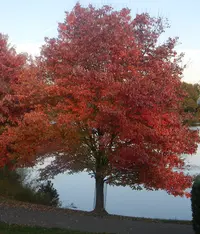
  • Mature plant: The tree broadens into an open, irregular crown, often 30-70 feet (9-21 m) tall, with thicker bark and strong, often clustered trunk thorns.
  • Fruiting stage: Female trees carry long, twisting dark brown pods, often 8-16 inches (20-40 cm) long, which hang conspicuously and alter the branch outline.

Several named forms of honey locust tree are easy to separate by crown shape, thorniness, or leaf color.

  • 'Sunburst': New leaves emerge bright yellow to golden, then soften to light green; the canopy stays noticeably brighter than the typical form.
  • 'Skyline': Has a narrower, upright-pyramidal crown than the broad, open typical tree, often maturing about 35 to 45 feet tall (11 to 14 m).
  • 'Imperial': Shows a dense, rounded crown and a smaller mature size, commonly around 30 to 35 feet tall (9 to 11 m).
  • f. inermis: Lacks the large branched thorns on trunk and branches that are characteristic of the typical form.

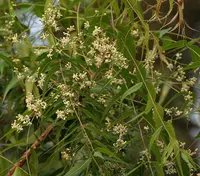
In spring, honey locust tree leafs out with fine, fernlike foliage. Small greenish flowers appear in late spring to early summer, though they are often less noticeable than the leaves. By late summer into fall, long twisted seed pods become obvious and may hang on after leaf drop. Winter exposes the open branching and, on some trees, large branched thorns on trunk and limbs.

A few thorny, compound-leaved trees can be mistaken for honey locust tree.

black locust(Robinia pseudoacacia)

Similar because both have pinnate leaves and bean-like pods. Black locust usually has paired short spines at the leaf nodes, not the large branched trunk thorns of Gleditsia. Its pods are smaller and flatter, typically 2 to 4 inches (5 to 10 cm) long.

Kentucky coffeetree(Gymnocladus dioicus)

Similar because both can have very large compound leaves and coarse branching. Kentucky coffeetree lacks thorns and has fewer, much larger leaflets. Its pods are thick, dark, and blunt, not the long, twisted straps seen on mature honey locust.

Gleditsia triacanthos is native to the central and eastern United States, especially the Mississippi River basin and nearby regions, with natural populations extending from Pennsylvania west to Nebraska and south to Texas and Louisiana. In the wild it is most often found in bottomlands, floodplains, open woods, stream banks, and disturbed ground. That setting can help with identification, especially when a suspected tree is growing in lowland woodland or along rivers rather than in dry upland forest.

  • Sharp spines: Honey locust often has long, rigid spines on the trunk and branches. These are a physical injury risk to humans and pets through skin puncture on contact.
  • Pods and seeds: The seed pods and especially the seeds are reported to cause stomach upset if eaten by humans or pets. This concern relates to ingestion, not skin contact.

Check Your Plant ID

Use Botan to identify or confirm a plant from a photo, which helps avoid mix-ups before you label, buy, or remove it.

FAQ

Yes. Mature trees often develop a broad, open crown and thick gray-brown bark with long, branched thorns on trunk and limbs. Leaves stay finely textured, but size and thorn development make older specimens easier for honey locust tree identification.

More Plant Identification Guides

Identify Your Plant with Botan

Identify a plant from a photo, then get species-specific care information, safety notes, and common problems.

Botan app identifying a plant from a photo
13 Best Front Yard Trees for Every Home and Yard

12 min read · 7 Aug 2026

13 Best Front Yard Trees for Every Home and Yard

A front yard tree can stay for decades. Therefore, choosing one deserves serious consideration. Here are 13 trees that have proven themselves, sorted by their purpose. You'll also find five species to avoid and basic planting information.

Plant Recommendations
13 Best Front Yard Trees for Every Home and Yard
Top 15 Plants That Don’t Need Sunlight

8 min read · 17 Sept 2026

Top 15 Plants That Don’t Need Sunlight

Some plants thrive in dim rooms, shaded corners, and places with indirect light. In this guide, you’ll explore the top 15 species best suited to low-light conditions and how to care for them.

Plant Recommendations
Top 15 Plants That Don’t Need Sunlight
Best Time to Water Grass in Summer – Lawn Watering Tips

5 min read · 21 Jul 2026

Best Time to Water Grass in Summer – Lawn Watering Tips

Summer watering is easy to get wrong. This guide explains when to turn on your sprinkler, how much liquid your grass needs each week, and how to tell if you're overwatering or underwatering.

Plant Care
Best Time to Water Grass in Summer – Lawn Watering Tips