
Prickly pear Identification (Opuntia ficus-indica)

Recognize Prickly pear by its large, flat oval pads joined edge to edge, forming an open, branching cactus. Pads are usually 8 to 16 inches long (20 to 40 cm).

Older plants often develop a short woody trunk, and the pads carry small, widely spaced clusters of spines or glochids.

Opuntia ficus-indica Identification

Check Your Plant ID

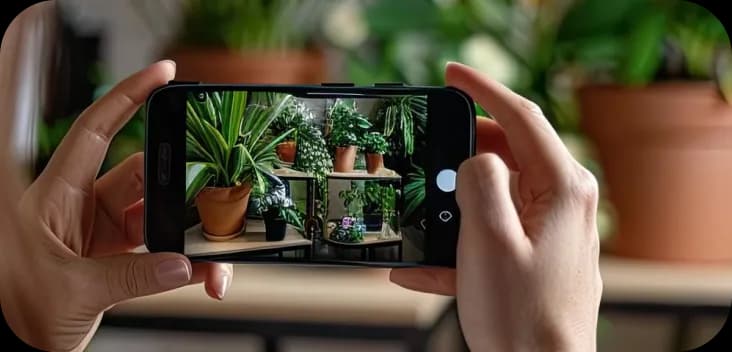
Not sure about your plant ID? Upload a photo and check it with Botan.

Clear images work best. Avoid photos taken too close or too far away

Check the pads, flowers, and fruit first on Opuntia ficus-indica.

  • Flattened oval to oblong pads join in chains, forming a broad, much-branched cactus.
  • Pads are thick and fleshy, usually 8-16 inches (20-40 cm) long, with scattered areoles in neat rows.
  • Areoles often carry a few longer spines or none, plus tiny bristles called glochids.
  • Flowers are large, cup-shaped, and usually yellow to orange, about 2-3 inches (5-8 cm) across.
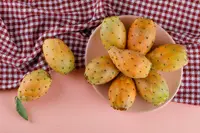
  • Fruits are oval, thick-skinned, and about 2-4 inches (5-10 cm) long, sitting on pad edges.

Fruit and flowers usually appear along the upper edges of the pads.

Opuntia ficus-indica shows clear visual shifts from tiny pads to a woody, fruiting framework.

  • Seedling: Seedlings start as a small, rounded succulent body before obvious flat pads form. The first true pads are few, soft-looking, and close to the soil.
  • Young plant: Young plants produce distinct oval to oblong pads in short chains, with little or no trunk. Clumps stay low, often under 3 feet (0.9 m).
  • Mature plant: Mature plants develop a woody base and a clear trunk-like lower section. Upper branching carries many larger pads, creating a broad, layered, tree-like outline.
  • Fruiting stage: Fruiting plants show fleshy, oval fruits borne along pad edges after flowering. The fruits make branch tips look heavier and more segmented than nonfruiting plants.

In spring, Opuntia ficus-indica may show tiny, short-lived awl-like leaves at the edges of new pads. These small green leaves soon dry and drop, while fresh pads stay brighter green than older ones. Late spring into summer brings large yellow to orange flowers along pad margins. After flowering, fleshy pear-shaped fruits develop and often remain visible into late summer or fall, adding a strong seasonal clue.

Several flat-padded cacti are mistaken for prickly pear at a glance.

Indian fig opuntia(Opuntia streptacantha)

Often confused because both form large shrubs or small trees with broad pads and edible-looking fruits. O. streptacantha usually has smaller, more rounded pads and tends to branch more densely; its fruits are typically smaller than those of Opuntia ficus-indica.

cochineal nopal cactus(Nopalea cochenillifera)

Confusion happens because it also has flattened pads and a similar upright habit. The quickest visible difference is the flower: Nopalea flowers are narrower and more tubular, while Opuntia ficus-indica has broader, more open flowers.

Opuntia ficus-indica is widely cultivated and naturalized, so native-range clues are limited. It is generally treated as native to Mexico, but the exact original wild range is uncertain, which means geography alone is not a dependable identification tool. Habitat is still somewhat useful. Wild and naturalized plants are most often found in dry, open settings such as rocky slopes, scrub, disturbed ground, and semi-arid lowlands, rather than shaded woodland or wetlands.

  • Spines and glochids: The stems and fruit can carry long spines and tiny barbed glochids. Skin contact can cause painful punctures and irritation in humans and pets.
  • Pet contact and chewing: Dogs and cats that mouth or chew pads or fruit can get spines or glochids in the mouth, lips, or paws. This is an injury risk rather than a poisoning risk.

Not Sure About the ID?

Upload a photo to Botan to identify the plant or confirm your match before you label it or compare similar species.

FAQ

Yes. For how to identify Prickly pear without blooms, check the flat, paddle-like stem segments, sparse long spines or none on some cultivated plants, and dense tiny glochids at the areoles.

Everything About Prickly pear

More Plant Identification Guides

One Photo. More About Your Plant.

Use Botan to identify a plant from a photo, then review species-specific care information, safety notes, and common problems.

Botan app identifying a plant from a photo
How Long Can Flowers Go Without Water? Everything You Need to Know

6 min read · 10 Jul 2026

How Long Can Flowers Go Without Water? Everything You Need to Know

Flowers can survive without water anywhere from 1-2 hours to several months, depending on the plant type, species, and growing conditions. Some strong-looking flowers are drought-sensitive, while delicate-looking plants may tolerate long dry periods surprisingly well.

Plant Care
How Long Can Flowers Go Without Water? Everything You Need to Know
Best Water for Plants – How to Choose the Right Type

7 min read · 13 Aug 2026

Best Water for Plants – How to Choose the Right Type

Rainwater, filtered, distilled, and tap water affect plants differently. Learn which types support healthy growth and which cause slow damage. Match each to your plants and discover how to easily improve tap water quality.

Plant Care
Best Water for Plants – How to Choose the Right Type
How to Water Houseplants: Watering Guide

7 min read · 24 Aug 2026

How to Water Houseplants: Watering Guide

Learn how often to water indoor plants, key factors for proper watering, and how to adjust the care routine by plant type, season, pot size, light, and indoor conditions.

Plant Care
How to Water Houseplants: Watering Guide