


grape vine Identification (Vitis vinifera)

To recognize Vitis vinifera, look for a woody climbing vine with curling tendrils opposite the leaves, single leaves arranged alternately, and broad, palmately lobed blades usually 4 to 8 inches (10 to 20 cm) across.

Older plants develop a thick, twisting trunk and long canes, while the small green flowers are borne in branched clusters.

Vitis vinifera Identification

Check Your Plant with Botan

Take a photo and use Botan to confirm your plant identification.

Clear images work best. Avoid photos taken too close or too far away

Check the vine’s leaves, tendrils, bark, and fruit for a quick read on Vitis vinifera.

  • Leaves are simple, alternate, and broadly round to heart-shaped, often with 3 to 5 shallow lobes.
  • Leaf blades are usually 5 to 8 inches (13 to 20 cm) wide, with coarse teeth along the edges.
  • Slender, branching tendrils grow opposite the leaves at the nodes and help the stems climb.
  • Older stems become woody with shaggy, peeling bark; the trunk can look twisted with age.
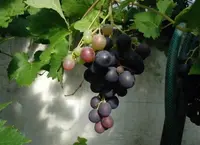
  • Fruit hangs in dense clusters of smooth, round berries.

Grapes in clusters plus opposite tendrils are especially useful visible clues.

Vitis vinifera shows clear visual changes as shoots, flowers, and fruit clusters develop.

  • Young plant: Young vines are slender climbers with green flexible stems, widely spaced leaves, and small tendrils opposite the leaves before any woody trunk forms.
  • Mature plant: Mature plants develop a woody, often twisted trunk and permanent branching framework; leaves are broader, commonly 5-8 inches (13-20 cm) across, with clearer lobing.
  • Flowering stage: Flowering shoots carry loose branched clusters opposite leaves, filled with many tiny greenish flowers; the inflorescences stand out before berries begin to swell.
  • Fruiting stage: Fruit clusters become pendent and obvious, bearing many round grapes that shift from hard green berries to fuller, translucent or dark-skinned fruit.

Several forms of Vitis vinifera are easy to separate by berry color and leaf shape.

  • 'Purpurea': Young leaves emerge deep reddish purple and often keep a bronzed to purple cast longer than the typical green-leaved form.
  • 'Laciniata': Leaves are much more deeply cut, with narrow, pointed lobes that give a finely divided outline instead of the broader lobes usual for the species.
  • var. apyrena: Fruit is seedless or nearly so, unlike the typical form with fully developed seeds visible in cut berries.

In spring, Vitis vinifera leafs out with fresh green, lobed leaves. By late spring to early summer, small flower clusters become visible, followed by developing grape clusters that are easier to spot through summer. In fall, leaves often turn yellow before dropping. After leaf drop, the vine shows a bare, woody framework with twisting stems and visible buds along the canes.

Several climbing vines can be mistaken for Vitis vinifera at a quick glance.

Virginia creeper(Parthenocissus quinquefolia)

Often confused when young because both are woody climbers with toothed leaves. Virginia creeper usually has 5 separate leaflets, not one simple leaf with lobes, and it climbs with adhesive pads rather than tendrils opposite the leaves.

Boston ivy(Parthenocissus tricuspidata)

Can resemble grape from a distance because both have simple, lobed leaves on a wall-climbing vine. Boston ivy leaves are typically glossy and 3-lobed with little or no edge teeth, and the vine attaches by adhesive pads instead of coiling tendrils.

Vitis vinifera is native from the Mediterranean region and Europe into western Asia, with its wild forms centered around the Caucasus and nearby areas. That range helps separate it from North American wild grapes when a vine is encountered outside cultivation. In natural settings, it occurs in open woodland margins, river valleys, scrub, and rocky slopes rather than deep forest. Finding a climbing grape in those habitats, especially in Mediterranean to southwest Asian landscapes, can support identification.

  • Toxic to pets: Grapes and raisins, the fruit of Vitis vinifera, can cause serious poisoning if eaten by dogs, and risk is also noted for cats. This is an ingestion hazard for pets.
  • Dangerous look-alike: Wild grapes can be confused with moonseed (Menispermum canadense), a poisonous vine for humans. A key visible difference is that moonseed fruit has one crescent-shaped seed, while grapes usually have several round seeds.

Confirm the Species with Botan

Use a photo to identify or verify the plant, helping avoid mix-ups with similar species before you label or buy it.

FAQ

The clearest field mark is its coiling tendrils opposite the leaves on a woody climbing vine. In grape vine identification, broad simple leaves are usually heart-based and often shallowly 3- to 5-lobed with toothed edges.

More Plant Identification Guides

Identify First. Learn What Comes Next.

Upload a photo to identify the plant, then get species-specific care information, safety notes, and common problems.

Botan app identifying a plant from a photo
Best Water for Plants – How to Choose the Right Type

7 min read · 13 Aug 2026

Best Water for Plants – How to Choose the Right Type

Rainwater, filtered, distilled, and tap water affect plants differently. Learn which types support healthy growth and which cause slow damage. Match each to your plants and discover how to easily improve tap water quality.

Plant Care
Best Water for Plants – How to Choose the Right Type
Best Fertilizer for Vegetable Gardens – What to Use for Each Plant

11 min read · 20 Jul 2026

Best Fertilizer for Vegetable Gardens – What to Use for Each Plant

Here, you’ll find the right fertilizer formula for vegetables in your garden. Learn how to adjust feeding correctly throughout the growing cycle, spot nutrient deficiencies by their symptoms, and keep your plants healthy and prolific.

Plant Recommendations
Best Fertilizer for Vegetable Gardens – What to Use for Each Plant
Top 15 Fast-Growing Trees For Your Garden

13 min read · 28 Jul 2026

Top 15 Fast-Growing Trees For Your Garden

Learn which of the 15 fastest-growing trees will suit your area. We’ll share detailed information on each: growth rate, mature spread, key tree demands, and main vulnerabilities. Read on and make the best choice possible.

Plant Recommendations
Top 15 Fast-Growing Trees For Your Garden