

Christmas cactus Identification (Cylindropuntia leptocaulis)

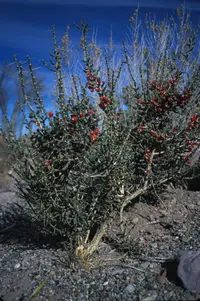
To recognize Cylindropuntia leptocaulis, look for a much-branched cactus made of very slender cylindrical stem segments, often about pencil width, with short spines arising from widely spaced areoles.

It usually forms a loose shrub or small tree, and the joints are narrow and elongated rather than flat or strongly swollen.

Cylindropuntia leptocaulis Identification

Check Your Plant ID

Check your plant ID by uploading a clear photo to Botan.

Clear images work best. Avoid photos taken too close or too far away

Use these quick traits to check for Cylindropuntia leptocaulis.

  • Shrubby cactus with many thin, pencil-like cylindrical stems that branch densely into a twiggy outline.
  • Stems are narrow, usually about 1/8 to 1/4 inch (3-6 mm) thick, and made of short joints.
  • Areoles sit along the joints, each usually carrying 1 slender spine, sometimes a few more.
  • Small, narrow leaves may be present on new growth, but the plant is mostly stem-focused in appearance.
  • Fruits are smooth to lightly spiny, often red, and stay attached along the stems.

Check the overall fine, jointed branching before relying on spine count alone.

Cylindropuntia leptocaulis shows clear structural changes from sparse young stems to fruiting branch networks.

  • Young plant: Starts as a few very slender, pencil-like green joints with little branching; the plant stays open and upright rather than forming a tangled crown.
  • Mature plant: Builds many narrow cylindrical branches into a shrubby framework, often 3 to 5 feet (0.9 to 1.5 m) tall, with denser, more intricate branching.
  • Fruiting stage: Shows smooth, red to yellowish fruits perched along the thin stems; these bead-like fruits make the branch pattern easier to notice than in nonfruiting plants.

In spring and early summer, tiny short-lived leaves may appear on new stem growth, then drop, leaving the plant looking mostly leafless again. This brief leaf flush can help separate it from cacti that stay consistently bare year-round. Flowers usually become visible in spring to early summer, followed by small red fruits that often persist and stand out against the thin green stems of Cylindropuntia leptocaulis.

A few slender chollas can be mistaken for Cylindropuntia leptocaulis at a glance.

tasajillo(Cylindropuntia acanthocarpa)

Both have jointed cylindrical stems. Tasajillo is usually much denser and more heavily spined, with thicker stem segments often over 3/8 inch (1 cm) wide; C. leptocaulis has notably thinner, pencil-like branchlets.

Christmas cholla(Cylindropuntia kleiniae)

This species also has narrow, segmented branches and an open shrub form. It differs by having stouter segments, commonly 1/4 to 1/2 inch (6-12 mm) wide, and a grayer, more uniformly armed look rather than very fine green twigs.

Cylindropuntia leptocaulis is native to the southwestern United States and northern Mexico, especially the Chihuahuan Desert and nearby dry regions. It occurs in desert scrub, grassland, and open thorny brush, often on flats, washes, and rocky slopes. This setting helps narrow identification because plants found in arid lowland habitats of Texas, New Mexico, Arizona, and adjacent Mexico are more likely to match this species than similar cacti from higher, cooler sites.

  • Spines and barbed glochids: The stems carry sharp spines and tiny barbed glochids, which are small hair-like bristles. Skin contact can cause painful punctures and irritation in humans and pets.
  • Fruit and stem handling: The red fruit and jointed stems are also armed, so handling or accidental mouthing can injure the mouth or digestive tract of humans and pets even without a known poison.

Confirm It from a Photo

Use Botan to identify or verify the plant from a photo, helping avoid mix-ups with similar species.

FAQ

Look for a shrubby cholla with many pencil-thin, jointed green stems. Branches are cylindrical rather than flat, often loosely tangled, with small areoles that may carry 1 to several short spines. This is central for Cylindropuntia leptocaulis identification.

More Plant Identification Guides

Identify It. Learn More About It.

Use Botan to identify a plant from a photo, then get plant details, care information, and common problems for that species.

Botan app identifying a plant from a photo
Dill Companion Plants – What to Grow Next to Dill

9 min read · 17 Jul 2026

Dill Companion Plants – What to Grow Next to Dill

Dill is an easy-to-grow plant that gets along well with many vegetables. This guide describes 15 plants that can be planted alongside it, a few to avoid, and mistakes that can quietly sabotage the entire process.

Plant Recommendations

Dill Companion Plants – What to Grow Next to Dill
13 Best Front Yard Trees for Every Home and Yard

12 min read · 7 Aug 2026

13 Best Front Yard Trees for Every Home and Yard

A front yard tree can stay for decades. Therefore, choosing one deserves serious consideration. Here are 13 trees that have proven themselves, sorted by their purpose. You'll also find five species to avoid and basic planting information.

Plant Recommendations
13 Best Front Yard Trees for Every Home and Yard
How to Use a Moisture Meter for Plants

5 min read · 4 Sept 2026

How to Use a Moisture Meter for Plants

Watering by feel kills plenty of houseplants. A moisture meter checks the soil for you, and takes the guesswork out of it. This guide will show you how to use it correctly, from the first touch to the final reading.

Beginner Guides
How to Use a Moisture Meter for Plants