
Mother of Thousands Identification (Kalanchoe daigremontiana)

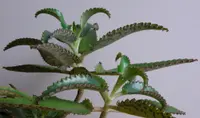
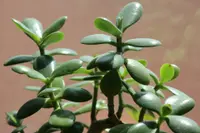
Recognize Mother of Thousands by its upright single stem and opposite, narrow triangular leaves that point upward along the stem.

Each leaf typically carries rows of tiny plantlets along the margins, creating a clear, species-specific outline visible at a glance.

Kalanchoe daigremontiana Identification

Identify Your Plant with Botan

Upload a plant photo and check the identification in seconds.

Clear images work best. Avoid photos taken too close or too far away

Start with the leaf edges and upright succulent form.

  • Leaves are narrow triangular to lance-shaped, often 4-8 inches (10-20 cm) long, held in opposite pairs.
  • Leaf margins are lined with many tiny plantlets, each sitting in shallow notches along the edge.
  • The blade is thick and slightly folded along the midrib, giving each leaf a V-like cross section.
  • Stems are single to few, upright, smooth, and usually unbranched low on the plant.
  • When present, flowers hang downward in a loose cluster and look tubular to bell-shaped.

The rows of baby plantlets along the leaf margins are the fastest visual clue.

Kalanchoe daigremontiana shows clear stage-based changes in form, leaf proportions, and flowering structure.

  • Seedling: Seedlings usually begin as tiny plantlets from leaf margins, with a short stem and a few narrow opposite leaves.
  • Young plant: The plant forms a single upright stem with broader triangular leaves, while plantlets line the edges more consistently than in seedlings.
  • Mature plant: Mature plants are taller, often 1-3 feet (30-90 cm), with long, downward-arching leaves and a bare lower stem from older leaf loss.
  • Flowering stage: At flowering, the top elongates into a tall cluster of hanging tubular pinkish-gray flowers, shifting the outline from leafy to top-heavy.

Late fall into winter is the main season when Mother of Thousands shows a clear new clue: a tall flower stalk rising above the leaf rosette, carrying many dangling, tubular pink to grayish-pink flowers. Outside the flowering period, the plant usually keeps its fleshy, scalloped leaves, so seasonal leaf drop is not a dependable field mark for this species.

Several close relatives are often mistaken for Mother of Thousands.

mother of millions(Kalanchoe delagoensis)

Confused because both make many plantlets along leaf edges. Kalanchoe delagoensis has narrow, tube-like leaves, usually in whorls of three, not broad triangular leaves.

hybrid mother of thousands(Kalanchoe × houghtonii)

Often mistaken for it because it also has plantlets on the margins and a similar upright habit. This hybrid has narrower, more folded leaves with fewer broad triangular blades.

Kalanchoe daigremontiana is native to southwestern Madagascar. Reliable sources place it in dry, rocky habitats, often on slopes and other well-drained ground in a seasonally dry tropical landscape. That setting helps with identification because this species is tied to Madagascar rather than the American deserts where it is often naturalized. Finding a self-sown plant on rocky ground in frost-free coastal or subtropical regions can fit the species, but only Madagascar reflects its native range.

  • Toxic leaves and plantlets: Kalanchoe daigremontiana contains cardiac glycosides in the leaves and the small plantlets along the leaf edges. The main risk is ingestion by humans or pets, especially cats, dogs, and livestock.
  • Pets are the main concern indoors: Even small pieces can be tempting because plantlets drop easily from the leaf margins. This matters most for pets that chew houseplants; the hazard is from eating the plant, not normal skin contact.

Does Your Plant Match?

Use Botan to compare a photo and confirm the identification before you label it or look up the right information.

FAQ

The most reliable feature is the rows of tiny plantlets along the leaf margins, especially near the tips. In this species, those baby plants form directly on the leaf edge, making Mother of Thousands identification straightforward.

Everything About Mother of Thousands

More Plant Identification Guides

Find Out What Plant It Is

Upload a photo to identify it with Botan, then get plant details, care information, and common problems for that species.

Botan app identifying a plant from a photo
What Plants Don't Like Epsom Salt?

11 min read · 29 Jul 2026

What Plants Don't Like Epsom Salt?

Learn which plants can be seriously damaged by Epsom salt and which will thrive on it. We’ll explain when and how to use it properly, provide tips for indoor & outdoor plants — read on and enjoy a healthy garden.

Plant Care
What Plants Don't Like Epsom Salt?
Top 15 Fast-Growing Trees For Your Garden

13 min read · 28 Jul 2026

Top 15 Fast-Growing Trees For Your Garden

Learn which of the 15 fastest-growing trees will suit your area. We’ll share detailed information on each: growth rate, mature spread, key tree demands, and main vulnerabilities. Read on and make the best choice possible.

Plant Recommendations
Top 15 Fast-Growing Trees For Your Garden
Plants That Repel Mosquitoes – 10 Effective Choices

8 min read · 6 Jul 2026

Plants That Repel Mosquitoes – 10 Effective Choices

Plants that repel mosquitoes can help mask human scent naturally and make outdoor spaces more comfortable. Explore the most effective options, their benefits and drawbacks, and choose the right plant for your space.

Plant Recommendations
Plants That Repel Mosquitoes – 10 Effective Choices