Flapjacks plant Identification (Kalanchoe thyrsiflora)

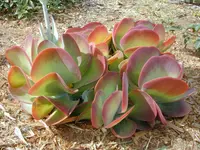
To recognize Kalanchoe thyrsiflora, look for a basal rosette of large, flat, round to paddle-shaped leaves stacked in opposite pairs.

Mature plants stay low, usually under 2 feet (0.6 m) wide, then send up a single upright flower stalk with dense, thyrse-like clusters of small, urn-shaped flowers.

Kalanchoe thyrsiflora Identification

Scan to Confirm Flapjacks plant

Upload a clear photo to check your plant identification with Botan.

Clear images work best. Avoid photos taken too close or too far away

Use these quick visual checks for Kalanchoe thyrsiflora.

  • Leaves form a tight basal rosette, stacked in opposite pairs with little or no visible stem.
  • Each leaf is broad, flat, and paddle-shaped, usually 4-8 inches (10-20 cm) long with rounded tips.
  • Leaf surfaces look smooth and powdery, often pale blue-green with red edging, especially near the margins.
  • The plant stays low and wide, typically under 2 feet (0.6 m) tall before flowering.

Check the leaf shape, opposite pairing, and low rosette habit first.

Kalanchoe thyrsiflora shows clear structural changes from a low rosette to a flowering plant.

  • Juvenile plant: The plant starts as a tight basal rosette with smaller, rounder leaves held close together, and little or no visible stem between leaf bases.
  • Mature plant: A nonflowering mature rosette is broader and flatter, often 1-2 feet (30-60 cm) across, with thick paddle-shaped leaves stacked in opposite pairs.
  • Flowering stage: At bloom, the rosette sends up a tall central stalk, changing the silhouette from flat and circular to upright, with many small clustered flowers above.

In bright conditions, the broad paddle leaves often show stronger red edging in cooler months, especially from late fall into winter. The plant usually keeps its leaf rosette, so the color shift is the main seasonal clue. When it flowers, usually in winter to early spring, Kalanchoe thyrsiflora sends up a tall, upright bloom stalk above the rosette, making the plant much easier to recognize at a glance.

Several paddle-leaved succulents are mistaken for Kalanchoe thyrsiflora.

paddle plant(Kalanchoe luciae)

Often sold under the wrong name because both make flat, round leaf rosettes with red margins. Kalanchoe luciae usually has larger leaves with stronger red edging, while Kalanchoe thyrsiflora is more evenly gray-green and blooms with yellow flowers.

florist kalanchoe(Kalanchoe blossfeldiana)

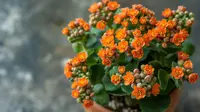
Young plants can suggest a smaller paddle plant because the leaves are thick and opposite. It differs by having shorter, oval to scalloped leaves and a branched flowering head, not the tall, dense, upright flower spike seen here.

Kalanchoe thyrsiflora is native to southern Africa, especially South Africa, with records centered in inland provinces rather than coastal rainforest or woodland settings. It occurs in open, dry habitats such as rocky grassland and slopes. That context helps with identification because it points to a species associated with exposed, well-lit terrain, not shade-loving forest understories or wetland plants.

  • Toxic if eaten: Leaves and stems contain cardiac glycosides. Ingestion is the main risk and can affect both humans and pets, especially cats, dogs, and grazing animals.
  • Pet exposure: Even small amounts of chewed leaf tissue can be a concern for pets because Kalanchoe species are well known for poisoning after ingestion.

Confirm It from a Photo

Use Botan to identify or verify your plant from an image, which helps avoid mix-ups with similar species.

FAQ

The quickest clue is its flat, round to paddle-shaped leaves stacked in a basal rosette, often with red-edged margins. For how to identify Flapjacks plant, look for the tight, plate-like leaf layering.

More Plant Identification Guides

Find the Plant. Get the Details.

Identify a plant from a photo with Botan, then review plant details, care information, and common problems for that species.

Botan app identifying a plant from a photo
Best Fertilizer for Vegetable Gardens – What to Use for Each Plant

11 min read · 20 Jul 2026

Best Fertilizer for Vegetable Gardens – What to Use for Each Plant

Here, you’ll find the right fertilizer formula for vegetables in your garden. Learn how to adjust feeding correctly throughout the growing cycle, spot nutrient deficiencies by their symptoms, and keep your plants healthy and prolific.

Plant Recommendations
Best Fertilizer for Vegetable Gardens – What to Use for Each Plant
Dill Companion Plants – What to Grow Next to Dill

9 min read · 17 Jul 2026

Dill Companion Plants – What to Grow Next to Dill

Dill is an easy-to-grow plant that gets along well with many vegetables. This guide describes 15 plants that can be planted alongside it, a few to avoid, and mistakes that can quietly sabotage the entire process.

Plant Recommendations
Dill Companion Plants – What to Grow Next to Dill
What Plants Don't Like Epsom Salt?

11 min read · 29 Jul 2026

What Plants Don't Like Epsom Salt?

Learn which plants can be seriously damaged by Epsom salt and which will thrive on it. We’ll explain when and how to use it properly, provide tips for indoor & outdoor plants — read on and enjoy a healthy garden.

Plant Care
What Plants Don't Like Epsom Salt?