

Weeping Fig Identification (Ficus benjamina)

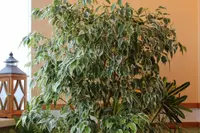
To recognize Weeping Fig, look for narrow, pointed leaves 2-5 inches (5-13 cm) long, borne singly in an alternate pattern along slender, drooping branchlets.

Mature plants often form a small tree with a smooth, light gray trunk and a dense, rounded crown made of many fine, hanging twigs.

Ficus benjamina Identification

Identify Your Plant with Botan

Not sure about your plant ID? Upload a photo and check it with Botan.

Clear images work best. Avoid photos taken too close or too far away

Check the leaf shape, branch habit, and trunk form of Ficus benjamina.

  • Leaves are simple, alternate, and narrowly oval with a long pointed tip.
  • Blades are usually 2 to 5 inches long (5 to 13 cm) with smooth edges and a slight droop.
  • Twigs are slender and arching, giving the crown a weeping outline.
  • Older plants often show a short trunk with smooth, light gray bark and many fine branchlets.

Look for the overall drooping canopy as a final check.

Ficus benjamina shows useful visual changes as stems, branching, and trunk structure develop.

  • Seedling: Seedlings have a single thin upright stem with few side shoots. Leaves are smaller, thinner, and set more sparsely than on older plants.
  • Young plant: Young plants form several flexible, arching branches and a denser outline. Leaves commonly reach about 2-4 inches (5-10 cm) long and hang more noticeably.
  • Mature plant: Mature plants develop a woody trunk, broader crown, and layered branch structure. Older indoor specimens often show a slightly drooping canopy and exposed gray bark.

Weeping fig has several well-established cultivars that can be separated by leaf color, variegation, and growth habit.

  • 'Danielle': Leaves are darker green than the typical form, with a denser, fuller-looking canopy.
  • 'Golden King': Leaves are variegated green with broad creamy yellow margins, making the foliage distinctly bicolored.
  • 'Starlight': Leaves have much narrower green centers and wider white margins than most variegated forms, so the plant looks paler overall.
  • 'Too Little': Leaves are smaller and more strongly curled, and the branching is tighter, giving a compact, tufted outline.

Several indoor trees are often mistaken for Ficus benjamina.

Indian laurel fig(Ficus microcarpa)

Similar glossy, pointed leaves and a dense crown cause confusion. Ficus microcarpa usually has stiffer, broader leaves and a more upright habit, while Ficus benjamina has a clearer droop to its branch tips.

longleaf fig(Ficus binnendijkii)

This fig is sold as a similar indoor tree. It differs by its much narrower, strap-like leaves, often 4 to 10 inches (10 to 25 cm) long, rather than the shorter oval leaves of Ficus benjamina.

Ficus benjamina is native from the Indian subcontinent through southern China and Taiwan to mainland Southeast Asia, Malesia, New Guinea, and northern Australia. In the wild it is most often a lowland to foothill tropical forest tree, including rainforest margins, riverine forest, and other moist wooded sites. That range helps with identification because a wild fig matching this species is expected in humid forested landscapes across South and Southeast Asia to northern Australia, not in dry inland or cold-climate habitats.

  • Irritating sap: The milky latex sap in leaves and stems can irritate human skin and eyes on contact. It can also trigger stronger reactions in people with latex sensitivity.
  • Pets and ingestion: Leaves and sap are toxic to cats and dogs if chewed or eaten, and can also irritate the mouth in people. The concern is ingestion, not casual proximity.

Confirm the Species with Botan

Upload a photo to help identify the plant or verify your guess before you label it or compare similar houseplants.

FAQ

Leaves are arranged alternately along the stems, not in opposite pairs. This helps with Weeping Fig identification, especially when combined with the narrow, pointed leaf tip and the plant’s fine, drooping branchlets.

More Plant Identification Guides

From Plant ID to Plant Info

Upload a photo to identify the plant, then get species-specific care information, safety notes, and common problems.

Botan app identifying a plant from a photo
How To Revive a Dying Plant: 6 Steps To Bring A Plant Back To Life

6 min read · 1 Sept 2026

How To Revive a Dying Plant: 6 Steps To Bring A Plant Back To Life

Drooping leaves and brown tips don't always mean the end, and a weakened plant can often recover with a little help. These six simple steps will help you revive a dying plant and restore its health.

Plant Care
How To Revive a Dying Plant: 6 Steps To Bring A Plant Back To Life
Top 15 Plants That Don’t Need Sunlight

8 min read · 17 Sept 2026

Top 15 Plants That Don’t Need Sunlight

Some plants thrive in dim rooms, shaded corners, and places with indirect light. In this guide, you’ll explore the top 15 species best suited to low-light conditions and how to care for them.

Plant Recommendations
Top 15 Plants That Don’t Need Sunlight
How to Tell if a Plant Is Dead

6 min read · 19 Aug 2026

How to Tell if a Plant Is Dead

A plant can lose its leaves, stop growing, or collapse and still remain alive. A closer look at the stems, roots, bulbs, and tubers can show whether the plant still has a chance to recover.

Beginner Guides
How to Tell if a Plant Is Dead