


fairy ring mushroom Identification (Marasmius oreades)

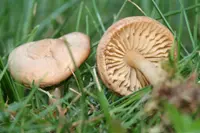
To recognize fairy ring mushroom, look for small caps about 1–2 inches (2.5–5 cm) wide with a central bump, widely spaced gills, and a thin, tough stem.

It often appears in a distinct ring or arc, and the stem is usually bare and equal in width from top to base.

Marasmius oreades Identification

Identify a Plant by Photo

Upload a clear photo to check your plant identification with Botan.

Clear images work best. Avoid photos taken too close or too far away

Check the cap, gills, stem, and growth pattern first.

  • Caps are small, usually 1-2 inches (2.5-5 cm) wide, tan to buff, often with a low central bump.
  • The cap edge is smooth and often slightly wavy, not shaggy or scaly.
  • Gills are well spaced and pale, attached to the stem or nearly free rather than crowded.
  • Stems are slender, tough, and equal in width from top to base, without a ring.
  • Mushrooms often appear in arcs or full circles, with fruiting bodies spaced along the line.

A tough, wiry stem is one of the most useful visible checks.

Marasmius oreades shows useful visual changes as the fruiting body expands and ages.

  • Young plant: Buttons begin as small, rounded caps on slender stems, with inrolled margins hiding most gills and a firmer, more compact profile than later stages.
  • Mature plant: Caps flatten to broadly convex or nearly plane, often with a central bump, reaching about 1-2 inches (2.5-5 cm) across on wiry stems.
  • Fruiting stage: Fully expanded mushrooms show widely spaced, pale gills attached free or narrowly, while aging caps may lift at the edge and fade slightly from tan-buff.

The clearest seasonal clue is when Marasmius oreades fruits. Small tan to buff mushrooms typically appear from late spring through fall, often after rain, and commonly form arcs or full fairy rings in lawns and meadows. In dry weather, the fruiting bodies may shrivel and fade, then revive after moisture returns. That on-and-off appearance across the warm season can help explain why rings seem to disappear and reappear.

Several lawn mushrooms can be mistaken for fairy ring mushroom.

false chanterelle mushroom(Clitocybe rivulosa)

Often grows in grass and can form rings. It differs by crowded, strongly decurrent gills that run down the stem, while Marasmius oreades has well-spaced gills that are attached or only slightly notched.

fool’s funnel(Clitocybe dealbata)

This small pale lawn mushroom also appears in rings. It is usually whitish to buff with closely packed decurrent gills; Marasmius oreades is more tan to buff and shows wider gill spacing.

Marasmius oreades is native to Europe and is now widely established in temperate parts of North America and other regions. Geography alone is not very diagnostic, but its repeated association with open grassy places is useful. Look for it in lawns, pastures, meadows, and other short grass rather than in woodland leaf litter or on wood. That habitat helps separate it from many small brown mushrooms that favor forest floors or decaying logs.

  • Misidentification risk: This mushroom is associated with serious ingestion risk because it can be confused with poisonous lawn mushrooms. A key safety check is the gills: Marasmius oreades has widely spaced gills that do not run down the stem.
  • Dangerous look-alike: The deadly fool's funnel, Clitocybe rivulosa, is the main concern for humans if eaten by mistake. It usually has crowded, decurrent gills, meaning the gills run down the stem.

Confirm the Species with Botan

Use a photo to identify or verify the find and compare likely matches before making a decision.

FAQ

Yes. This species is strongly associated with grassland habitats such as lawns, pastures, meadows, and park turf. It often appears in arcs or full rings and is less typical of wooded forest floors.

More Plant Identification Guides

Identify the Plant and Get Its Profile

Snap a photo with Botan to identify it, then review plant details, care information, and common problems for that species.

Botan app identifying a plant from a photo
Thorny Plants: A Comprehensive Guide

10 min read · 25 Aug 2026

Thorny Plants: A Comprehensive Guide

Many plants defend themselves with sharp thorns. This guide explores over 20 examples among flowers, shrubs, trees, and vines. You'll learn what each plant looks like, why it grows thorns, and how to quickly identify them.

Plant Recommendations

Thorny Plants: A Comprehensive Guide
How to Winterize Your Garden in 6 Steps

5 min read · 28 Sept 2026

How to Winterize Your Garden in 6 Steps

Learn how to prepare your garden for winter with a practical six-step checklist covering cleanup, tender plant care, watering, mulching, winter protection, and winterizing equipment and containers.

Plant Care
How to Winterize Your Garden in 6 Steps
How to Use a Moisture Meter for Plants

5 min read · 4 Sept 2026

How to Use a Moisture Meter for Plants

Watering by feel kills plenty of houseplants. A moisture meter checks the soil for you, and takes the guesswork out of it. This guide will show you how to use it correctly, from the first touch to the final reading.

Beginner Guides
How to Use a Moisture Meter for Plants