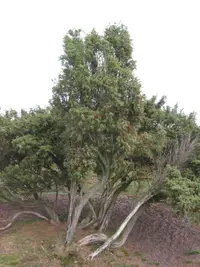

common juniper Identification (Juniperus communis)

To recognize common juniper, look for stiff, sharp needles borne in whorls of three, each needle marked with a single white band on the upper surface.

It usually forms a low, spreading to upright conifer with many stems, and carries round berry-like seed cones about 1/4 inch (6 mm) across.

Juniperus communis Identification

Is This common juniper?

Use a clear photo to confirm what plant you have.

Clear images work best. Avoid photos taken too close or too far away

Check Juniperus communis for a narrow, prickly, needle-covered form.

  • Leaves are stiff needles in whorls of three, each about 1/4-3/4 inch (6-20 mm) long.
  • Each needle shows a bold white band on the upper side and a sharp pointed tip.
  • Twigs are densely clothed in needles, giving shoots a bristly, spiny look.
  • Berry-like seed cones are round, about 1/4 inch (6-8 mm) wide, usually blue-black with a pale waxy bloom.

Look for the three-needle whorls first, then confirm with the white needle band and small round cones.

Juniperus communis shows clear visual shifts from spiny juveniles to berry-bearing mature plants.

  • Seedling: Seedlings carry small whorls of needle-like leaves, already sharp-tipped, on a single slender stem with few side branches.
  • Juvenile plant: Juvenile plants form dense, low sprays of stiff needles in whorls of three; each needle shows a pale upper band and reaches about 1/2 inch (1 cm).
  • Mature plant: Mature plants become narrow shrubs or small trees with layered branching and rough gray-brown bark; the crown is more open than in juvenile growth.
  • Fruiting stage: Fruiting plants show round, berry-like seed cones that ripen blue-black with a pale waxy bloom, visually standing out against the sharp green needles.

Common juniper has several named forms that are easy to separate by habit and foliage color.

  • 'Compressa': A very narrow, columnar plant, usually 2-4 feet (0.6-1.2 m) tall, with dense, tightly packed blue-green needles.
  • 'Depressa Aurea': A low, spreading form with golden-yellow new growth that gives the plant a warmer overall color than the typical green form.
  • 'Hibernica': An upright, pencil-like cultivar, often 10-15 feet (3-4.6 m) tall, with short blue-green needles held close to the stems.
  • 'Repanda': A prostrate form that stays under 1 foot (30 cm) tall and spreads several feet wide, forming a flat mat.

Common juniper stays evergreen, so it does not drop its needle-like leaves in fall. In winter, the stiff, sharp needles and dense branching remain visible, often with a slightly duller or bronzed cast in cold weather. The most useful seasonal clue is the berry-like cone crop. Female plants may show green cones at first, then older cones ripen to a blue-black color with a pale, waxy bloom.

A few conifers can be mistaken for Juniperus communis at a glance.

Rocky Mountain juniper(Juniperus scopulorum)

Similar because both can show bluish berry-like cones and sharp juvenile foliage. Rocky Mountain juniper usually has mostly scale-like adult leaves pressed to the twigs, while common juniper keeps needle-like leaves in whorls of three with a broad white band above.

Eastern redcedar(Juniperus virginiana)

Often confused when young, since both are evergreen with blue cones. Eastern redcedar typically develops dense scale foliage and a more tree-like form. Its awl-like leaves, when present, are shorter and lack the bold white stomatal band seen on common juniper needles.

Juniperus communis is native across much of the Northern Hemisphere, including North America, Europe, and Asia. That broad range matters because it is one of the few junipers regularly found far north and into subarctic regions, which can help narrow identification in wild settings. It typically grows in open, sunny habitats such as heaths, rocky slopes, coastal dunes, grasslands, open woodland, and montane ground up to alpine zones. Finding it in exposed, dry, nutrient-poor sites is a useful field clue.

  • Sharp foliage: The needle-like leaves are stiff and sharply pointed. Skin contact can cause minor puncture injury, especially for children, people handling dense branches, and pets pushing through the plant.
  • Berry confusion: Its fleshy cone-like berries create a real misidentification risk with yew. Yew has flat needles in two ranks and a red cup around a single seed, not bluish berry-like cones. Yew ingestion is highly poisonous to humans and pets.

Scan. Check. Confirm.

Use Botan to identify or verify a plant from a photo when you want a quicker, more confident answer.

FAQ

The clearest feature is its needle-like leaves in whorls of three. Each sharp needle has a broad white stomatal band, a pale stripe on the upper surface that stands out in common juniper identification.

More Plant Identification Guides

Scan Your Plant. Get the Details.

Identify a plant from a photo with Botan, then review plant details, care information, and common problems.

Botan app identifying a plant from a photo
Plants That Repel Bugs – 20 Effective Options

12 min read · 16 Jul 2026

Plants That Repel Bugs – 20 Effective Options

Mosquitoes on the patio? Gnats in the kitchen? Some plants keep them away with the scent of their own leaves. Here are 20 that deal with mosquitoes, flies, aphids, and more, plus where to put them so they help.

Plant Recommendations
Plants That Repel Bugs – 20 Effective Options
How To Revive a Dying Plant: 6 Steps To Bring A Plant Back To Life

6 min read · 1 Sept 2026

How To Revive a Dying Plant: 6 Steps To Bring A Plant Back To Life

Drooping leaves and brown tips don't always mean the end, and a weakened plant can often recover with a little help. These six simple steps will help you revive a dying plant and restore its health.

Plant Care
How To Revive a Dying Plant: 6 Steps To Bring A Plant Back To Life
How to Use a Moisture Meter for Plants

5 min read · 4 Sept 2026

How to Use a Moisture Meter for Plants

Watering by feel kills plenty of houseplants. A moisture meter checks the soil for you, and takes the guesswork out of it. This guide will show you how to use it correctly, from the first touch to the final reading.

Beginner Guides
How to Use a Moisture Meter for Plants