
Jack Pine Identification (Pinus banksiana)

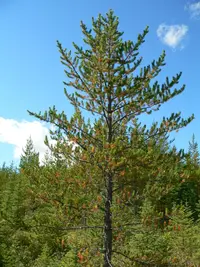
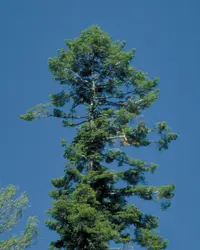
Recognize Jack Pine by its short needles in pairs, usually 3/4 to 2 inches (2 to 5 cm) long, and by its irregular, often leaning crown.

Its cones are small, curved, and commonly stay closed on the branches, often persisting for years.

Pinus banksiana Identification

Check Your Plant with Botan

Not sure about your plant ID? Upload a photo and check it with Botan.

Clear images work best. Avoid photos taken too close or too far away

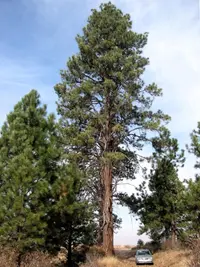
Start with the sparse, irregular crown and often crooked trunk of Pinus banksiana.

  • Needles are in pairs, short and slightly twisted, usually 3/4-2 inches (2-5 cm) long.
  • Twigs and branches often look uneven, with open spacing rather than a dense, full outline.
  • Cones are small, curved, and often stay attached to branches, about 1 1/2-2 inches (4-5 cm) long.
  • The upper trunk is often narrow, with branching that can begin relatively low on the tree.

Check several branches, since the combination of paired short needles and curved persistent cones is especially useful.

Pinus banksiana shows clear age-related changes in form, bark, and cone display.

  • Seedling: Seedlings begin with several slender juvenile leaves, then shift into the species’ paired needles, giving a sparse, upright look on a thin stem.
  • Young plant: Young plants form an irregular, open crown with many angled branches. Needles are short, usually 3/4-2 inches (2-5 cm), and often slightly twisted.
  • Mature plant: Mature trees develop a narrow to uneven crown and a more evident trunk, with darker, rougher bark broken into small scaly plates.
  • Fruiting stage: Cones become a strong visual marker in Jack Pine, often curved and asymmetrical, and many remain attached to branches instead of dropping quickly.

Pinus banksiana stays needled year-round, so the clearest seasonal clue is its cones. In spring, small pollen cones become visible near twig tips, while seed cones are easier to notice as they develop on branches. By late fall and winter, the irregular, often curved cones stand out more clearly against the evergreen needles. Their persistent, closed-looking cones can remain attached for years, making them especially noticeable in the dormant season.

A few two-needle pines are regularly confused with Pinus banksiana.

Virginia pine(Pinus virginiana)

Often mistaken for it because both have short, twisted needles in pairs and irregular crowns. Virginia pine usually has stouter, straighter cones, about 1.5-3 inches (4-8 cm) long, and needles are usually a bit longer and less tightly twisted.

lodgepole pine(Pinus contorta var. latifolia)

Confusion happens because both can have paired needles and small, somewhat curved cones. Lodgepole pine usually has straighter needles, a more even trunk, and cones that are more symmetrical rather than strongly curved.

Pinus banksiana is native across much of boreal Canada and extends into the northern United States, including the Great Lakes and New England. That range helps separate it from many pines centered farther south or west. It is most often found in dry, sandy or rocky ground, barrens, and open woods, often after fire. Seeing a pine in those northern, nutrient-poor habitats can strongly support this identification.

Confirm the Species with Botan

Upload a photo to compare key details and get help identifying the plant or double-checking a likely match.

FAQ

The clearest clue is its short needles in pairs, usually 3/4 to 2 inches (2 to 5 cm) long, often twisted. Mature cones are strongly curved, asymmetrical, and commonly stay on the branches for years.

More Plant Identification Guides

Identify First. Learn What Comes Next.

Use Botan to identify a plant from a photo, then get species-specific care information, common problems, and safety notes.

Botan app identifying a plant from a photo
How Often to Water Fruit Trees

7 min read · 11 Aug 2026

How Often to Water Fruit Trees

Irrigation needs change as roots establish and weather shifts. This guide gives practical starting intervals, explains how soil and tree type change them, and shows how to recognize both excess moisture and drought stress.

Plant Care
How Often to Water Fruit Trees
Plants That Repel Mosquitoes – 10 Effective Choices

8 min read · 6 Jul 2026

Plants That Repel Mosquitoes – 10 Effective Choices

Plants that repel mosquitoes can help mask human scent naturally and make outdoor spaces more comfortable. Explore the most effective options, their benefits and drawbacks, and choose the right plant for your space.

Plant Recommendations
Plants That Repel Mosquitoes – 10 Effective Choices
12 Best Plants That Repel Spiders For Your Home and Garden

8 min read · 24 Jul 2026

12 Best Plants That Repel Spiders For Your Home and Garden

Spiders constantly appear in places you don't want them. A few common plants can help repel them using scent alone. Here are 12 options suitable for both indoors and outdoors, plus care tips for each.

Plant Recommendations
12 Best Plants That Repel Spiders For Your Home and Garden